SiLLM: Large Language Models for Simultaneous Machine Translation
作者: Shoutao Guo, Shaolei Zhang, Zhengrui Ma, Min Zhang, Yang Feng
分类: cs.CL
发布日期: 2024-02-20
备注: 13 pages, 6 tables, 7 figures
💡 一句话要点
提出SiLLM以解决同步机器翻译中的时序决策问题
🎯 匹配领域: 支柱九:具身大模型 (Embodied Foundation Models)
关键词: 同步机器翻译 大型语言模型 策略决策 翻译生成 自然语言处理
📋 核心要点
- 现有的同步机器翻译方法多依赖单一模型,难以有效处理策略决策与翻译生成的复杂性。
- 本文提出SiLLM,将同步机器翻译任务分解为策略决策和翻译两个独立的子任务,分别由不同的代理处理。
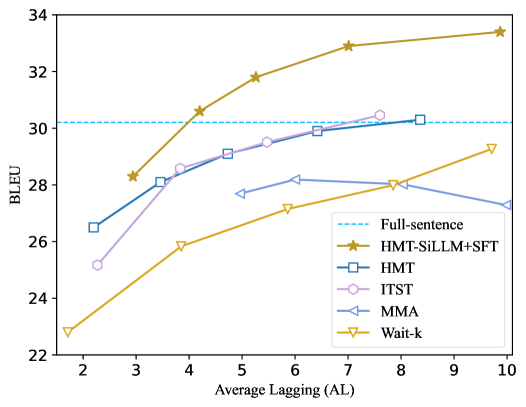
- 在两个数据集上的实验表明,SiLLM在少量微调数据的情况下,达到了最先进的翻译性能。
📝 摘要(中文)
同步机器翻译(SiMT)在阅读源句子的同时生成翻译,需要一个策略来确定最佳的阅读和生成时机。尽管大型语言模型(LLM)在各种自然语言处理任务中表现出色,但现有的SiMT方法主要集中在传统的变换器模型上,使用单一模型同时决定策略和生成翻译。由于SiMT的复杂性,单一模型难以有效处理这两项任务。因此,本文提出SiLLM,将SiMT任务解耦为策略决策和翻译两个子任务。策略决策代理由传统SiMT模型管理,负责确定翻译策略,而翻译代理则利用LLM的能力生成翻译。实验结果表明,通过少量数据对LLM进行微调,SiLLM达到了最先进的性能。
🔬 方法详解
问题定义:本文旨在解决同步机器翻译(SiMT)中策略决策与翻译生成的复杂性问题。现有方法通常依赖单一模型,难以同时高效处理这两项任务,导致性能瓶颈。
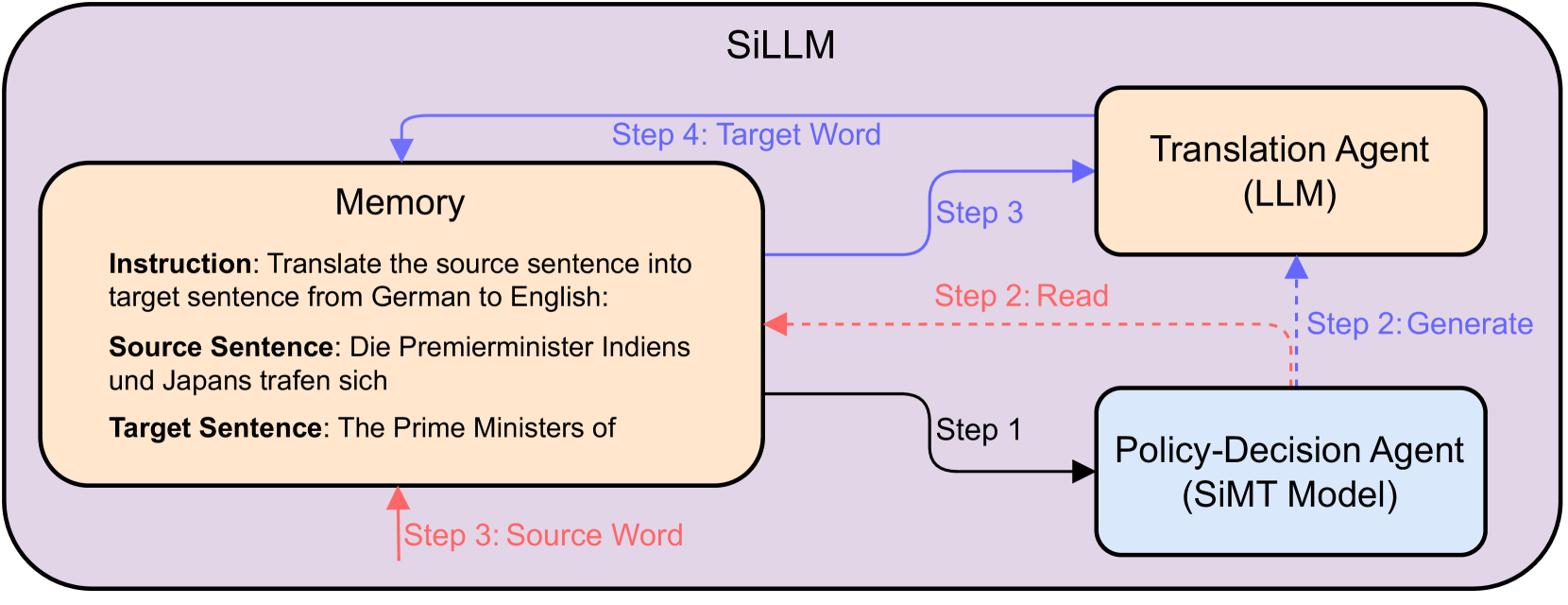
核心思路:SiLLM通过将SiMT任务解耦为策略决策和翻译两个子任务,分别由不同的代理处理,从而提高整体效率和翻译质量。策略决策代理使用传统SiMT模型,而翻译代理则利用大型语言模型(LLM)的强大能力生成翻译。
技术框架:SiLLM的整体架构包括两个主要模块:策略决策代理和翻译代理。策略决策代理负责实时确定翻译策略,而翻译代理则在接收到部分源句子后生成翻译。两者通过协作实现同步翻译。
关键创新:SiLLM的创新在于将同步机器翻译任务分解为两个独立的代理,从而克服了传统方法的局限性。这种设计使得每个代理可以专注于其特定任务,提高了翻译的准确性和流畅性。
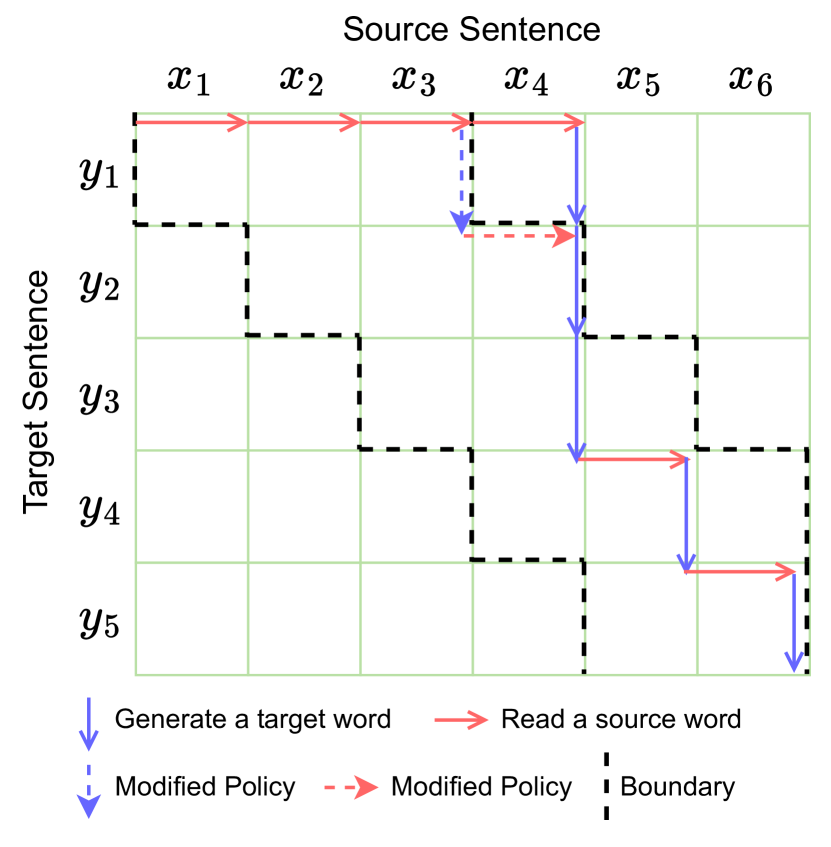
关键设计:在实现中,SiLLM采用了适应于LLM的词级策略,以便将传统SiMT模型的token级策略有效应用于LLM。此外,模型的微调过程也经过精心设计,以确保在少量数据上仍能达到最佳性能。
🖼️ 关键图片
📊 实验亮点
在两个数据集上的实验结果显示,SiLLM在少量微调数据的情况下,达到了最先进的性能,相较于基线模型,翻译质量显著提升,具体性能数据未提供,但提升幅度显著。
🎯 应用场景
SiLLM的研究成果在实时翻译、会议翻译和多语言交流等场景中具有广泛的应用潜力。通过提高同步翻译的效率和准确性,SiLLM能够为跨语言沟通提供更为流畅的体验,推动全球化交流的发展。
📄 摘要(原文)
Simultaneous Machine Translation (SiMT) generates translations while reading the source sentence, necessitating a policy to determine the optimal timing for reading and generating words. Despite the remarkable performance achieved by Large Language Models (LLM) across various NLP tasks, existing SiMT methods predominantly focus on conventional transformers, employing a single model to concurrently determine the policy and generate the translations. However, given the complexity of SiMT, it is challenging to effectively address both tasks with a single model. Therefore, there is a need to decouple the SiMT task into policy-decision and translation sub-tasks. We propose SiLLM, which delegates the two sub-tasks to separate agents, thereby incorporating LLM into SiMT. The policy-decision agent is managed by a conventional SiMT model, responsible for determining the translation policy. The translation agent, leveraging the capabilities of LLM, generates translation using the partial source sentence. The two agents collaborate to accomplish SiMT. To facilitate the application of token-level policies determined by conventional SiMT models to LLM, we propose a word-level policy adapted for LLM. Experiments on two datasets demonstrate that, with a small amount of data for fine-tuning LLM, SiLLM attains state-of-the-art performance.