Large Language Models for Stemming: Promises, Pitfalls and Failures
作者: Shuai Wang, Shengyao Zhuang, Guido Zuccon
分类: cs.IR, cs.CL
发布日期: 2024-02-19
💡 一句话要点
提出大语言模型进行词干提取以解决传统方法的局限性
🎯 匹配领域: 支柱九:具身大模型 (Embodied Foundation Models)
关键词: 大语言模型 词干提取 自然语言处理 信息检索 上下文理解 实体识别
📋 核心要点
- 现有的词干提取方法主要关注单个词汇,忽视了上下文信息,导致效果有限。
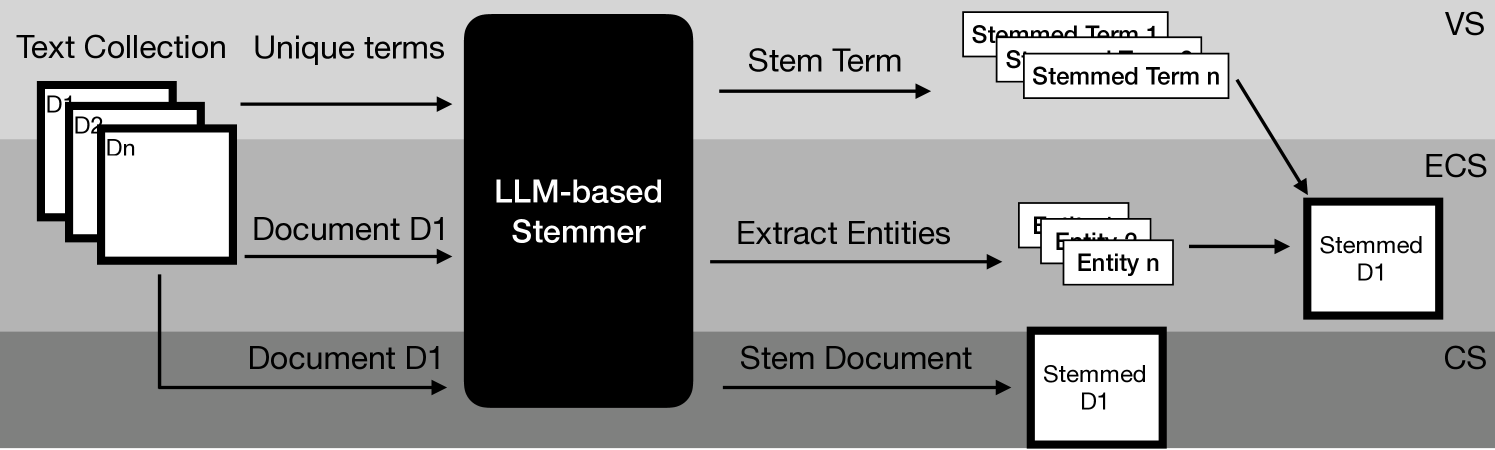
- 本文提出利用大语言模型进行词干提取,探索词汇词干提取、上下文词干提取和基于实体的上下文词干提取三种方法。
- 实验结果显示,基于实体的上下文词干提取在特定条件下优于传统的Porter词干提取器,具有更高的有效性。
📝 摘要(中文)
文本词干提取是一种自然语言处理技术,用于将单词简化为其基本形式。传统的词干提取方法往往忽视上下文信息的丰富性。本文探讨了利用大语言模型(LLMs)进行词干提取的潜力,提出了三种不同的策略:词汇词干提取、上下文词干提取和基于实体的上下文词干提取。通过实证实验,发现基于实体的上下文词干提取在特定条件下的效果优于传统的Porter词干提取器,而其他两种方法未能超越传统方法的效果。
🔬 方法详解
问题定义:本文旨在解决传统词干提取方法在处理上下文信息时的不足,特别是如何更有效地提取词干以提高信息检索效果。
核心思路:通过利用大语言模型的上下文理解能力,提出三种不同的词干提取策略,以期在保留上下文信息的同时提高提取效果。
技术框架:整体框架包括三个主要模块:词汇词干提取、上下文词干提取和基于实体的上下文词干提取,分别针对不同的应用场景进行优化。
关键创新:最重要的创新在于引入基于实体的上下文词干提取方法,该方法能够识别不应被词干化的实体,从而提高整体提取效果。
关键设计:在实验中,采用了不同的参数设置以优化模型性能,具体细节包括选择合适的损失函数和网络结构,以适应不同的词干提取任务。
🖼️ 关键图片
📊 实验亮点
实验结果表明,基于实体的上下文词干提取在特定条件下的有效性超过了传统的Porter词干提取器,显示出更高的性能。尽管词汇词干提取和上下文词干提取未能超越传统方法,但为未来的研究提供了新的思路。
🎯 应用场景
该研究的潜在应用领域包括信息检索、文本分析和自然语言处理等。通过提高词干提取的有效性,可以增强搜索引擎的性能,改善用户体验,并为后续的文本处理任务奠定基础。未来,随着大语言模型的进一步发展,该方法有望在更多实际场景中得到应用。
📄 摘要(原文)
Text stemming is a natural language processing technique that is used to reduce words to their base form, also known as the root form. The use of stemming in IR has been shown to often improve the effectiveness of keyword-matching models such as BM25. However, traditional stemming methods, focusing solely on individual terms, overlook the richness of contextual information. Recognizing this gap, in this paper, we investigate the promising idea of using large language models (LLMs) to stem words by leveraging its capability of context understanding. With this respect, we identify three avenues, each characterised by different trade-offs in terms of computational cost, effectiveness and robustness : (1) use LLMs to stem the vocabulary for a collection, i.e., the set of unique words that appear in the collection (vocabulary stemming), (2) use LLMs to stem each document separately (contextual stemming), and (3) use LLMs to extract from each document entities that should not be stemmed, then use vocabulary stemming to stem the rest of the terms (entity-based contextual stemming). Through a series of empirical experiments, we compare the use of LLMs for stemming with that of traditional lexical stemmers such as Porter and Krovetz for English text. We find that while vocabulary stemming and contextual stemming fail to achieve higher effectiveness than traditional stemmers, entity-based contextual stemming can achieve a higher effectiveness than using Porter stemmer alone, under specific conditions.