Extensible Embedding: A Flexible Multipler For LLM's Context Length
作者: Ninglu Shao, Shitao Xiao, Zheng Liu, Peitian Zhang
分类: cs.CL
发布日期: 2024-02-18
💡 一句话要点
提出可扩展嵌入以解决大型语言模型上下文长度限制问题
🎯 匹配领域: 支柱九:具身大模型 (Embodied Foundation Models)
关键词: 大型语言模型 上下文扩展 可扩展嵌入 信息密度 样本效率 自然语言处理 模型兼容性
📋 核心要点
- 现有方法在扩展大型语言模型的上下文时,成本高且质量差,限制了其应用潜力。
- 论文提出的可扩展嵌入通过代表可扩展上下文范围的信息,增强了令牌嵌入的能力,支持灵活的上下文扩展。
- 实验结果表明,可扩展嵌入在长上下文语言建模和理解任务中表现出色,验证了其有效性和高效性。
📝 摘要(中文)
大型语言模型(LLMs)需要扩展上下文以处理许多关键应用。然而,现有方法往往面临高昂的成本和较差的上下文扩展质量。本文提出了可扩展嵌入,能够以高质量、强灵活性和成本效益实现LLM上下文的扩展。可扩展嵌入作为典型令牌嵌入的增强,代表了可扩展上下文范围的信息,而非单一令牌。通过利用这种信息密度更高的紧凑输入单元,LLM即使在小的上下文窗口下也能访问广泛的上下文。系统优化的架构和训练方法使得可扩展嵌入具有多重优势,包括灵活的上下文扩展、高样本效率和与现有LLM的兼容性。综合评估表明,可扩展嵌入是一种有效、高效、灵活且兼容的上下文扩展方法。
🔬 方法详解
问题定义:本文旨在解决大型语言模型在上下文扩展方面的局限性,现有方法往往成本高且效果不佳,难以满足实际应用需求。
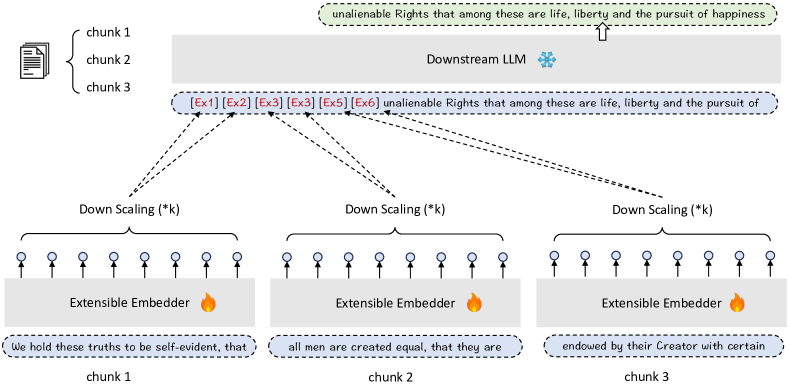
核心思路:提出可扩展嵌入作为一种新的输入表示方式,能够在小的上下文窗口中高效地编码更多信息,从而实现灵活的上下文扩展。
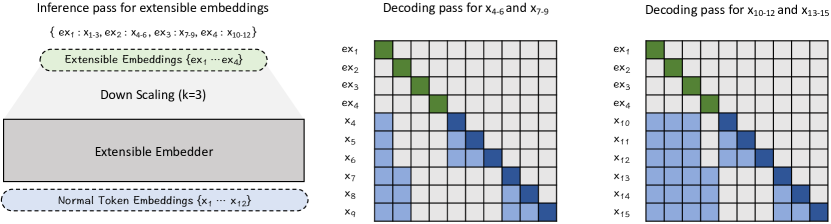
技术框架:整体架构包括可扩展嵌入模块,该模块与现有LLM无缝集成,支持多种上下文长度的灵活扩展。训练过程中采用优化的损失函数和高效的训练策略,以提高样本效率。
关键创新:可扩展嵌入的设计使得信息密度更高,能够在较小的上下文窗口中有效访问更广泛的上下文,与传统的令牌嵌入方法相比,具有显著的灵活性和效率提升。
关键设计:在模型设计中,采用了优化的网络结构和损失函数,确保可扩展嵌入的高效学习和良好的兼容性,具体参数设置和训练策略在文中进行了详细描述。
🖼️ 关键图片
📊 实验亮点
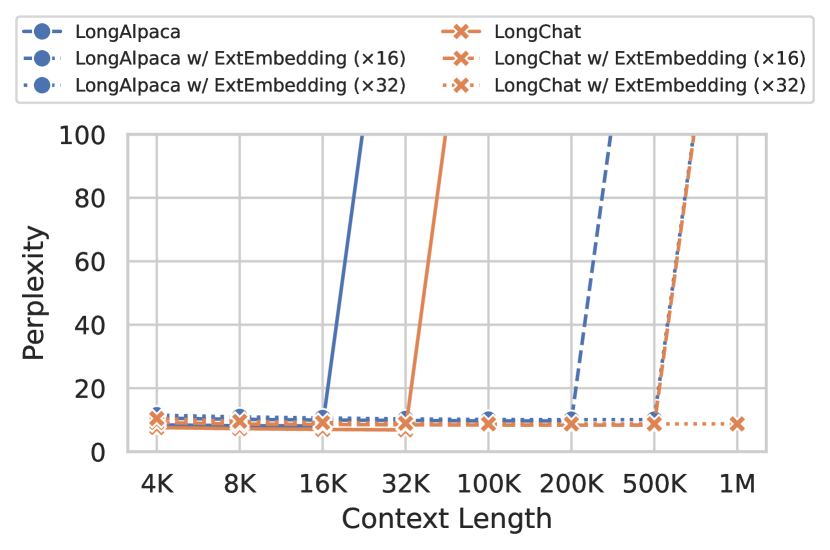
实验结果显示,采用可扩展嵌入的模型在长上下文语言建模任务中,相较于基线模型在上下文长度扩展上实现了显著提升,且在样本效率方面表现优异,验证了其有效性和实用性。
🎯 应用场景
该研究的潜在应用领域包括自然语言处理中的长文本理解、对话系统以及信息检索等。可扩展嵌入的灵活性和高效性使其能够在多种实际场景中应用,提升大型语言模型的性能和适用性,具有重要的实际价值和未来影响。
📄 摘要(原文)
Large language models (LLMs) call for extension of context to handle many critical applications. However, the existing approaches are prone to expensive costs and inferior quality of context extension. In this work, we propose Extensible Embedding, which realizes high-quality extension of LLM's context with strong flexibility and cost-effectiveness. Extensible embedding stand as an enhancement of typical token embedding, which represents the information for an extensible scope of context instead of a single token. By leveraging such compact input units of higher information density, the LLM can access to a vast scope of context even with a small context window. Extensible embedding is systematically optimized in architecture and training method, which leads to multiple advantages. 1) High flexibility of context extension, which flexibly supports ad-hoc extension of diverse context lengths. 2) Strong sample efficiency of training, which enables the embedding model to be learned in a cost-effective way. 3) Superior compatibility with the existing LLMs, where the extensible embedding can be seamlessly introduced as a plug-in component. Comprehensive evaluations on long-context language modeling and understanding tasks verify extensible embedding as an effective, efficient, flexible, and compatible method to extend the LLM's context.