EVEDIT: Event-based Knowledge Editing with Deductive Editing Boundaries
作者: Jiateng Liu, Pengfei Yu, Yuji Zhang, Sha Li, Zixuan Zhang, Heng Ji
分类: cs.CL
发布日期: 2024-02-17
💡 一句话要点
提出事件驱动的知识编辑方法以解决知识更新中的不确定性问题
🎯 匹配领域: 支柱九:具身大模型 (Embodied Foundation Models)
关键词: 知识编辑 事件驱动 推理锚点 大语言模型 不确定性处理 智能问答 知识图谱
📋 核心要点
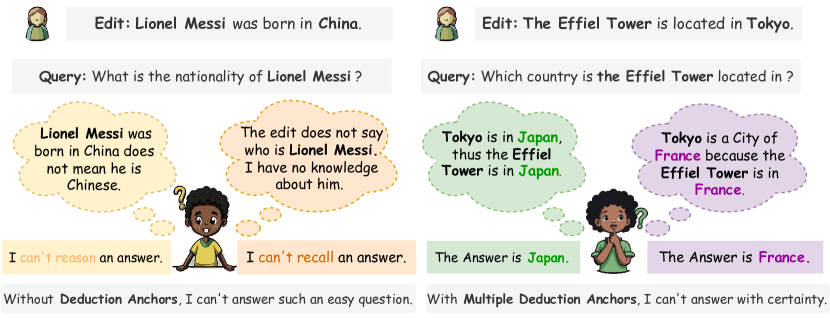
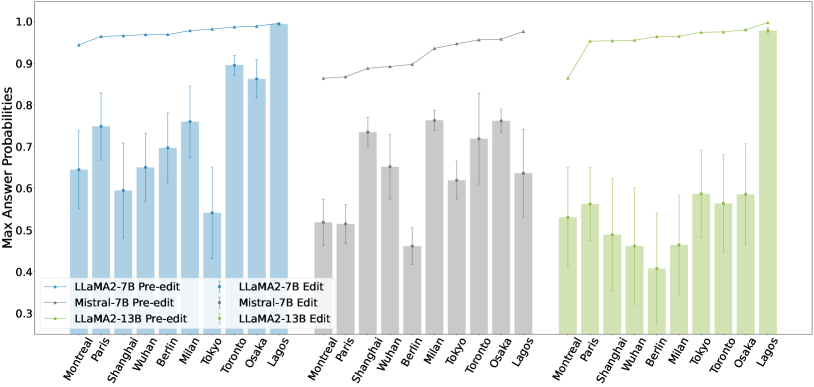
- 现有的知识编辑方法忽视了上下文信息,导致编辑后的知识存在不确定性,影响查询的可靠性。
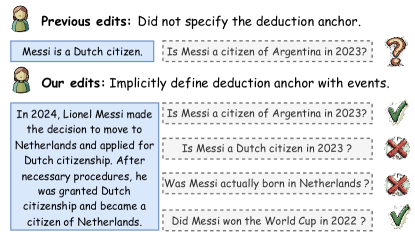
- 本文提出了一种事件驱动的知识编辑任务,通过结合事实与事件描述,定义推理锚点来解决编辑边界不确定性。
- 实验结果显示,事件驱动的编辑方法在一致性上提升了55.6%,并且保持了生成的自然性。
📝 摘要(中文)
现实世界信息的动态特性要求大语言模型(LLMs)具备高效的知识编辑能力。然而,现有的知识编辑方法通常基于(主体,关系,对象)三元组,忽视了上下文信息及不同知识之间的关系,导致编辑边界不确定,相关知识存在模糊性。本文通过引入一个理论框架,分析并提出了一种新的事件驱动知识编辑任务,结合事实与事件描述,模拟真实的编辑场景,并定义了推理锚点以解决不确定编辑边界的问题。实验证明,事件驱动的编辑方法在解决编辑模型的不确定性方面优于现有方法,并提出了一种新方法Self-Edit,显著提升了一致性。
🔬 方法详解
问题定义:本文要解决的是现有知识编辑方法在处理(主体,关系,对象)三元组时,缺乏上下文信息和知识间关系的考虑,导致编辑后的知识存在不确定性,影响查询的可靠性。
核心思路:论文提出了一种事件驱动的知识编辑方法,通过将事实与事件描述相结合,模拟真实的知识编辑场景,并引入推理锚点来明确不变的知识,从而减少编辑的不确定性。
技术框架:整体架构包括知识编辑的理论框架、事件驱动的任务设计和推理锚点的定义。主要模块包括知识提取、事件描述生成和知识一致性验证。
关键创新:最重要的创新点在于引入了事件驱动的知识编辑任务和推理锚点的概念,这与传统方法的静态三元组编辑方式有本质区别,能够更好地处理知识更新中的不确定性。
关键设计:在技术细节上,设计了新的损失函数以优化知识一致性,并采用了自编辑机制(Self-Edit)来提升生成的自然性和一致性。
🖼️ 关键图片
📊 实验亮点
实验结果表明,事件驱动的知识编辑方法在解决编辑模型的不确定性方面表现优越,相较于现有方法,一致性提升达55.6%。同时,新方法Self-Edit在保持生成自然性的同时,显著提高了知识编辑的效果。
🎯 应用场景
该研究的潜在应用领域包括知识图谱更新、智能问答系统和信息检索等。通过提高知识编辑的效率和准确性,能够在动态信息环境中更好地支持决策和推理,具有重要的实际价值和未来影响。
📄 摘要(原文)
The dynamic nature of real-world information necessitates efficient knowledge editing (KE) in large language models (LLMs) for knowledge updating. However, current KE approaches, which typically operate on (subject, relation, object) triples, ignore the contextual information and the relation among different knowledge. Such editing methods could thus encounter an uncertain editing boundary, leaving a lot of relevant knowledge in ambiguity: Queries that could be answered pre-edit cannot be reliably answered afterward. In this work, we analyze this issue by introducing a theoretical framework for KE that highlights an overlooked set of knowledge that remains unchanged and aids in knowledge deduction during editing, which we name as the deduction anchor. We further address this issue by proposing a novel task of event-based knowledge editing that pairs facts with event descriptions. This task manifests not only a closer simulation of real-world editing scenarios but also a more logically sound setting, implicitly defining the deduction anchor to address the issue of indeterminate editing boundaries. We empirically demonstrate the superiority of event-based editing over the existing setting on resolving uncertainty in edited models, and curate a new benchmark dataset EvEdit derived from the CounterFact dataset. Moreover, while we observe that the event-based setting is significantly challenging for existing approaches, we propose a novel approach Self-Edit that showcases stronger performance, achieving 55.6% consistency improvement while maintaining the naturalness of generation.