Navigating the Dual Facets: A Comprehensive Evaluation of Sequential Memory Editing in Large Language Models
作者: Zihao Lin, Mohammad Beigi, Hongxuan Li, Yufan Zhou, Yuxiang Zhang, Qifan Wang, Wenpeng Yin, Lifu Huang
分类: cs.CL, cs.AI
发布日期: 2024-02-16
备注: preprint, 15 pages
💡 一句话要点
提出全面评估序列记忆编辑以解决大语言模型的知识更新问题
🎯 匹配领域: 支柱九:具身大模型 (Embodied Foundation Models)
关键词: 记忆编辑 大语言模型 知识更新 逻辑推理 序列编辑 性能评估 参数修改 参数保留
📋 核心要点
- 现有的记忆编辑方法在评估时仅关注单次编辑,未能考虑连续编辑的实际需求。
- 本研究提出了一种全面的评估框架,探讨记忆编辑对LLMs多种能力的影响,并提出了不同的编辑策略。
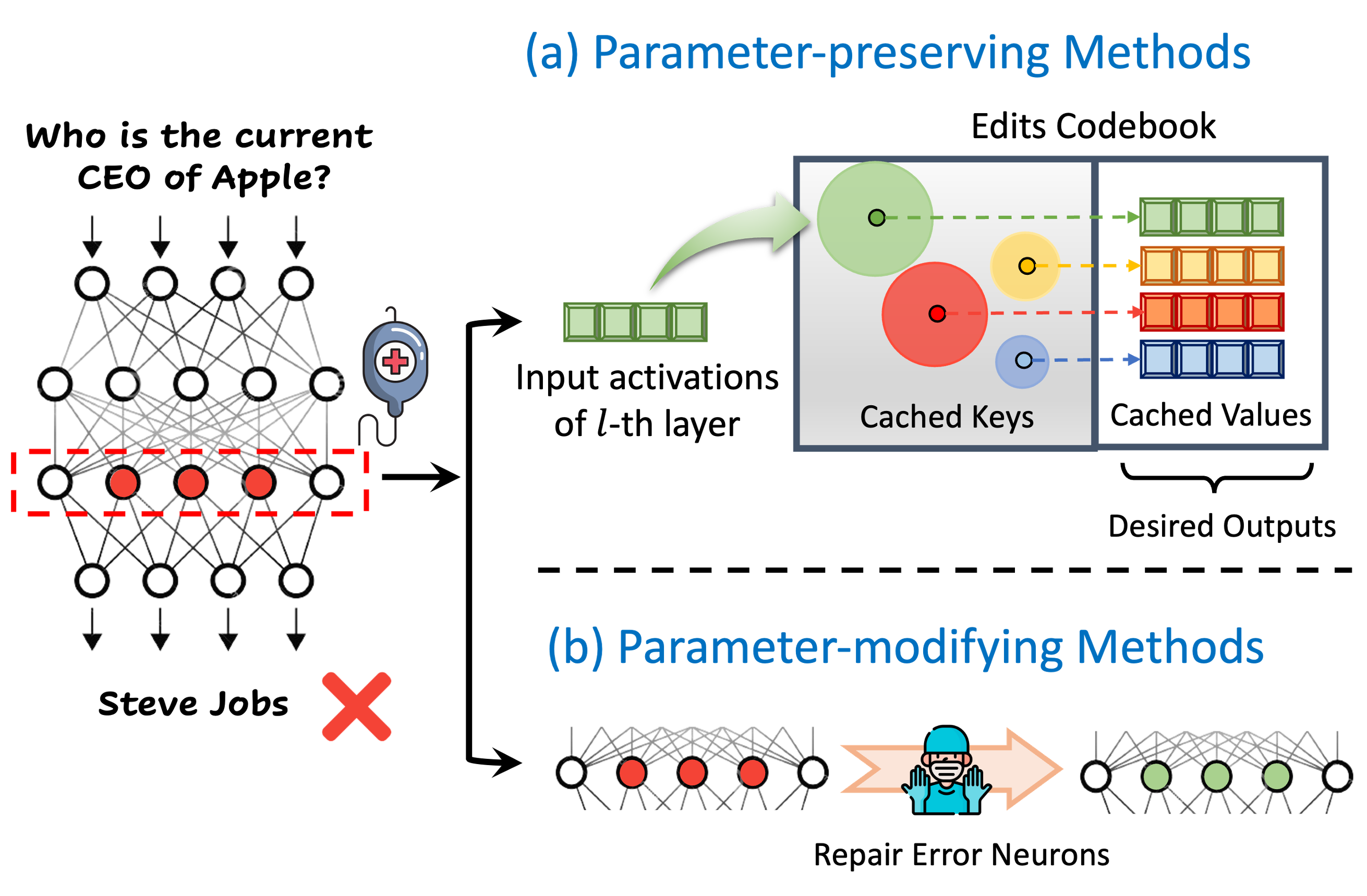
- 实验结果显示,参数修改型ME在多次编辑后会显著降低LLMs的性能,而参数保留型ME则能有效维持基本能力。
📝 摘要(中文)
记忆编辑(ME)已成为修改大型语言模型(LLMs)中错误事实或注入新事实的有效方法。现有的ME方法主要分为参数修改型和参数保留型。然而,之前的研究在ME评估上存在两个关键局限性:一是只评估单次编辑,忽视了连续编辑的需求;二是评估仅关注基本事实三元组,未考虑LLMs的逻辑推理和阅读理解等更广泛的能力。本研究通过三个方面的贡献来解决这些局限性:首先,探讨ME在序列编辑下对LLMs多种基本能力的影响;其次,扩展评估到不同的编辑设置;最后,从参数变化、语言建模能力和上下文学习能力三个维度解释参数修改型ME对LLMs的损害。
🔬 方法详解
问题定义:本论文旨在解决现有记忆编辑方法在评估时的局限性,特别是对连续编辑和LLMs更广泛能力的忽视。
核心思路:通过设计全面的评估框架,探索记忆编辑对LLMs的多种能力影响,并提出不同的编辑策略以减轻负面影响。
技术框架:整体架构包括三个主要模块:1) 记忆编辑方法的分类与比较;2) 多种编辑设置的实验评估;3) 从多个维度分析参数修改型ME的影响。
关键创新:本研究的创新点在于首次系统性地评估了序列记忆编辑对LLMs的影响,揭示了参数修改型ME的性能下降机制。
关键设计:在实验中,设置了不同的编辑层次、模型规模和指令调优等参数,并采用了多种损失函数来评估模型在不同任务上的表现。
🖼️ 关键图片


📊 实验亮点
实验结果表明,参数修改型ME在经过几次连续编辑后,LLMs在所有任务上的性能均显著下降,而参数保留型ME则在保持基本能力方面表现良好,但在不同格式下的知识回忆上存在困难。这一发现为记忆编辑的实际应用提供了重要的指导。
🎯 应用场景
该研究的潜在应用领域包括智能问答系统、对话生成和知识图谱更新等。通过改进记忆编辑方法,可以提升LLMs在实际应用中的知识更新能力和推理能力,进而提高用户体验和系统的智能化水平。
📄 摘要(原文)
Memory Editing (ME) has emerged as an efficient method to modify erroneous facts or inject new facts into Large Language Models (LLMs). Two mainstream ME methods exist: parameter-modifying ME and parameter-preserving ME (integrating extra modules while preserving original parameters). Regrettably, previous studies on ME evaluation have two critical limitations: (i) evaluating LLMs with single edit only, neglecting the need for continuous editing, and (ii) evaluations focusing solely on basic factual triples, overlooking broader LLM capabilities like logical reasoning and reading understanding. This study addresses these limitations with contributions threefold: (i) We explore how ME affects a wide range of fundamental capabilities of LLMs under sequential editing. Experimental results reveal an intriguing phenomenon: Most parameter-modifying ME consistently degrade performance across all tasks after a few sequential edits. In contrast, parameter-preserving ME effectively maintains LLMs' fundamental capabilities but struggles to accurately recall edited knowledge presented in a different format. (ii) We extend our evaluation to different editing settings, such as layers to edit, model size, instruction tuning, etc. Experimental findings indicate several strategies that can potentially mitigate the adverse effects of ME. (iii) We further explain why parameter-modifying ME damages LLMs from three dimensions: parameter changes after editing, language modeling capability, and the in-context learning capability. Our in-depth study advocates more careful use of ME in real-world scenarios.