A Trembling House of Cards? Mapping Adversarial Attacks against Language Agents
作者: Lingbo Mo, Zeyi Liao, Boyuan Zheng, Yu Su, Chaowei Xiao, Huan Sun
分类: cs.CL, cs.AI
发布日期: 2024-02-15
💡 一句话要点
提出系统性框架以映射语言代理的对抗攻击
🎯 匹配领域: 支柱一:机器人控制 (Robot Control) 支柱九:具身大模型 (Embodied Foundation Models)
关键词: 对抗攻击 语言代理 安全风险 大型语言模型 自动化技术 系统框架 风险评估
📋 核心要点
- 现有的语言代理系统在安全性方面存在显著的知识缺口,尤其是在对抗攻击的理解上。
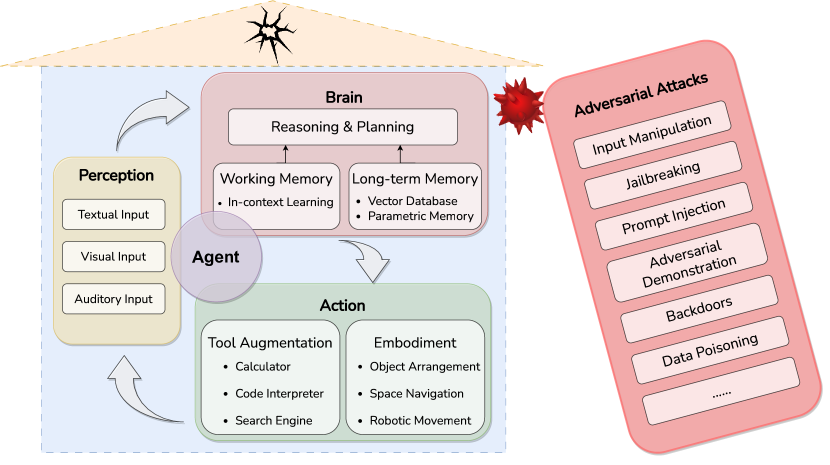
- 论文提出了一个统一的概念框架,涵盖语言代理的三个主要组件,并系统性地讨论了多种攻击策略。
- 通过对不同攻击场景的分析,强调了对语言代理安全风险的深入理解的重要性。
📝 摘要(中文)
随着大型语言模型(LLMs)的迅速发展,语言代理的能力在思维和交流中展现出极大的灵活性和多样性。然而,新的自动化技术伴随着新的安全风险,尤其是在复杂系统中。本文首次系统性地映射了针对语言代理的对抗攻击,提出了一个统一的概念框架,涵盖感知、思维和行动三个主要组件,并讨论了12种潜在的攻击场景,强调在广泛部署之前,深入理解语言代理的风险的紧迫性。
🔬 方法详解
问题定义:本文旨在解决当前对语言代理系统安全风险理解不足的问题,尤其是对抗攻击的潜在威胁。现有方法未能全面覆盖这些风险,导致安全隐患。
核心思路:论文提出的核心思路是构建一个统一的概念框架,系统性地识别和分类针对语言代理的对抗攻击,帮助研究者和开发者更好地理解和应对这些风险。
技术框架:整体架构分为三个主要模块:感知、思维和行动。每个模块对应不同的攻击策略,并通过12种潜在攻击场景进行详细讨论。
关键创新:最重要的技术创新在于首次系统性地映射了语言代理的对抗攻击,提供了一个全面的框架,填补了现有研究中的空白。
关键设计:论文中设计了多种攻击策略,包括输入操控、对抗示范、越狱和后门等,具体参数和实施细节未明确列出,需进一步研究。
🖼️ 关键图片
📊 实验亮点
论文通过系统性分析提出了12种针对语言代理的对抗攻击场景,强调了在广泛部署之前深入理解安全风险的重要性。虽然具体的性能数据未提供,但提出的框架为后续研究奠定了基础。
🎯 应用场景
该研究的潜在应用领域包括自动化客服、智能助手和其他依赖语言代理的系统。通过识别和理解对抗攻击,开发者可以增强系统的安全性,降低潜在风险,确保在实际应用中的可靠性和安全性。
📄 摘要(原文)
Language agents powered by large language models (LLMs) have seen exploding development. Their capability of using language as a vehicle for thought and communication lends an incredible level of flexibility and versatility. People have quickly capitalized on this capability to connect LLMs to a wide range of external components and environments: databases, tools, the Internet, robotic embodiment, etc. Many believe an unprecedentedly powerful automation technology is emerging. However, new automation technologies come with new safety risks, especially for intricate systems like language agents. There is a surprisingly large gap between the speed and scale of their development and deployment and our understanding of their safety risks. Are we building a house of cards? In this position paper, we present the first systematic effort in mapping adversarial attacks against language agents. We first present a unified conceptual framework for agents with three major components: Perception, Brain, and Action. Under this framework, we present a comprehensive discussion and propose 12 potential attack scenarios against different components of an agent, covering different attack strategies (e.g., input manipulation, adversarial demonstrations, jailbreaking, backdoors). We also draw connections to successful attack strategies previously applied to LLMs. We emphasize the urgency to gain a thorough understanding of language agent risks before their widespread deployment.