Pixel Sentence Representation Learning
作者: Chenghao Xiao, Zhuoxu Huang, Danlu Chen, G Thomas Hudson, Yizhi Li, Haoran Duan, Chenghua Lin, Jie Fu, Jungong Han, Noura Al Moubayed
分类: cs.CL, cs.CV
发布日期: 2024-02-13
🔗 代码/项目: GITHUB
💡 一句话要点
提出视觉句子表示学习框架以解决语言模型语义捕捉不足问题
🎯 匹配领域: 支柱二:RL算法与架构 (RL & Architecture)
关键词: 视觉表示学习 自然语言处理 无监督学习 跨语言迁移 语义理解
📋 核心要点
- 现有的预训练语言模型在捕捉句子和文档级语义方面存在显著不足,尤其是在处理扰动输入时。
- 本文提出了一种将句子级文本语义学习视为视觉表示学习过程的框架,采用视觉基础的文本扰动方法。
- 通过大规模无监督训练和自然语言推理监督,实验结果显示该方法在语义文本相似度任务上表现优异,具有零-shot跨语言迁移能力。
📝 摘要(中文)
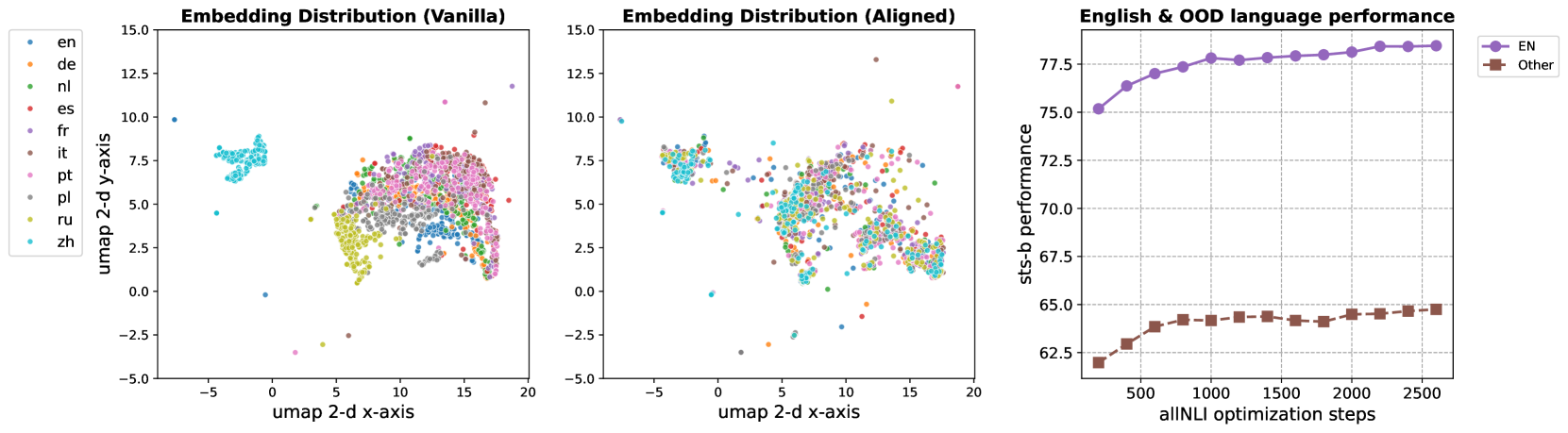
预训练语言模型在捕捉句子和文档级语义方面表现不佳。尽管这一问题受到广泛研究,但将基于扰动的方法从无监督视觉表示学习转移到自然语言处理仍未解决。本文将句子级文本语义学习概念化为视觉表示学习过程,提出了一种无监督的视觉句子表示学习框架,采用与人类认知模式相呼应的视觉基础文本扰动方法,如拼写错误和词序打乱。通过大规模无监督主题对齐训练和自然语言推理监督,我们的方法在语义文本相似度(STS)任务上达到了与现有最先进的NLP方法相当的性能,并展示了其固有的零-shot跨语言迁移能力。
🔬 方法详解
问题定义:本文旨在解决现有预训练语言模型在捕捉句子和文档级语义时的不足,尤其是在处理扰动输入时的局限性。现有方法由于语言模型的分词离散性,难以形成语义保留的正样本对。
核心思路:我们将句子级文本语义学习视为一种视觉表示学习过程,采用与人类认知模式相符的视觉基础文本扰动方法,如拼写错误和词序打乱,使得文本扰动被视为连续的。
技术框架:整体框架包括无监督的视觉句子表示学习模块,结合视觉基础的扰动方法和大规模无监督主题对齐训练,辅以自然语言推理监督,形成完整的学习流程。
关键创新:本研究首次提出一种不依赖传统语言模型的表示学习方法,显著提升了对句子和文档语义的理解能力,接近人类的文本理解水平。
关键设计:在技术细节上,采用了特定的扰动策略(如拼写错误和词序打乱),并通过大规模无监督训练和自然语言推理监督来优化模型性能,确保语义的保留与提升。
🖼️ 关键图片


📊 实验亮点
实验结果显示,所提方法在语义文本相似度(STS)任务上达到了与现有最先进NLP方法相当的性能,展现出良好的零-shot跨语言迁移能力,标志着在多语言处理领域的显著进展。
🎯 应用场景
该研究的潜在应用领域包括自然语言处理、机器翻译和跨语言信息检索等。通过提升句子和文档的语义理解能力,能够为多语言环境中的信息处理提供更为精准的支持,未来可能对人机交互和智能助手的发展产生深远影响。
📄 摘要(原文)
Pretrained language models are long known to be subpar in capturing sentence and document-level semantics. Though heavily investigated, transferring perturbation-based methods from unsupervised visual representation learning to NLP remains an unsolved problem. This is largely due to the discreteness of subword units brought by tokenization of language models, limiting small perturbations of inputs to form semantics-preserved positive pairs. In this work, we conceptualize the learning of sentence-level textual semantics as a visual representation learning process. Drawing from cognitive and linguistic sciences, we introduce an unsupervised visual sentence representation learning framework, employing visually-grounded text perturbation methods like typos and word order shuffling, resonating with human cognitive patterns, and enabling perturbation to texts to be perceived as continuous. Our approach is further bolstered by large-scale unsupervised topical alignment training and natural language inference supervision, achieving comparable performance in semantic textual similarity (STS) to existing state-of-the-art NLP methods. Additionally, we unveil our method's inherent zero-shot cross-lingual transferability and a unique leapfrogging pattern across languages during iterative training. To our knowledge, this is the first representation learning method devoid of traditional language models for understanding sentence and document semantics, marking a stride closer to human-like textual comprehension. Our code is available at https://github.com/gowitheflow-1998/Pixel-Linguist