Calibrating Long-form Generations from Large Language Models
作者: Yukun Huang, Yixin Liu, Raghuveer Thirukovalluru, Arman Cohan, Bhuwan Dhingra
分类: cs.CL, cs.AI, cs.LG
发布日期: 2024-02-09 (更新: 2024-10-25)
💡 一句话要点
提出统一校准框架以提升大型语言模型的可靠性
🎯 匹配领域: 支柱九:具身大模型 (Embodied Foundation Models)
关键词: 大型语言模型 模型校准 长文本生成 自一致性 自评估 置信度评估 文本摘要 问答系统
📋 核心要点
- 现有的置信度引导方法主要依赖于二元评估,无法有效处理长文本生成中的部分正确性问题。
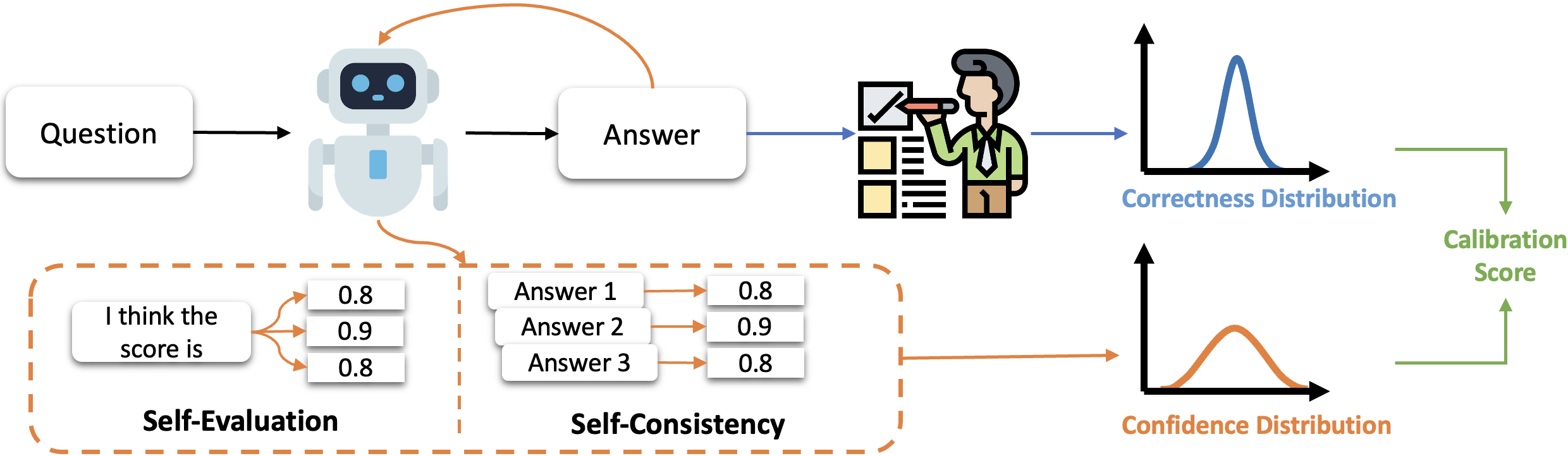
- 本文提出一个统一的校准框架,将响应的正确性和置信度视为分布,并开发了三种评估指标和两种引导方法。
- 实验结果显示,模型的校准性能与模型大小无关,且自一致性方法在特定数据集上表现突出,校准可通过多种技术提升。
📝 摘要(中文)
为了增强大型语言模型(LLMs)的可靠性,校准至关重要——模型评估的置信度分数应与其响应正确的实际可能性相一致。然而,目前的置信度引导方法和校准指标通常依赖于对响应正确性的二元真/假评估,这种方法不适用于长文本生成。为了解决这一问题,本文提出了一个统一的校准框架,其中LLMs响应的正确性及其相关置信度水平被视为一系列分数的分布。在此框架内,我们开发了三种指标来精确评估LLM的校准,并进一步提出了基于自一致性和自评估的两种置信度引导方法。实验结果表明,较大的模型并不一定保证更好的校准,校准性能依赖于指标,并且自一致性方法在事实数据集上表现优异。
🔬 方法详解
问题定义:本文旨在解决大型语言模型在长文本生成中的校准问题,现有方法无法有效评估部分正确的响应,导致置信度与实际正确性不一致。
核心思路:提出一个统一的校准框架,将响应的正确性和置信度视为分布,从而更全面地评估模型的表现。通过引入自一致性和自评估方法,增强置信度的可靠性。
技术框架:整体框架包括三个主要模块:1) 置信度分布的评估;2) 校准指标的计算;3) 置信度引导方法的应用。每个模块相互关联,共同提升模型的校准性能。
关键创新:最重要的创新在于将校准视为分布问题,而非简单的二元评估。这一方法使得模型能够更好地处理长文本生成中的复杂性。
关键设计:在设计中,采用了多种评估指标,结合自一致性和自评估方法,调整了温度参数,并引入相关源文档,以优化模型的校准效果。实验中还探讨了微调等技术对校准的影响。
🖼️ 关键图片


📊 实验亮点
实验结果表明,较大的模型并不一定保证更好的校准,且校准性能依赖于所用的评估指标。自一致性方法在事实数据集上表现优异,结合其他技术如微调和温度调整,能够显著提升模型的校准效果。
🎯 应用场景
该研究的潜在应用领域包括长文本生成、问答系统和文本摘要等场景。通过提升模型的校准性能,可以增强用户对模型输出的信任度,从而在实际应用中提高决策的准确性和可靠性。未来,该方法可能会影响更多领域的模型设计和评估标准。
📄 摘要(原文)
To enhance Large Language Models' (LLMs) reliability, calibration is essential -- the model's assessed confidence scores should align with the actual likelihood of its responses being correct. However, current confidence elicitation methods and calibration metrics typically rely on a binary true/false assessment of response correctness. This approach does not apply to long-form generation, where an answer can be partially correct. Addressing this gap, we introduce a unified calibration framework, in which both the correctness of the LLMs' responses and their associated confidence levels are treated as distributions across a range of scores. Within this framework, we develop three metrics to precisely evaluate LLM calibration and further propose two confidence elicitation methods based on self-consistency and self-evaluation. Our experiments, which include long-form QA and summarization tasks, demonstrate that larger models don't necessarily guarantee better calibration, that calibration performance is found to be metric-dependent, and that self-consistency methods excel in factoid datasets. We also find that calibration can be enhanced through techniques such as fine-tuning, integrating relevant source documents, scaling the temperature, and combining self-consistency with self-evaluation. Lastly, we showcase a practical application of our system: selecting and cascading open-source models and ChatGPT to optimize correctness given a limited API budget. This research not only challenges existing notions of LLM calibration but also offers practical methodologies for improving trustworthiness in long-form generation.