Exploring Group and Symmetry Principles in Large Language Models
作者: Shima Imani, Hamid Palangi
分类: cs.CL
发布日期: 2024-02-09 (更新: 2024-09-05)
💡 一句话要点
提出基于群体与对称原则的框架以评估大语言模型的推理能力
🎯 匹配领域: 支柱九:具身大模型 (Embodied Foundation Models)
关键词: 大语言模型 推理能力 群体属性 对称原则 算术推理 评估框架 合成数据集
📋 核心要点
- 现有的大语言模型在推理能力评估上存在显著挑战,尤其是在保持群体属性方面表现不佳。
- 本文提出了一个基于群体和对称原则的评估框架,专注于算术推理中的四个群体属性。
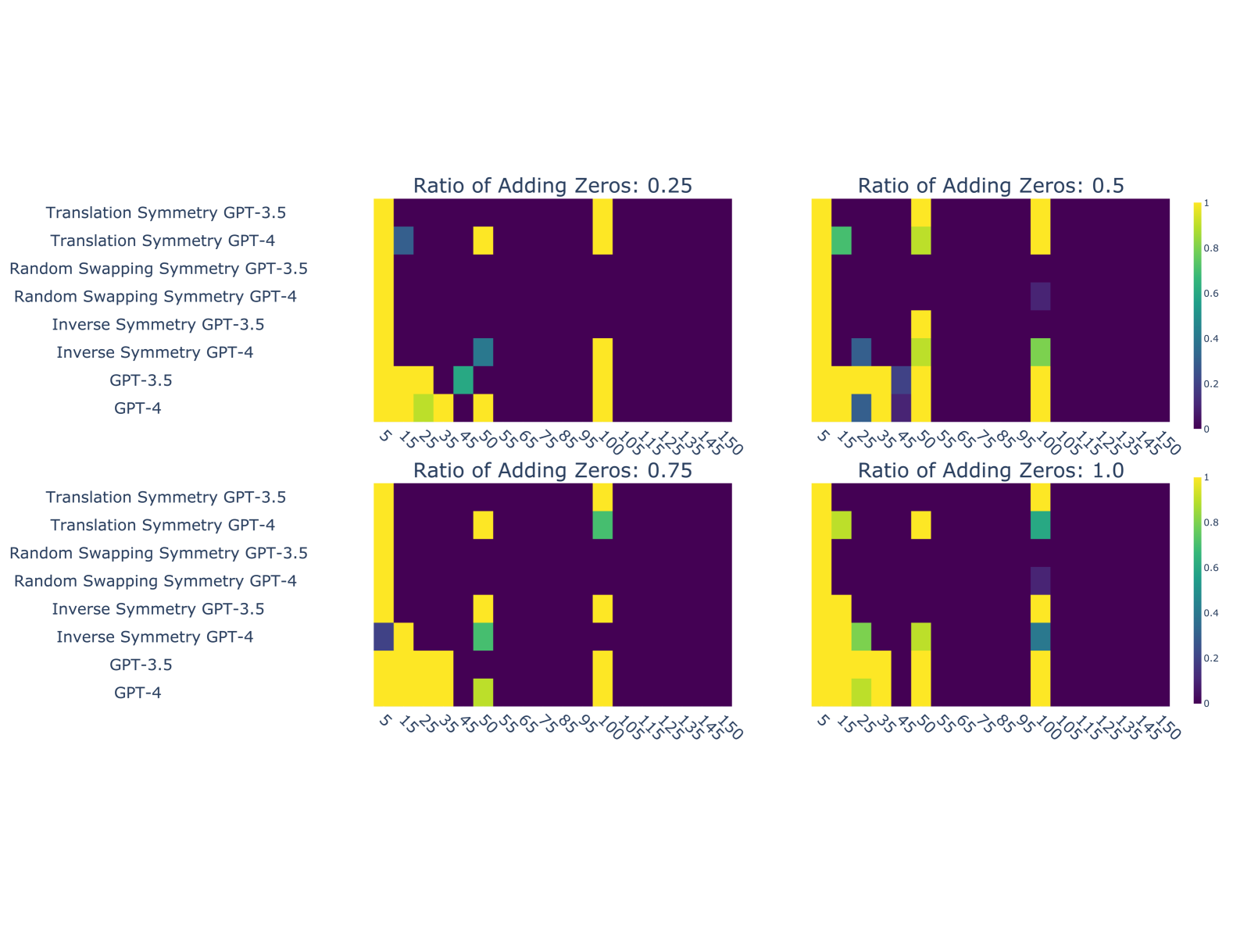
- 实验结果显示,LLMs在闭合性和身份测试中表现不佳,但通过问题分解,结合性测试的表现有所提升。
📝 摘要(中文)
大语言模型(LLMs)在多种应用中表现出色,但评估其推理能力仍然是一个重大挑战。本文提出了一个基于群体和对称原则的框架,这些原则在物理和数学等领域中发挥了重要作用,提供了一种评估LLMs能力的新方法。我们专注于算术推理,考察模型在四个群体属性(闭合性、身份、逆元素和结合性)上的表现。研究发现,所考察的LLMs在不同测试条件下难以保持群体属性,尤其在闭合性测试中表现出对特定输出的偏见,并且在特定序列长度后性能急剧下降。身份测试和逆元素测试的表现也不佳,但在结合性测试中,通过将问题分解为更小的步骤,模型的表现有所改善。为支持这些测试,我们开发了一个合成数据集,并计划发布。
🔬 方法详解
问题定义:本文旨在解决大语言模型在推理能力评估中的不足,尤其是如何保持群体属性的问题。现有方法在这一方面的表现不尽如人意,缺乏系统性评估。
核心思路:论文的核心思路是引入群体和对称原则作为评估框架,通过这些数学和物理中的基本概念来分析LLMs的推理能力,尤其是在算术推理中的应用。
技术框架:整体架构包括四个主要测试模块:闭合性测试、身份测试、逆元素测试和结合性测试。每个模块针对特定的群体属性进行设计,以评估模型的表现。
关键创新:最重要的技术创新点在于将群体和对称原则引入LLMs的评估中,这与传统的评估方法有本质区别,提供了新的视角和方法论。
关键设计:在实验中,采用了合成数据集,并设计了特定的测试序列和参数设置,以确保测试的有效性和可重复性。
🖼️ 关键图片


📊 实验亮点
实验结果显示,在闭合性测试中,模型的表现从100%急剧下降至0%,显示出明显的输出偏见。在身份测试中,模型表现不佳,而在结合性测试中,通过将问题分解为小步骤,模型的表现得到了改善。这些发现为理解LLMs的推理能力提供了新的视角。
🎯 应用场景
该研究的潜在应用领域包括教育、自动化推理系统和智能助手等。通过更准确地评估大语言模型的推理能力,可以提升其在实际应用中的表现,推动智能系统的进一步发展。未来,这一框架可能会影响模型设计和评估标准的制定。
📄 摘要(原文)
Large Language Models (LLMs) have demonstrated impressive performance across a wide range of applications; however, assessing their reasoning capabilities remains a significant challenge. In this paper, we introduce a framework grounded in group and symmetry principles, which have played a crucial role in fields such as physics and mathematics, and offer another way to evaluate their capabilities. While the proposed framework is general, to showcase the benefits of employing these properties, we focus on arithmetic reasoning and investigate the performance of these models on four group properties: closure, identity, inverse, and associativity. Our findings reveal that LLMs studied in this work struggle to preserve group properties across different test regimes. In the closure test, we observe biases towards specific outputs and an abrupt degradation in their performance from 100% to 0% after a specific sequence length. They also perform poorly in the identity test, which represents adding irrelevant information in the context, and show sensitivity when subjected to inverse test, which examines the robustness of the model with respect to negation. In addition, we demonstrate that breaking down problems into smaller steps helps LLMs in the associativity test that we have conducted. To support these tests we have developed a synthetic dataset which will be released.