Large Language Models are Geographically Biased
作者: Rohin Manvi, Samar Khanna, Marshall Burke, David Lobell, Stefano Ermon
分类: cs.CL, cs.AI, cs.CY, cs.LG
发布日期: 2024-02-05 (更新: 2024-10-05)
🔗 代码/项目: PROJECT_PAGE
💡 一句话要点
研究大型语言模型的地理偏见以提升公平性与准确性
🎯 匹配领域: 支柱九:具身大模型 (Embodied Foundation Models)
关键词: 大型语言模型 地理偏见 社会公平 零样本学习 偏见评分
📋 核心要点
- 现有大型语言模型在训练过程中吸收了社会偏见,导致其在地理相关任务中表现出系统性错误。
- 本文提出通过地理视角分析LLMs的知识,揭示其在地理预测中的偏见,尤其是在社会经济条件较低地区的表现。
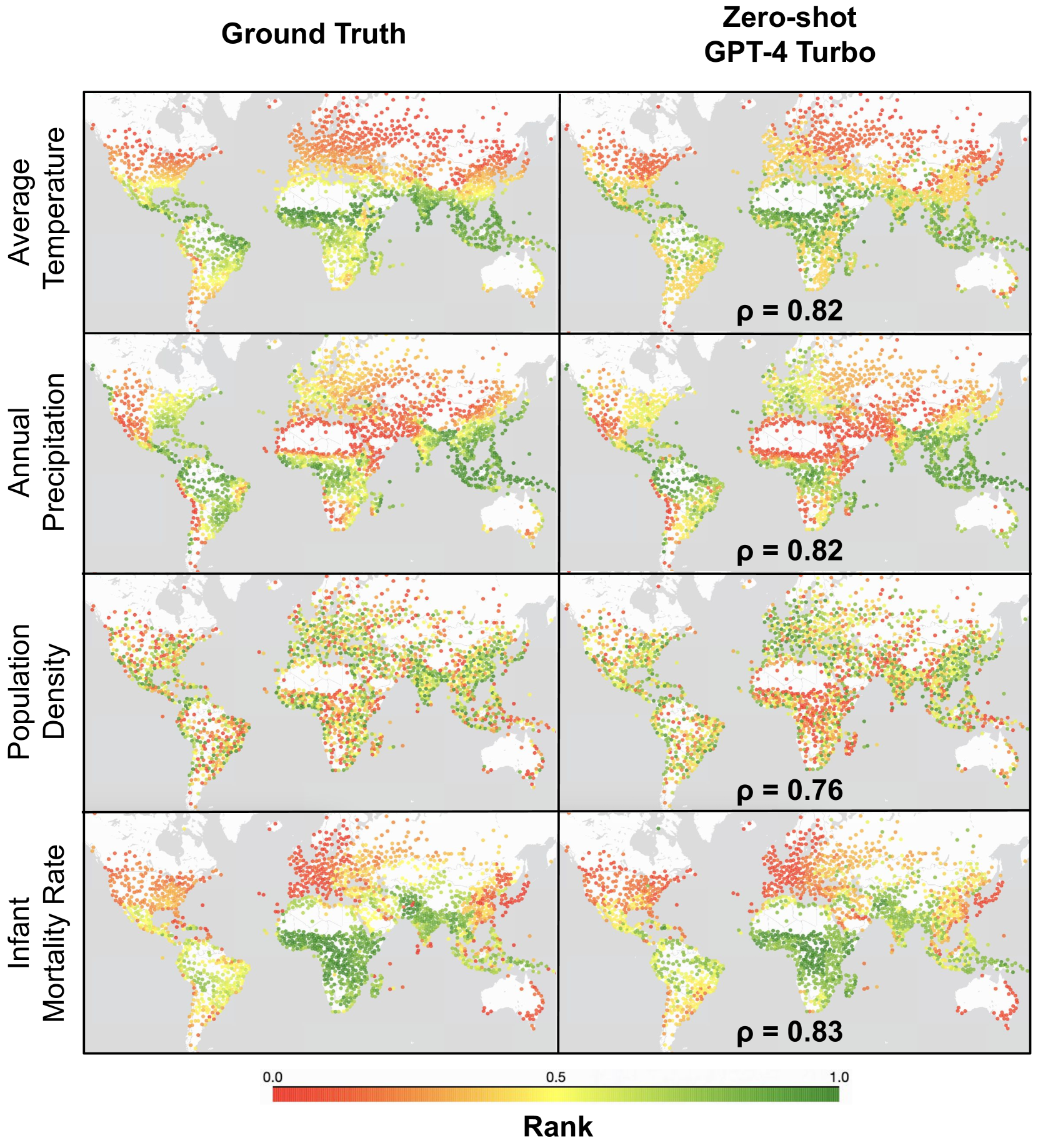
- 研究结果显示,LLMs在零样本地理预测中与真实数据的相关性高达0.89,并在敏感主题上对低社会经济地区表现出偏见,相关性高达0.70。
📝 摘要(中文)
大型语言模型(LLMs)在其训练语料中固有的偏见可能导致社会危害的延续。随着这些基础模型影响力的扩大,理解和评估其偏见变得至关重要。本文通过地理视角研究LLMs对世界的认知,揭示了其在地理预测中的系统性错误。研究表明,LLMs在零样本地理预测中表现出与真实数据的强相关性,同时在涉及社会经济条件较低的地区时,表现出明显的偏见。最后,提出了一种偏见评分来量化这些偏见,并发现不同LLMs之间的偏见程度存在显著差异。
🔬 方法详解
问题定义:本文旨在揭示大型语言模型在地理预测中存在的系统性偏见,现有方法未能充分评估这些模型的社会影响和准确性。
核心思路:通过分析LLMs在地理空间上的表现,研究其对不同地区的偏见,尤其是对低社会经济条件地区的偏见,以此提高模型的公平性和准确性。
技术框架:研究首先通过零样本学习评估LLMs的地理预测能力,接着分析其在不同主题上的偏见,最后引入偏见评分量化偏见程度。
关键创新:提出了一种新的偏见评分机制,能够量化和比较不同LLMs在地理预测中的偏见程度,这是对现有方法的重要补充。
关键设计:在实验中使用Spearman相关系数评估模型预测与真实数据的相关性,设置了多个敏感主题进行分析,并对不同LLMs的偏见程度进行了系统比较。
🖼️ 关键图片


📊 实验亮点
实验结果显示,LLMs在零样本地理预测中与真实数据的Spearman相关系数高达0.89,而在对低社会经济地区的敏感主题分析中,相关系数达到0.70,表明模型在这些领域存在显著偏见。不同LLMs之间的偏见程度差异显著,提供了量化偏见的新视角。
🎯 应用场景
该研究的潜在应用领域包括社会科学研究、政策制定和人工智能伦理。通过识别和量化语言模型的地理偏见,可以为模型的改进提供指导,促进更公平的技术应用,减少社会不平等现象的加剧。
📄 摘要(原文)
Large Language Models (LLMs) inherently carry the biases contained in their training corpora, which can lead to the perpetuation of societal harm. As the impact of these foundation models grows, understanding and evaluating their biases becomes crucial to achieving fairness and accuracy. We propose to study what LLMs know about the world we live in through the lens of geography. This approach is particularly powerful as there is ground truth for the numerous aspects of human life that are meaningfully projected onto geographic space such as culture, race, language, politics, and religion. We show various problematic geographic biases, which we define as systemic errors in geospatial predictions. Initially, we demonstrate that LLMs are capable of making accurate zero-shot geospatial predictions in the form of ratings that show strong monotonic correlation with ground truth (Spearman's $ρ$ of up to 0.89). We then show that LLMs exhibit common biases across a range of objective and subjective topics. In particular, LLMs are clearly biased against locations with lower socioeconomic conditions (e.g. most of Africa) on a variety of sensitive subjective topics such as attractiveness, morality, and intelligence (Spearman's $ρ$ of up to 0.70). Finally, we introduce a bias score to quantify this and find that there is significant variation in the magnitude of bias across existing LLMs. Code is available on the project website: https://rohinmanvi.github.io/GeoLLM