Aligner: Efficient Alignment by Learning to Correct
作者: Jiaming Ji, Boyuan Chen, Hantao Lou, Donghai Hong, Borong Zhang, Xuehai Pan, Juntao Dai, Tianyi Qiu, Yaodong Yang
分类: cs.CL, cs.AI, cs.LG
发布日期: 2024-02-04 (更新: 2024-11-02)
备注: Accepted by NeurIPS 2024 Oral Presentation
💡 一句话要点
提出Aligner以解决大语言模型对齐效率问题
🎯 匹配领域: 支柱九:具身大模型 (Embodied Foundation Models)
关键词: 大语言模型 对齐方法 模型无关 性能提升 快速迭代 修正残差 人工智能
📋 核心要点
- 现有对齐方法复杂且难以快速迭代,无法满足实际应用需求。
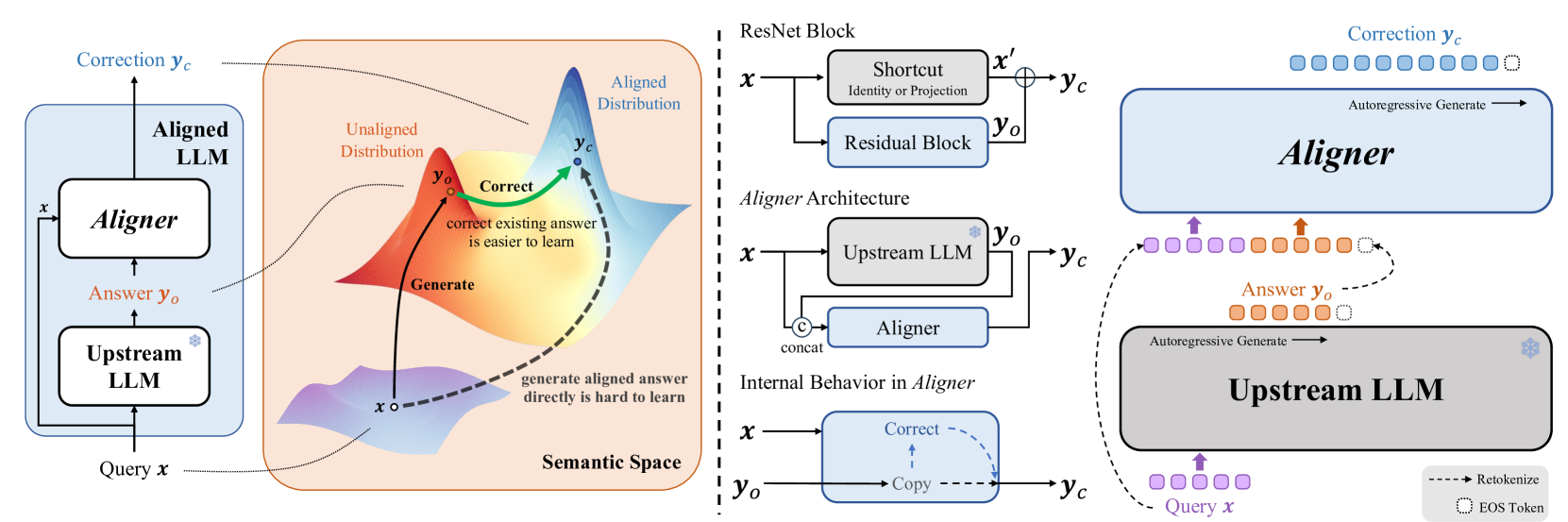
- Aligner通过学习偏好与非偏好答案的修正残差,提供了一种简单有效的对齐方法。
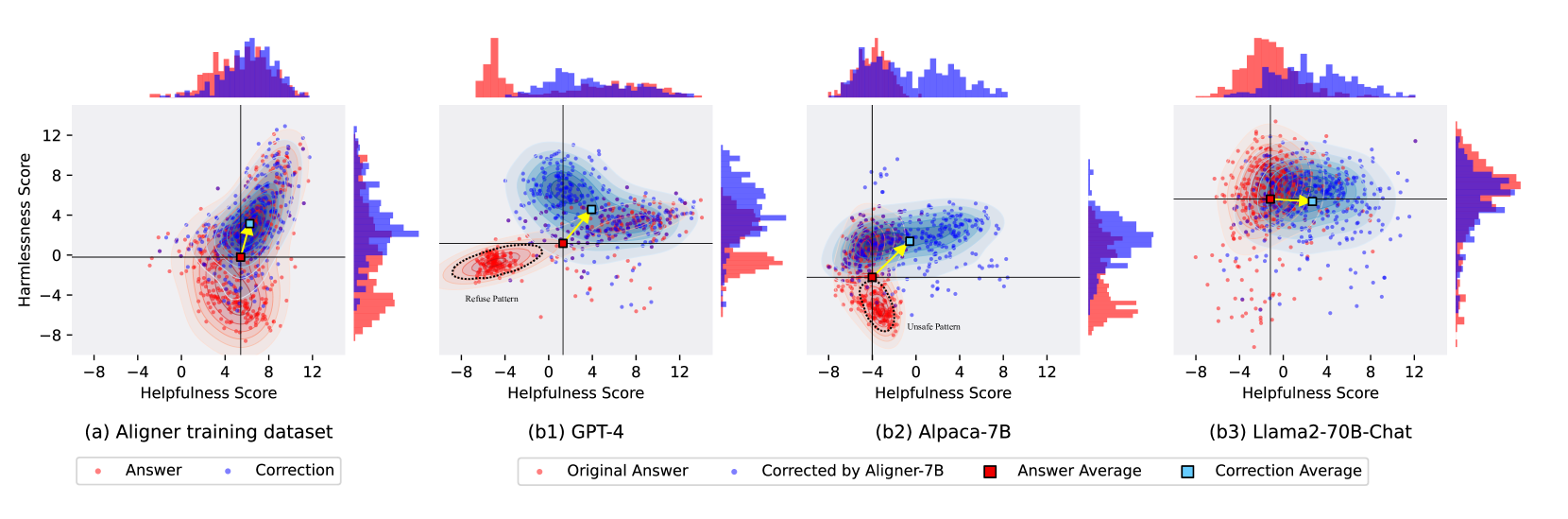
- Aligner-7B在11种LLMs上实现了68.9%的有用性提升和23.8%的无害性提升,显著降低了幻觉现象。
📝 摘要(中文)
随着大语言模型(LLMs)的快速发展,寻找高效的对齐方法变得至关重要。现有方法复杂且迭代速度慢,限制了其在实际场景中的应用。本文提出Aligner,一种新颖且简单的对齐范式,通过学习偏好与非偏好答案之间的修正残差,使用小模型进行对齐。Aligner作为模型无关的模块,能够直接应用于多种开源和API模型,仅需一次训练,适合快速迭代。实验表明,Aligner在11种不同的LLMs上均有性能提升,特别是在有用性和无害性方面,Aligner-7B分别提高了68.9%和23.8%。
🔬 方法详解
问题定义:现有的大语言模型对齐方法复杂,难以快速适应实际应用场景,导致迭代效率低下。
核心思路:Aligner通过学习偏好与非偏好答案之间的修正残差,提供了一种简单且高效的对齐方式,旨在提升模型的响应质量。
技术框架:Aligner设计为一个模型无关的模块,可以直接集成到各种开源和API模型中。其流程包括:首先进行一次性训练,然后在不同模型上应用修正后的响应,最终实现性能提升。
关键创新:Aligner的主要创新在于其模型无关性和简单性,能够在多种大规模模型上快速部署,并通过修正响应迭代提升模型性能,突破性能瓶颈。
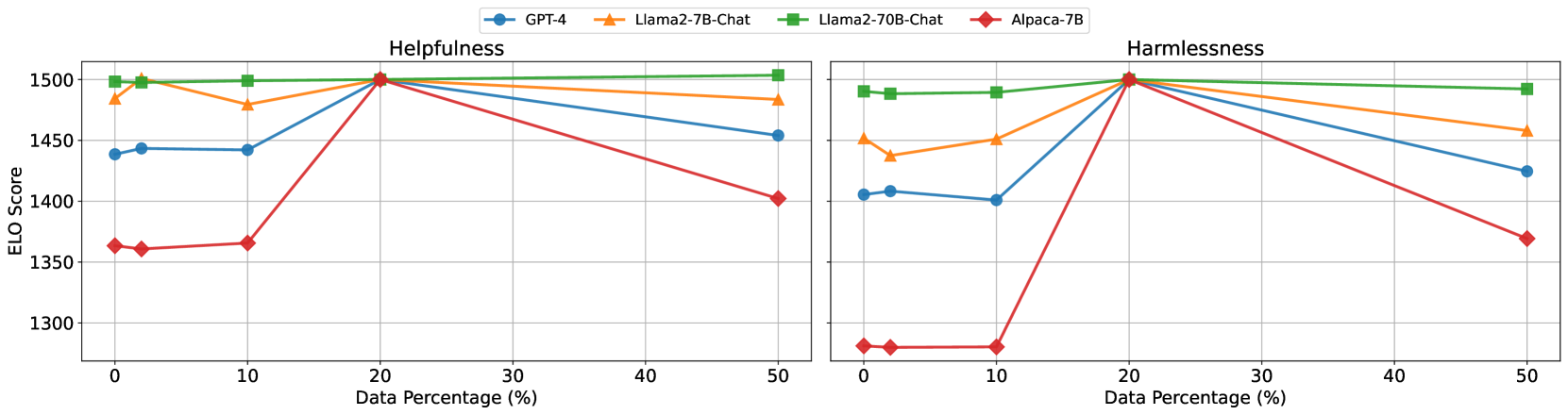
关键设计:Aligner使用小模型进行训练,关键参数设置和损失函数设计旨在优化偏好与非偏好答案的修正残差,确保对齐效果的有效性和稳定性。
🖼️ 关键图片
📊 实验亮点
Aligner在11种不同的LLMs上均表现出色,Aligner-7B在有用性上提升了68.9%,无害性提升了23.8%。在Alpaca-Eval排行榜中,将Aligner-2B叠加在GPT-4 Turbo上,其LC胜率从55.0%提升至58.3%,超越了GPT-4 Omni的57.5%。
🎯 应用场景
Aligner的潜在应用场景包括各种基于大语言模型的对话系统、问答系统和内容生成工具。其高效的对齐能力能够提升用户体验,降低模型的偏见和错误信息传播风险,具有广泛的实际价值和未来影响。
📄 摘要(原文)
With the rapid development of large language models (LLMs) and ever-evolving practical requirements, finding an efficient and effective alignment method has never been more critical. However, the tension between the complexity of current alignment methods and the need for rapid iteration in deployment scenarios necessitates the development of a model-agnostic alignment approach that can operate under these constraints. In this paper, we introduce Aligner, a novel and simple alignment paradigm that learns the correctional residuals between preferred and dispreferred answers using a small model. Designed as a model-agnostic, plug-and-play module, Aligner can be directly applied to various open-source and API-based models with only one-off training, making it suitable for rapid iteration. Notably, Aligner can be applied to any powerful, large-scale upstream models. Moreover, it can even iteratively bootstrap the upstream models using corrected responses as synthetic human preference data, breaking through the model's performance ceiling. Our experiments demonstrate performance improvements by deploying the same Aligner model across 11 different LLMs, evaluated on the 3H dimensions (helpfulness, harmlessness, and honesty). Specifically, Aligner-7B has achieved an average improvement of 68.9% in helpfulness and 23.8% in harmlessness across the tested LLMs while also effectively reducing hallucination. In the Alpaca-Eval leaderboard, stacking Aligner-2B on GPT-4 Turbo improved its LC Win Rate from 55.0% to 58.3%, surpassing GPT-4 Omni's 57.5% Win Rate (community report).