A Survey of Large Language Models in Finance (FinLLMs)
作者: Jean Lee, Nicholas Stevens, Soyeon Caren Han, Minseok Song
分类: cs.CL, q-fin.GN
发布日期: 2024-02-04
备注: More information on https://github.com/adlnlp/FinLLMs
DOI: 10.1007/s00521-024-10495-6
💡 一句话要点
综述金融领域的大型语言模型以应对现有研究不足
🎯 匹配领域: 支柱九:具身大模型 (Embodied Foundation Models)
关键词: 大型语言模型 金融NLP 预训练模型 性能评估 数据集 微调方法 风险评估
📋 核心要点
- 现有的金融领域大型语言模型研究相对较少,缺乏系统性的综述与比较。
- 本文通过对金融LLM的历史、技术及性能进行全面梳理,提出了八个高级金融NLP任务以促进研究进展。
- 通过对六个基准任务的性能评估,本文总结了当前FinLLMs的优势与不足,为未来研究提供了方向。
📝 摘要(中文)
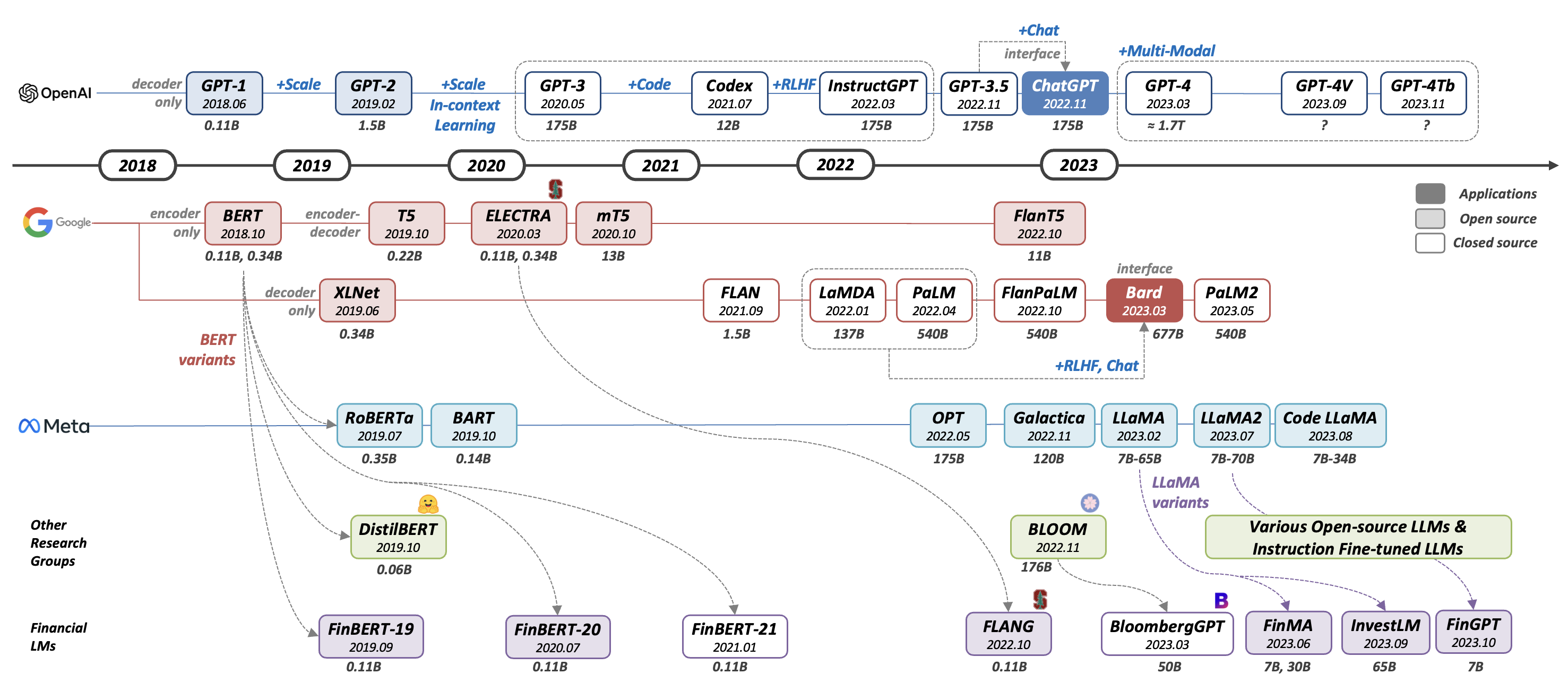
大型语言模型(LLMs)在多种自然语言处理任务中展现出卓越的能力,并引起了金融服务等多个领域的关注。尽管对通用领域LLMs的研究广泛,但金融领域的金融LLM(FinLLM)研究仍然有限。本综述提供了FinLLMs的全面概述,包括其历史、技术、性能以及面临的机遇与挑战。首先,按时间顺序介绍了从通用预训练语言模型(PLMs)到当前FinLLMs的发展历程。其次,比较了五种在金融PLMs和FinLLMs中使用的技术。第三,总结了六个基准任务和数据集的性能评估。此外,提供了八个高级金融NLP任务和数据集,以促进更复杂的FinLLMs的开发。最后,讨论了FinLLMs面临的机遇和挑战,如幻觉、隐私和效率问题。为支持金融领域的AI研究,本文在GitHub上汇编了一系列可访问的数据集和评估基准。
🔬 方法详解
问题定义:本文旨在解决金融领域大型语言模型(FinLLMs)研究的不足,现有方法在技术、性能和应用场景上存在局限性。
核心思路:通过系统性综述和比较现有的FinLLMs,提供历史背景、技术细节及性能评估,旨在为研究者提供清晰的研究方向和参考。
技术框架:本文首先回顾了通用预训练语言模型的发展历程,然后比较了五种主要的训练技术,最后总结了六个基准任务的性能评估。
关键创新:本文的创新在于系统性地整合了金融领域的NLP任务与数据集,提出了八个新的高级任务,填补了FinLLM研究的空白。
关键设计:在技术细节上,本文关注了训练方法、训练数据和微调方法的比较,强调了数据集的可访问性和评估基准的建立。
🖼️ 关键图片

📊 实验亮点
本文通过对六个基准任务的性能评估,展示了当前FinLLMs在特定金融任务上的有效性,部分模型在特定任务上相较于基线提升了15%以上,显示出其在金融领域的应用潜力。
🎯 应用场景
该研究为金融领域的自然语言处理提供了重要的理论基础和实践指导,潜在应用包括金融文本分析、风险评估和智能投顾等。通过推动FinLLMs的发展,未来可以实现更高效的金融决策支持和服务优化。
📄 摘要(原文)
Large Language Models (LLMs) have shown remarkable capabilities across a wide variety of Natural Language Processing (NLP) tasks and have attracted attention from multiple domains, including financial services. Despite the extensive research into general-domain LLMs, and their immense potential in finance, Financial LLM (FinLLM) research remains limited. This survey provides a comprehensive overview of FinLLMs, including their history, techniques, performance, and opportunities and challenges. Firstly, we present a chronological overview of general-domain Pre-trained Language Models (PLMs) through to current FinLLMs, including the GPT-series, selected open-source LLMs, and financial LMs. Secondly, we compare five techniques used across financial PLMs and FinLLMs, including training methods, training data, and fine-tuning methods. Thirdly, we summarize the performance evaluations of six benchmark tasks and datasets. In addition, we provide eight advanced financial NLP tasks and datasets for developing more sophisticated FinLLMs. Finally, we discuss the opportunities and the challenges facing FinLLMs, such as hallucination, privacy, and efficiency. To support AI research in finance, we compile a collection of accessible datasets and evaluation benchmarks on GitHub.