Panacea: Pareto Alignment via Preference Adaptation for LLMs
作者: Yifan Zhong, Chengdong Ma, Xiaoyuan Zhang, Ziran Yang, Haojun Chen, Qingfu Zhang, Siyuan Qi, Yaodong Yang
分类: cs.CL
发布日期: 2024-02-03 (更新: 2024-05-23)
💡 一句话要点
提出Panacea以解决大语言模型对人类偏好的多维对齐问题
🎯 匹配领域: 支柱九:具身大模型 (Embodied Foundation Models)
关键词: 大语言模型 人类偏好 多维对齐 偏好优化 奇异值分解 低秩适应 模型对齐 机器学习
📋 核心要点
- 现有方法通常使用标量偏好标签,无法充分表达人类偏好的多维特性,导致模型对齐效果不佳。
- Panacea将对齐问题视为多维偏好优化,采用SVD基础的低秩适应方法,使模型能够在线适应多样化的偏好。
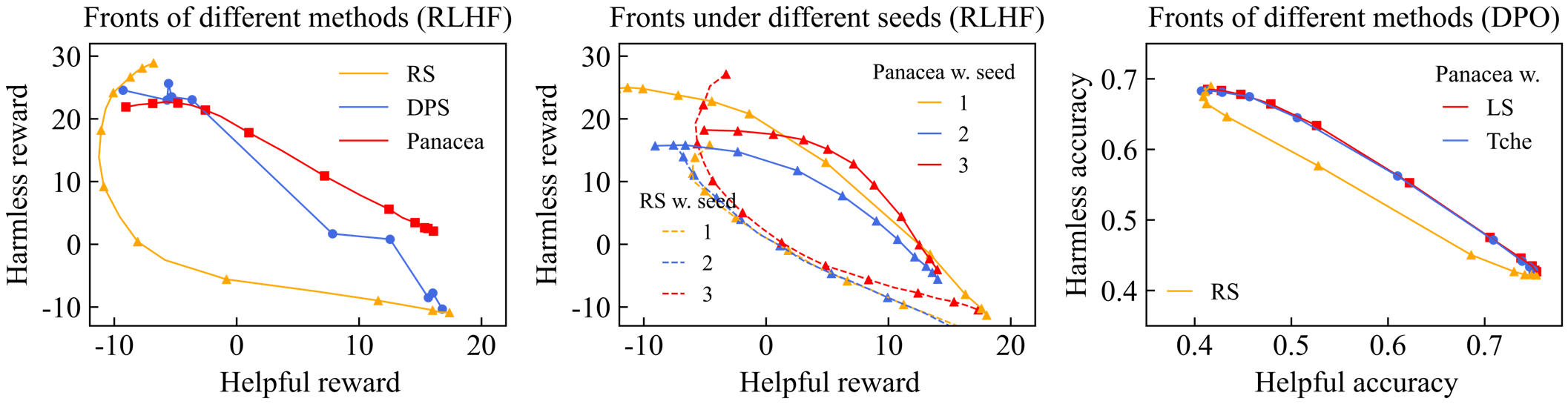
- 实验结果表明,Panacea能够有效对齐单一LLM,覆盖广泛的人类偏好,展示了其在优化方法上的可行性。
📝 摘要(中文)
当前的大语言模型对齐方法通常依赖于标量人类偏好标签,这种做法往往简化了人类偏好的多维和异质特性,导致表达能力降低甚至出现不对齐。本文提出了Panacea,这是一种创新的方法,将对齐问题重新框架为多维偏好优化问题。Panacea训练一个能够在线适应多样偏好的单一模型,且无需进一步调优。通过奇异值分解(SVD)基础的低秩适应,Panacea能够将偏好向量在线注入为奇异值。理论上,我们证明了在温和条件下,Panacea能够恢复整个Pareto前沿。此外,实验首次展示了通过各种优化方法将单一LLM对齐以表示人类偏好的广泛谱系的可行性。
🔬 方法详解
问题定义:现有的大语言模型对齐方法过于依赖标量人类偏好标签,无法有效捕捉偏好的多维性和复杂性,导致模型的表达能力和对齐效果下降。
核心思路:Panacea通过将对齐问题重新定义为多维偏好优化问题,设计了一个能够在线适应多样偏好的单一模型,避免了传统方法中的重复调优过程。
技术框架:整体架构包括一个主模型和一个偏好适应模块,主模型负责生成输出,而偏好适应模块则通过低秩适应技术将偏好向量注入主模型,从而实现对齐。
关键创新:Panacea的主要创新在于使用奇异值分解(SVD)进行低秩适应,使得偏好向量能够以奇异值的形式在线注入,从而有效引导模型行为,这一方法与传统的标量偏好标签方法有本质区别。
关键设计:在参数设置上,Panacea采用了低秩矩阵来表示偏好向量,损失函数设计为能够聚合多种偏好信息,确保模型在多维空间中的优化效果。
🖼️ 关键图片


📊 实验亮点
实验结果显示,Panacea能够有效对齐单一LLM以表示广泛的人类偏好,首次实现了在多种优化方法下的Pareto最优对齐。与基线方法相比,模型在偏好表达的多样性和对齐效果上有显著提升,具体性能数据尚未披露。
🎯 应用场景
该研究的潜在应用领域包括个性化推荐系统、智能助手和人机交互等。通过更好地对齐模型与人类偏好,Panacea能够提升用户体验,增强模型在复杂场景中的适应能力,未来可能在多个行业中产生深远影响。
📄 摘要(原文)
Current methods for large language model alignment typically use scalar human preference labels. However, this convention tends to oversimplify the multi-dimensional and heterogeneous nature of human preferences, leading to reduced expressivity and even misalignment. This paper presents Panacea, an innovative approach that reframes alignment as a multi-dimensional preference optimization problem. Panacea trains a single model capable of adapting online and Pareto-optimally to diverse sets of preferences without the need for further tuning. A major challenge here is using a low-dimensional preference vector to guide the model's behavior, despite it being governed by an overwhelmingly large number of parameters. To address this, Panacea is designed to use singular value decomposition (SVD)-based low-rank adaptation, which allows the preference vector to be simply injected online as singular values. Theoretically, we prove that Panacea recovers the entire Pareto front with common loss aggregation methods under mild conditions. Moreover, our experiments demonstrate, for the first time, the feasibility of aligning a single LLM to represent an exponentially vast spectrum of human preferences through various optimization methods. Our work marks a step forward in effectively and efficiently aligning models to diverse and intricate human preferences in a controllable and Pareto-optimal manner.