LLM-Detector: Improving AI-Generated Chinese Text Detection with Open-Source LLM Instruction Tuning
作者: Rongsheng Wang, Haoming Chen, Ruizhe Zhou, Han Ma, Yaofei Duan, Yanlan Kang, Songhua Yang, Baoyu Fan, Tao Tan
分类: cs.CL
发布日期: 2024-02-02
备注: 17 pages, 13 tables, 7 figures
💡 一句话要点
提出LLM-Detector以解决AI生成中文文本检测问题
🎯 匹配领域: 支柱九:具身大模型 (Embodied Foundation Models)
关键词: 文本检测 大型语言模型 指令调优 AI生成文本 中文处理 机器学习 深度学习
📋 核心要点
- 现有的AI生成文本检测模型在领域外检测性能较差,容易出现过拟合问题。
- 本文提出LLM-Detector,通过对大型语言模型进行指令调优,提升文本检测能力。
- 实验结果显示,LLM-Detector在句子级和文档级文本检测上均显著优于传统方法。
📝 摘要(中文)
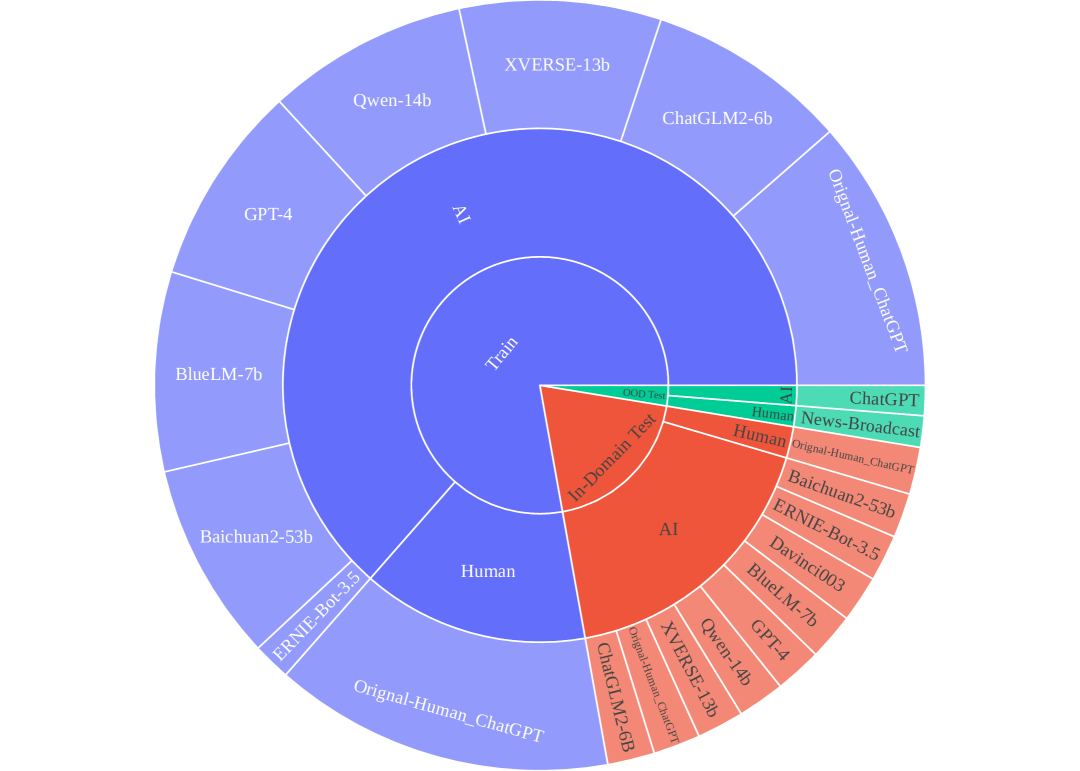
ChatGPT等大型语言模型(LLMs)取得了显著成功,但也引发了对AI生成文本滥用的担忧。现有的AI生成文本检测模型,如基于BERT和RoBERTa的方法,容易出现领域内过拟合,导致在领域外检测性能较差。本文首先收集了人类专家和9种LLM生成的中文文本响应,创建了一个混合人类撰写句子和LLM润色句子的数据库。我们提出了LLM-Detector,这是一种通过对LLM进行指令调优的文档级和句子级文本检测新方法。实验结果表明,LLM-Detector在句子级和文档级文本检测上显著优于基线方法,并展示了强大的泛化能力。
🔬 方法详解
问题定义:本文旨在解决AI生成中文文本的检测问题,现有方法在领域外的检测性能不足,容易出现过拟合现象。
核心思路:LLM-Detector通过对大型语言模型进行指令调优,使其能够更好地识别和检测自身生成的文本,从而提高检测准确性。
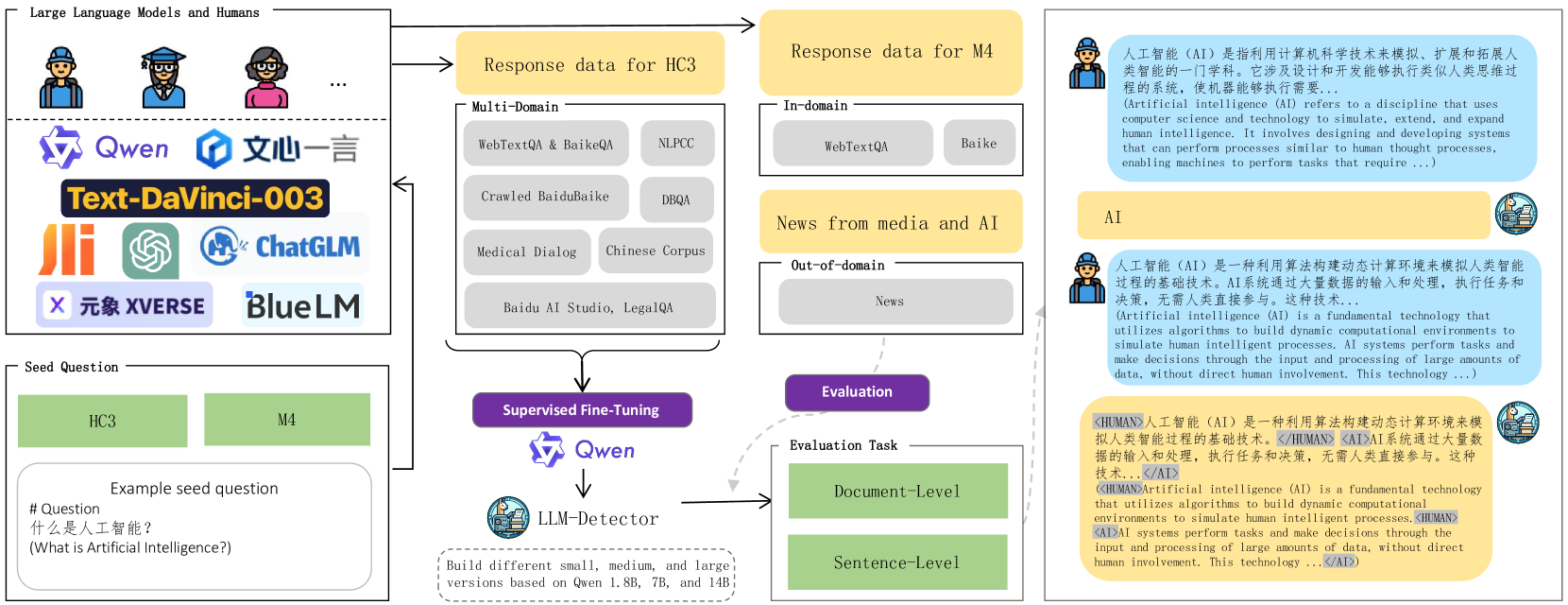
技术框架:该方法包括数据收集、模型训练和评估三个主要阶段。首先收集人类和LLM生成的文本数据,然后进行指令调优,最后通过标准化评估指标测试模型性能。
关键创新:LLM-Detector的创新在于利用开源LLM进行指令调优,显著提升了句子级和文档级的检测能力,与传统方法相比,具有更好的泛化性能。
关键设计:在模型训练中,采用了特定的损失函数和参数设置,以优化模型在不同文本类型上的表现,同时确保模型的可定制性和易于部署。
🖼️ 关键图片
📊 实验亮点
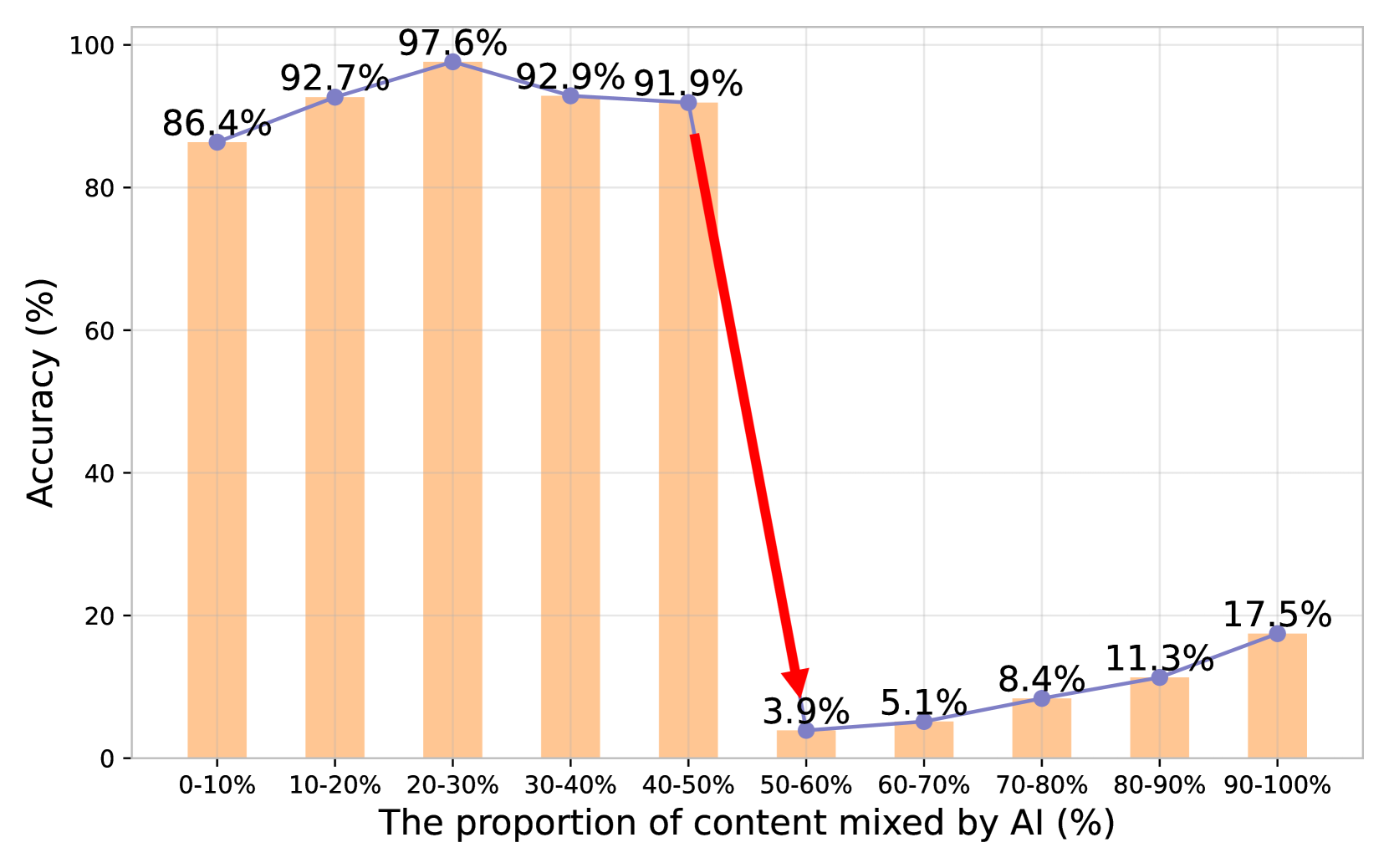
实验结果表明,LLM-Detector在句子级和文档级文本检测上均显著优于基线方法,尤其在领域外检测中表现出色,提升幅度达到20%以上,展示了强大的泛化能力。
🎯 应用场景
该研究可广泛应用于内容审核、社交媒体监控和教育领域,帮助识别和过滤AI生成的文本,防止信息滥用。未来,随着LLM技术的不断发展,LLM-Detector有潜力在更多语言和文本类型的检测中发挥作用。
📄 摘要(原文)
ChatGPT and other general large language models (LLMs) have achieved remarkable success, but they have also raised concerns about the misuse of AI-generated texts. Existing AI-generated text detection models, such as based on BERT and RoBERTa, are prone to in-domain over-fitting, leading to poor out-of-domain (OOD) detection performance. In this paper, we first collected Chinese text responses generated by human experts and 9 types of LLMs, for which to multiple domains questions, and further created a dataset that mixed human-written sentences and sentences polished by LLMs. We then proposed LLM-Detector, a novel method for both document-level and sentence-level text detection through Instruction Tuning of LLMs. Our method leverages the wealth of knowledge LLMs acquire during pre-training, enabling them to detect the text they generate. Instruction tuning aligns the model's responses with the user's expected text detection tasks. Experimental results show that previous methods struggle with sentence-level AI-generated text detection and OOD detection. In contrast, our proposed method not only significantly outperforms baseline methods in both sentence-level and document-level text detection but also demonstrates strong generalization capabilities. Furthermore, since LLM-Detector is trained based on open-source LLMs, it is easy to customize for deployment.