Evaluating Large Language Models for Generalization and Robustness via Data Compression
作者: Yucheng Li, Yunhao Guo, Frank Guerin, Chenghua Lin
分类: cs.CL, cs.AI
发布日期: 2024-02-01 (更新: 2024-02-04)
💡 一句话要点
提出无损数据压缩评估方法以解决大语言模型的泛化与鲁棒性问题
🎯 匹配领域: 支柱九:具身大模型 (Embodied Foundation Models)
关键词: 大语言模型 数据压缩 泛化能力 鲁棒性 评估方法 机器学习 自然语言处理
📋 核心要点
- 现有评估方法存在数据污染、对提示敏感和基准创建成本高等问题,影响模型性能的准确评估。
- 本文提出了一种无损数据压缩的评估方法,通过压缩性能来衡量模型在未见数据上的泛化能力。
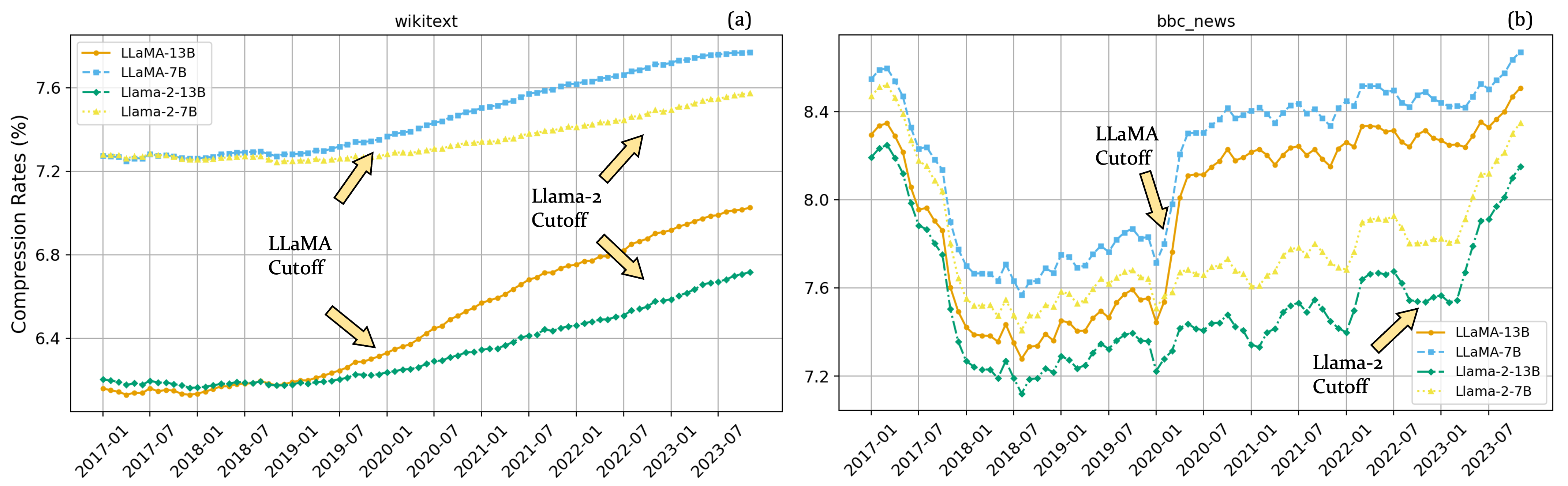
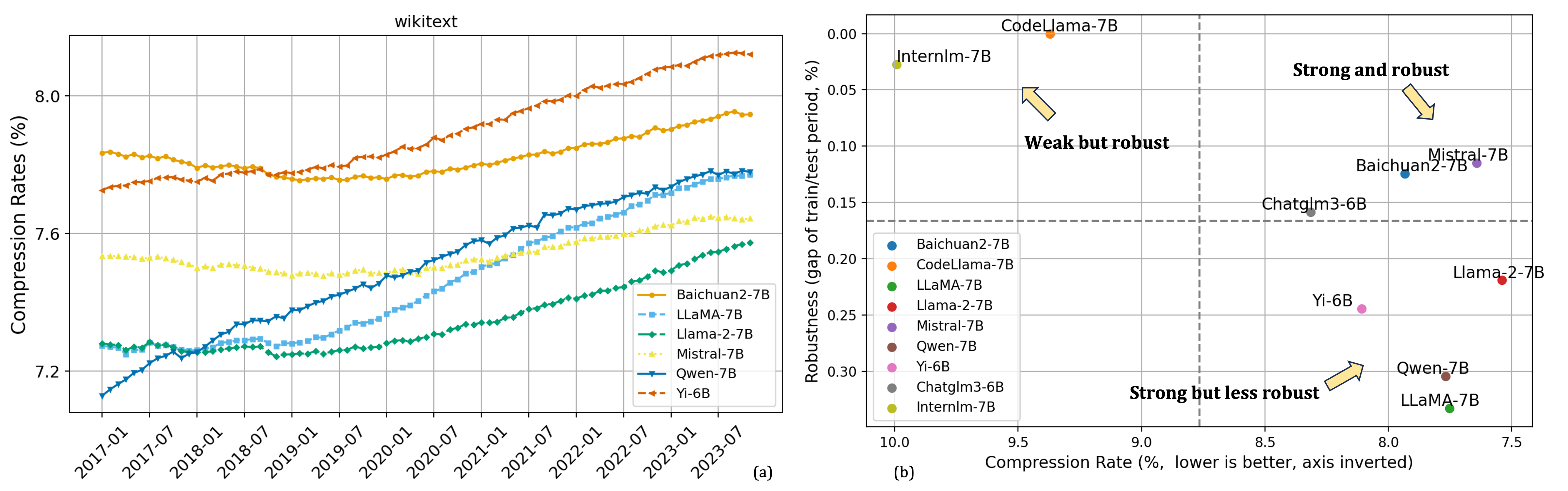
- 实验结果表明,许多模型在截止日期后压缩率显著降低,Mistral和Llama-2在性能与鲁棒性上表现较好。
📝 摘要(中文)
现有的大语言模型评估方法面临数据污染、对提示敏感以及基准创建成本高等挑战。为此,本文提出了一种基于无损数据压缩的评估方法,测试模型在训练截止后的预测能力泛化。我们收集了2017至2023年间的综合测试数据,并根据模型的训练数据截止日期将数据分为训练和测试阶段。我们测量了测试阶段的压缩性能作为对未见数据的泛化度量,以及训练和测试阶段之间的性能差距作为鲁棒性度量。实验测试了14种不同规模的大语言模型,结果显示许多模型在截止日期后压缩率显著降低,但如Mistral和Llama-2等模型在性能与鲁棒性之间表现出良好的平衡。
🔬 方法详解
问题定义:本文旨在解决现有大语言模型评估方法面临的数据污染、提示敏感性和高成本等问题。这些问题导致模型的真实性能难以准确评估。
核心思路:论文提出了一种基于无损数据压缩的评估方法,通过分析模型在训练截止后对未见数据的压缩性能,来评估其泛化能力和鲁棒性。
技术框架:整体流程包括数据收集、数据分割、模型训练和测试、压缩性能测量等主要模块。我们收集了2017至2023年的数据,并根据模型的训练截止日期将数据分为训练和测试阶段。
关键创新:最重要的创新在于利用无损数据压缩作为评估指标,提供了一种新的视角来衡量模型的泛化能力和鲁棒性。这与传统的基于准确率或损失的评估方法有本质区别。
关键设计:在实验中,我们测试了14种不同规模的模型,关注上下文大小和分词实现对压缩性能的影响,确保评估的全面性和准确性。
🖼️ 关键图片
📊 实验亮点
实验结果显示,许多模型在训练截止后压缩率显著降低,尤其是在新闻和代码数据上表现不佳,而在arXiv论文上表现良好。Mistral和Llama-2模型在性能与鲁棒性之间取得了良好的平衡,展示了其在实际应用中的潜力。
🎯 应用场景
该研究的潜在应用领域包括自然语言处理、机器翻译和信息检索等。通过提供一种新的评估方法,可以帮助研究人员和工程师更好地理解和改进大语言模型的性能,推动相关技术的进步与应用。
📄 摘要(原文)
Existing methods for evaluating large language models face challenges such as data contamination, sensitivity to prompts, and the high cost of benchmark creation. To address this, we propose a lossless data compression based evaluation approach that tests how models' predictive abilities generalize after their training cutoff. Specifically, we collect comprehensive test data spanning 83 months from 2017 to 2023 and split the data into training and testing periods according to models' training data cutoff. We measure: 1) the compression performance on the testing period as a measure of generalization on unseen data; and 2) the performance gap between the training and testing period as a measure of robustness. Our experiments test 14 representative large language models with various sizes on sources including Wikipedia, news articles, code, arXiv papers, and multi-modal data. We find that the compression rate of many models reduces significantly after their cutoff date, but models such as Mistral and Llama-2 demonstrate a good balance between performance and robustness. Results also suggest that models struggle to generalize on news and code data, but work especially well on arXiv papers. We also find the context size and tokenization implementation have a big impact of on the overall compression performance.