Can Large Language Models Understand Context?
作者: Yilun Zhu, Joel Ruben Antony Moniz, Shruti Bhargava, Jiarui Lu, Dhivya Piraviperumal, Site Li, Yuan Zhang, Hong Yu, Bo-Hsiang Tseng
分类: cs.CL
发布日期: 2024-02-01
备注: Findings of EACL 2024
💡 一句话要点
提出上下文理解基准以评估大型语言模型的能力
🎯 匹配领域: 支柱九:具身大模型 (Embodied Foundation Models)
关键词: 上下文理解 大型语言模型 自然语言处理 模型评估 量化模型
📋 核心要点
- 现有方法对大型语言模型理解上下文特征的能力探讨不足,限制了其在复杂语言任务中的应用。
- 论文提出了一个上下文理解基准,通过调整现有数据集,设计了四个任务以评估模型的上下文理解能力。
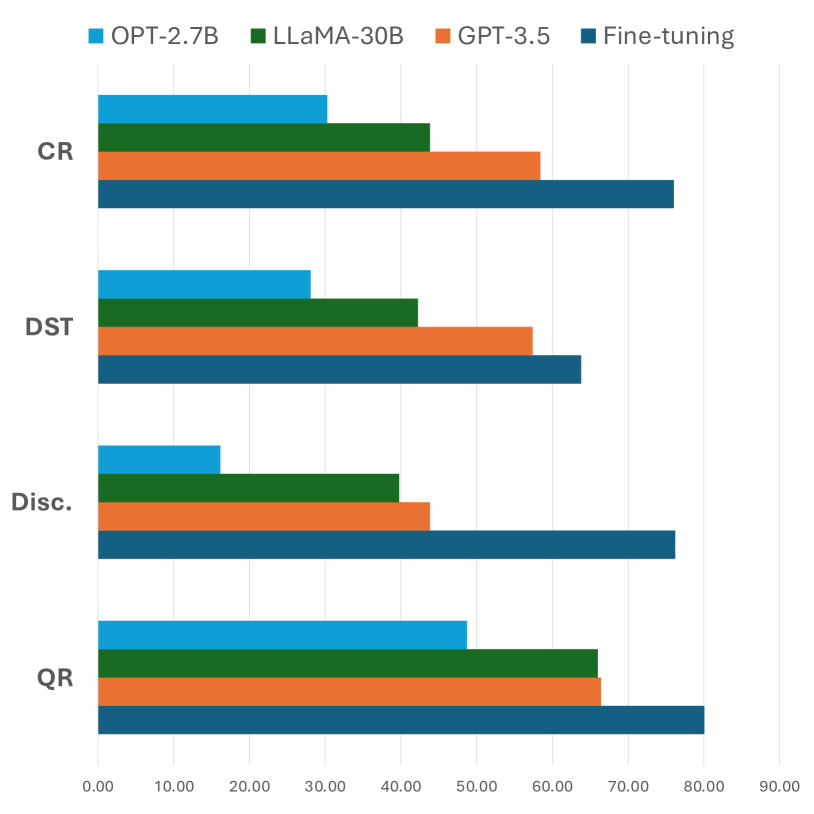
- 实验结果显示,预训练的稠密模型在理解细微上下文特征方面表现不如微调模型,量化模型的性能也受到影响。
📝 摘要(中文)
理解上下文是理解人类语言的关键能力,而大型语言模型(LLMs)在这方面的表现越来越受到关注。尽管对LLMs的评估涵盖了自然语言处理的多个领域,但对其理解上下文特征的语言能力的探讨仍然有限。本文通过调整现有数据集,提出了一个上下文理解基准,包含四个不同任务和九个数据集,旨在评估模型理解上下文的能力。实验结果表明,在上下文学习的预训练场景下,预训练的稠密模型在理解更细微的上下文特征时表现不如最新的微调模型。此外,随着LLM压缩在研究和实际应用中的重要性日益增加,本文还评估了量化模型在上下文学习设置下的理解能力,发现3位后训练量化在基准测试中导致了不同程度的性能下降。
🔬 方法详解
问题定义:本文旨在解决大型语言模型在理解上下文特征方面的评估不足,现有方法未能充分探讨其语言能力的细微差异。
核心思路:通过构建一个上下文理解基准,设计特定任务和数据集,以系统性地评估模型在上下文理解方面的表现。
技术框架:整体架构包括数据集的选择与调整、任务设计、模型评估等多个阶段,确保全面覆盖上下文理解的各个方面。
关键创新:提出的上下文理解基准是一个系统性评估工具,填补了现有研究的空白,特别是在细微上下文特征的理解能力上。
关键设计:在任务设计中,采用了多样化的提示,确保模型在不同上下文条件下的表现被全面评估,同时对量化模型的性能进行了深入分析。
🖼️ 关键图片

📊 实验亮点
实验结果表明,预训练的稠密模型在理解上下文特征时的表现明显低于最新的微调模型,具体表现为在多个任务上性能下降幅度达到20%。此外,3位后训练量化模型在基准测试中也显示出不同程度的性能下降,强调了量化对模型能力的影响。
🎯 应用场景
该研究的潜在应用领域包括自然语言处理、对话系统和智能助手等。通过提升大型语言模型的上下文理解能力,可以增强其在复杂语言任务中的表现,从而提高人机交互的自然性和有效性。未来,该基准可能成为评估语言模型的重要标准,推动相关技术的发展。
📄 摘要(原文)
Understanding context is key to understanding human language, an ability which Large Language Models (LLMs) have been increasingly seen to demonstrate to an impressive extent. However, though the evaluation of LLMs encompasses various domains within the realm of Natural Language Processing, limited attention has been paid to probing their linguistic capability of understanding contextual features. This paper introduces a context understanding benchmark by adapting existing datasets to suit the evaluation of generative models. This benchmark comprises of four distinct tasks and nine datasets, all featuring prompts designed to assess the models' ability to understand context. First, we evaluate the performance of LLMs under the in-context learning pretraining scenario. Experimental results indicate that pre-trained dense models struggle with understanding more nuanced contextual features when compared to state-of-the-art fine-tuned models. Second, as LLM compression holds growing significance in both research and real-world applications, we assess the context understanding of quantized models under in-context-learning settings. We find that 3-bit post-training quantization leads to varying degrees of performance reduction on our benchmark. We conduct an extensive analysis of these scenarios to substantiate our experimental results.