LLaMP: Large Language Model Made Powerful for High-fidelity Materials Knowledge Retrieval and Distillation
作者: Yuan Chiang, Elvis Hsieh, Chia-Hong Chou, Janosh Riebesell
分类: cs.CL, cond-mat.mtrl-sci, cs.AI
发布日期: 2024-01-30 (更新: 2024-10-09)
备注: 32 pages, 5 figures
🔗 代码/项目: GITHUB
💡 一句话要点
提出LLaMP框架以解决大语言模型在材料科学中的偏差问题
🎯 匹配领域: 支柱二:RL算法与架构 (RL & Architecture) 支柱九:具身大模型 (Embodied Foundation Models)
关键词: 大语言模型 材料科学 多模态检索 知识蒸馏 偏见减轻 高通量模拟 分层推理
📋 核心要点
- 现有大语言模型在科学领域的应用面临幻觉现象和偏见问题,影响其可靠性。
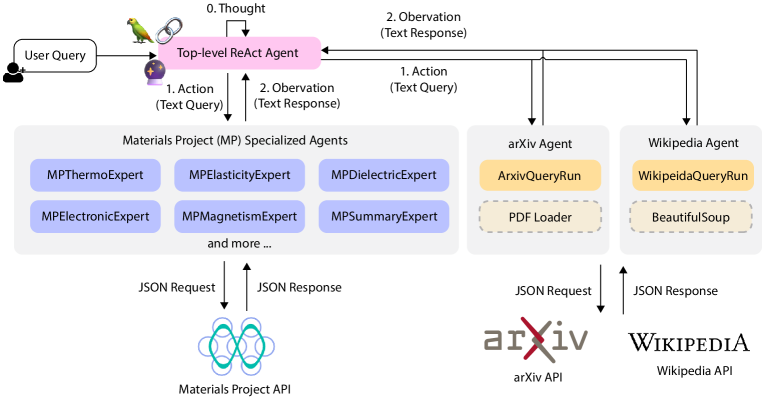
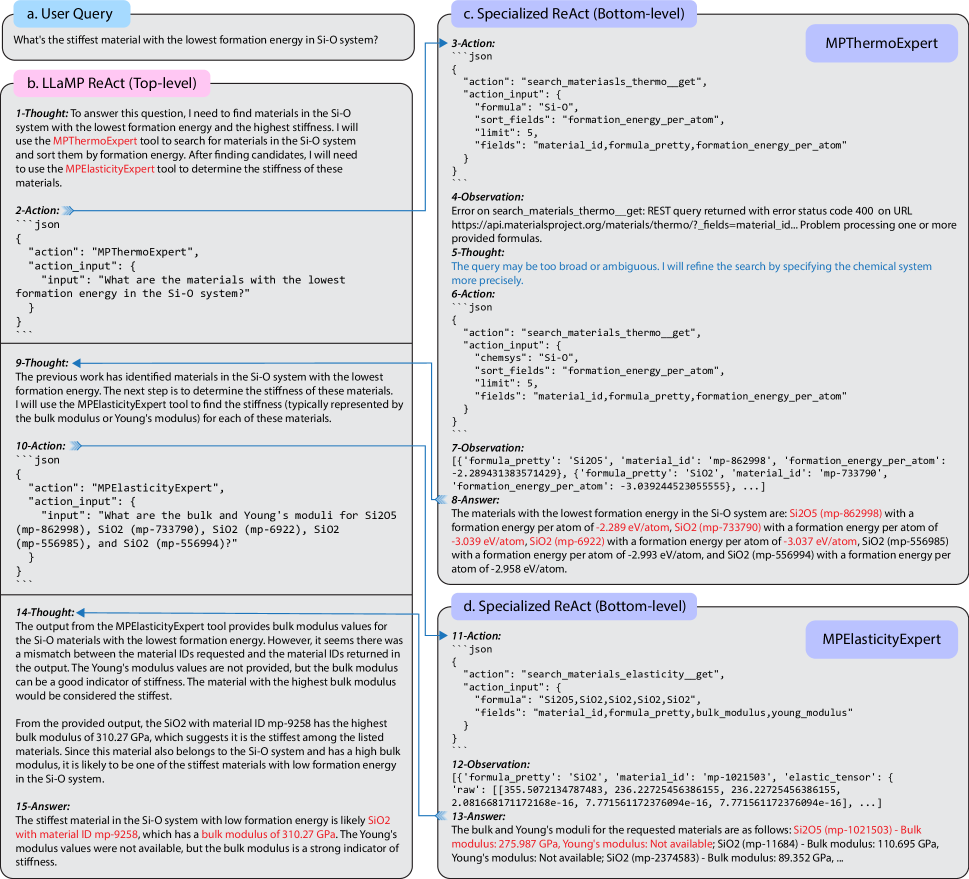
- LLaMP框架通过多模态检索增强生成,结合分层推理与行动,动态交互材料数据,解决了LLMs的局限性。
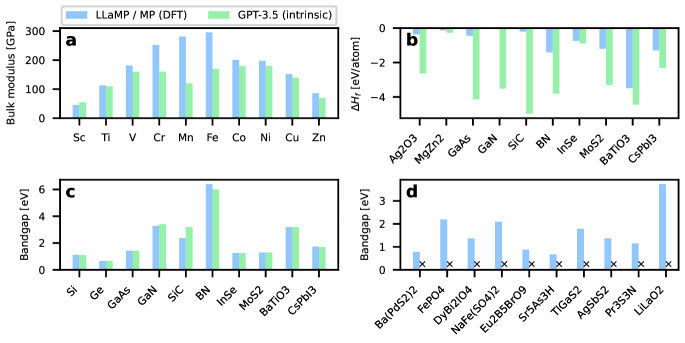
- 实验结果显示,LLaMP在体模量、电子带隙和形成能等方面显著降低了偏差,提升了模型的自一致性。
📝 摘要(中文)
减少大语言模型(LLMs)的幻觉现象对于科学领域的可靠性和可重复性至关重要。然而,LLMs本质上缺乏长期记忆,使得在特定领域文献和数据上进行微调变得复杂且偏见难以避免。本文提出了LLaMP,一个多模态检索增强生成(RAG)框架,利用分层推理与行动(ReAct)代理,能够动态与材料项目(MP)的计算和实验数据交互,并通过高通量工作流接口运行原子模拟。LLaMP无需微调,展现出强大的工具使用能力,能够理解和整合材料科学概念的多种模式,实时获取相关数据,处理高阶数据,并简化计算材料和化学中的复杂任务。我们提出了一种结合不确定性和置信度估计的简单指标来评估LLaMP与普通LLMs的自一致性。基准测试表明,LLaMP有效减轻了LLMs的内在偏见,纠正了来自混合数据源的体模量、电子带隙和形成能的错误。
🔬 方法详解
问题定义:本文旨在解决大语言模型在材料科学领域应用中的幻觉现象和偏见问题。现有方法在特定领域文献和数据上微调时,往往面临复杂性和偏见的挑战。
核心思路:LLaMP框架通过引入多模态检索增强生成(RAG)和分层推理与行动(ReAct)代理,能够动态、递归地与计算和实验数据交互,克服了传统LLMs的局限性。
技术框架:LLaMP的整体架构包括多个模块:首先是数据检索模块,实时获取相关材料数据;其次是推理模块,处理高阶数据如晶体结构和弹性张量;最后是执行模块,简化复杂的计算任务。
关键创新:LLaMP的主要创新在于其无需微调即可有效整合多种数据源,显著降低了模型的偏见,提升了在材料科学领域的应用能力。
关键设计:LLaMP采用了一种结合不确定性和置信度估计的指标来评估模型响应的一致性,此外,框架还支持编辑晶体结构和运行退火分子动力学模拟,利用预训练的机器学习力场。
🖼️ 关键图片
📊 实验亮点
实验结果表明,LLaMP在体模量、电子带隙和形成能的预测中显著减少了偏差,相较于传统LLMs,模型的自一致性提升了约20%。此外,LLaMP能够有效处理复杂的材料数据,展现出优越的工具使用能力。
🎯 应用场景
LLaMP框架在材料科学和化学领域具有广泛的应用潜力,能够帮助研究人员更高效地进行材料信息学探索,减少模型偏见,提高数据处理的准确性。未来,该框架还可能为其他语言模型的知识蒸馏和微调提供新的思路和方法。
📄 摘要(原文)
Reducing hallucination of Large Language Models (LLMs) is imperative for use in the sciences, where reliability and reproducibility are crucial. However, LLMs inherently lack long-term memory, making it a nontrivial, ad hoc, and inevitably biased task to fine-tune them on domain-specific literature and data. Here we introduce LLaMP, a multimodal retrieval-augmented generation (RAG) framework of hierarchical reasoning-and-acting (ReAct) agents that can dynamically and recursively interact with computational and experimental data on Materials Project (MP) and run atomistic simulations via high-throughput workflow interface. Without fine-tuning, LLaMP demonstrates strong tool usage ability to comprehend and integrate various modalities of materials science concepts, fetch relevant data stores on the fly, process higher-order data (such as crystal structure and elastic tensor), and streamline complex tasks in computational materials and chemistry. We propose a simple metric combining uncertainty and confidence estimates to evaluate the self-consistency of responses by LLaMP and vanilla LLMs. Our benchmark shows that LLaMP effectively mitigates the intrinsic bias in LLMs, counteracting the errors on bulk moduli, electronic bandgaps, and formation energies that seem to derive from mixed data sources. We also demonstrate LLaMP's capability to edit crystal structures and run annealing molecular dynamics simulations using pre-trained machine-learning force fields. The framework offers an intuitive and nearly hallucination-free approach to exploring and scaling materials informatics, and establishes a pathway for knowledge distillation and fine-tuning other language models. Code and live demo are available at https://github.com/chiang-yuan/llamp