LegalDuet: Learning Fine-grained Representations for Legal Judgment Prediction via a Dual-View Contrastive Learning
作者: Buqiang Xu, Xin Dai, Zhenghao Liu, Huiyuan Xie, Xiaoyuan Yi, Shuo Wang, Yukun Yan, Liner Yang, Yu Gu, Ge Yu
分类: cs.CL
发布日期: 2024-01-27 (更新: 2025-05-01)
🔗 代码/项目: GITHUB
💡 一句话要点
提出LegalDuet以解决法律判决预测中的细微差异识别问题
🎯 匹配领域: 支柱二:RL算法与架构 (RL & Architecture)
关键词: 法律判决预测 对比学习 语言模型 嵌入空间 刑事案件 深度学习 人工智能
📋 核心要点
- 现有法律判决预测模型主要关注识别法律触发因素,未能有效区分判决之间的细微差异,导致预测准确性不足。
- 本文提出LegalDuet,通过双视角机制持续预训练语言模型,旨在学习更为精细的法律案件嵌入空间。
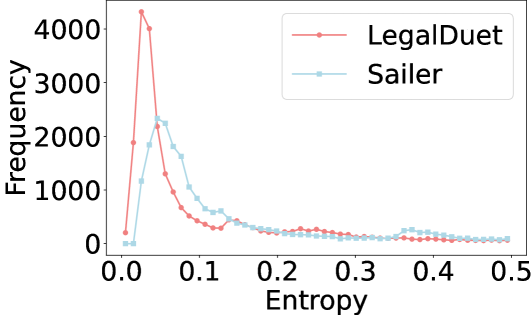
- 在CAIL2018数据集上的实验表明,LegalDuet提高了模型对混淆刑事指控的区分能力,减少了预测的不确定性。
📝 摘要(中文)
法律判决预测(LJP)是法律人工智能的基本任务,旨在自动预测法律案件的判决结果。现有的LJP模型主要集中在通过对比训练语言模型识别刑事事实描述中的法律触发因素,但忽略了有效区分判决之间细微差异的重要性。本文提出LegalDuet,通过设计双视角机制,持续预训练语言模型,以学习更为精细的法律案件嵌入空间。实验结果表明,LegalDuet显著提高了模型区分混淆刑事指控的能力,减少了预测不确定性,并增强了刑事指控的可分性。
🔬 方法详解
问题定义:本文旨在解决法律判决预测中对判决细微差异的识别不足的问题。现有方法主要依赖于对比训练,未能充分利用法律案件之间的相似性和差异性。
核心思路:LegalDuet通过双视角机制进行持续预训练,旨在构建一个更为精细的嵌入空间,以便更好地表示法律案件并区分判决。
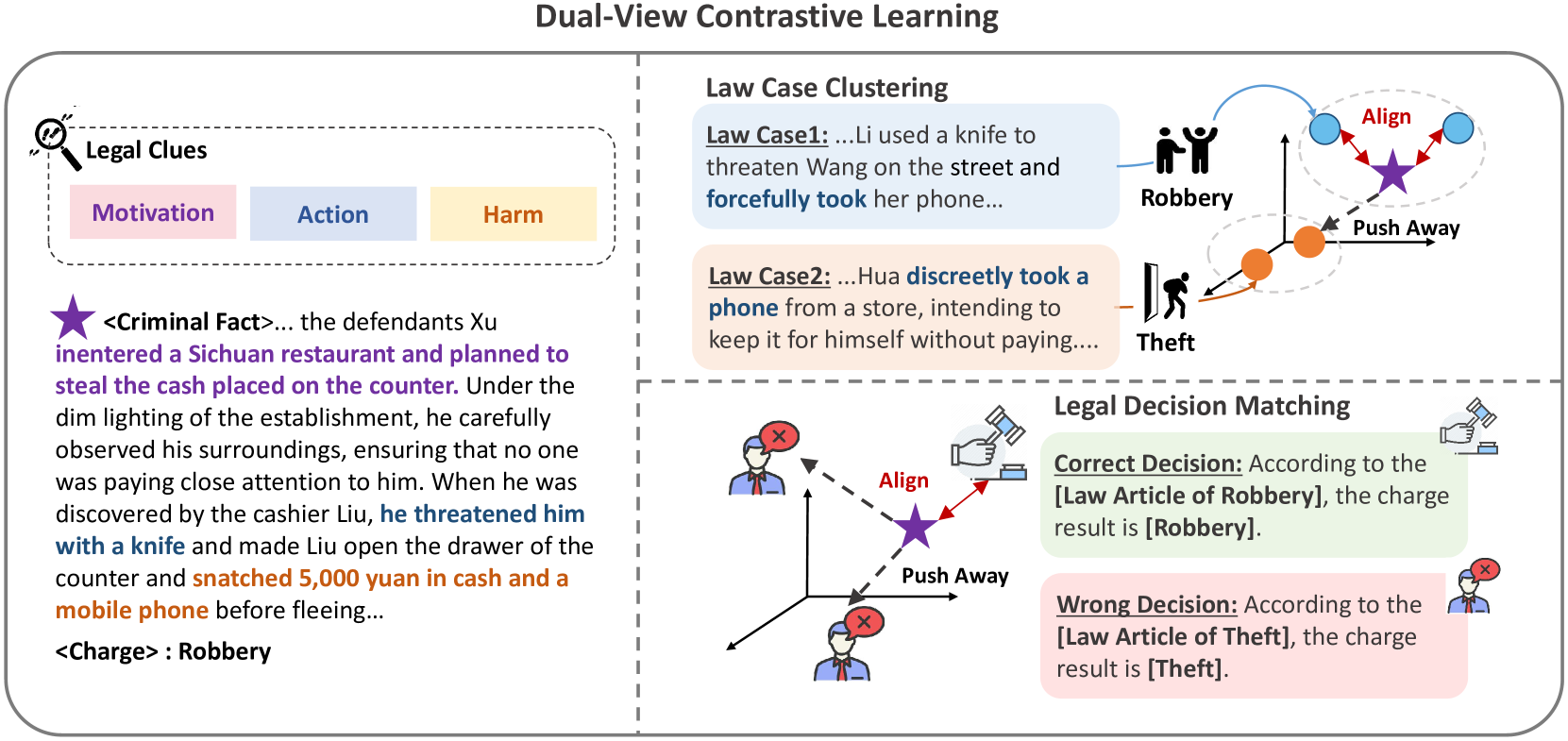
技术框架:该方法包括两个主要模块:法律案件聚类(Law Case Clustering)和法律决策匹配(Legal Decision Matching)。前者通过检索相似案件作为困难负样本,进行对比训练;后者则识别刑事事实描述中的法律线索,并将其与正确的法律决策推理链对齐。
关键创新:LegalDuet的创新在于其双视角机制,能够有效地将相似案件作为负样本进行对比训练,从而提升模型对混淆案件的区分能力。这一设计与传统方法的单一视角训练形成鲜明对比。
关键设计:在模型训练中,采用了特定的损失函数以增强判决之间的可分性,并通过精细的参数设置优化嵌入空间的结构。
🖼️ 关键图片

📊 实验亮点
实验结果显示,LegalDuet在CAIL2018数据集上显著提高了模型的性能,相较于基线模型,减少了预测不确定性,并增强了刑事指控的可分性,证明了其在法律判决预测中的有效性。
🎯 应用场景
该研究的潜在应用领域包括法律咨询、智能法庭系统和法律文书自动生成等。通过提高法律判决预测的准确性,LegalDuet能够为法律从业者提供更为可靠的决策支持,进而提升法律服务的效率和质量。
📄 摘要(原文)
Legal Judgment Prediction (LJP) is a fundamental task of legal artificial intelligence, aiming to automatically predict the judgment outcomes of legal cases. Existing LJP models primarily focus on identifying legal triggers within criminal fact descriptions by contrastively training language models. However, these LJP models overlook the importance of learning to effectively distinguish subtle differences among judgments, which is crucial for producing more accurate predictions. In this paper, we propose LegalDuet, which continuously pretrains language models to learn a more tailored embedding space for representing legal cases. Specifically, LegalDuet designs a dual-view mechanism to continuously pretrain language models: 1) Law Case Clustering retrieves similar cases as hard negatives and employs contrastive training to differentiate among confusing cases; 2) Legal Decision Matching aims to identify legal clues within criminal fact descriptions to align them with the chain of reasoning that contains the correct legal decision. Our experiments on the CAIL2018 dataset demonstrate the effectiveness of LegalDuet. Further analysis reveals that LegalDuet improves the ability of pretrained language models to distinguish confusing criminal charges by reducing prediction uncertainty and enhancing the separability of criminal charges. The experiments demonstrate that LegalDuet produces a more concentrated and distinguishable embedding space, effectively aligning criminal facts with corresponding legal decisions. The code is available at https://github.com/NEUIR/LegalDuet.