Transformer-Based Models Are Not Yet Perfect At Learning to Emulate Structural Recursion
作者: Dylan Zhang, Curt Tigges, Zory Zhang, Stella Biderman, Maxim Raginsky, Talia Ringer
分类: cs.CL, cs.AI, cs.FL, cs.LO, cs.PL
发布日期: 2024-01-23
备注: arXiv admin note: text overlap with arXiv:2305.14699
💡 一句话要点
提出框架以解决变换器模型学习结构递归的不足
🎯 匹配领域: 支柱九:具身大模型 (Embodied Foundation Models)
关键词: 结构递归 变换器模型 序列建模 编程语言 人工智能 语义理解 模型训练
📋 核心要点
- 现有的基于变换器的模型在学习结构递归时存在显著不足,无法有效捕捉递归的复杂性。
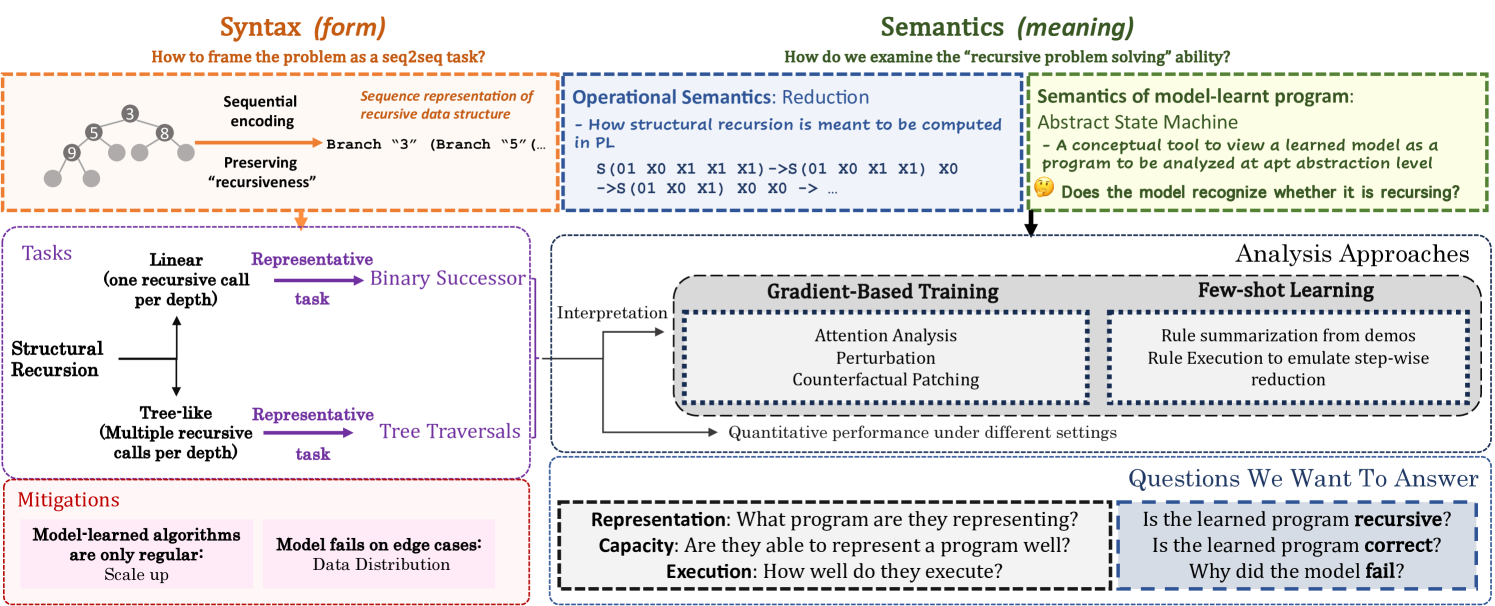
- 论文提出了一个通用框架,将结构递归的抽象概念与序列建模问题相结合,帮助理解模型行为。
- 研究表明,训练的模型倾向于拟合简化算法,无法解决训练分布中未充分代表的边缘案例。
📝 摘要(中文)
本文研究了基于变换器的模型在从示例中学习结构递归的能力。递归是自然语言和形式语言中的普遍概念,结构递归在编程语言和形式数学任务中至关重要。我们提出了一个通用框架,将编程语言领域的结构递归抽象概念与具体的序列建模问题及学习模型的行为连接起来。该框架包括捕捉结构递归一般语法的表示,结合了两种理解其语义的不同框架。通过该框架,我们识别了在不同设置下的各种问题,发现训练模型无法完全捕捉递归,且在处理某些边缘案例时表现不佳。与此同时,当前的大型语言模型在从上下文示例中提取递归规则时也面临困难。
🔬 方法详解
问题定义:本文旨在解决基于变换器的模型在学习结构递归时的局限性,现有方法无法有效捕捉递归的复杂性,导致在特定情况下表现不佳。
核心思路:通过引入一个通用框架,将结构递归的抽象概念与具体的序列建模问题相连接,帮助理解模型的语法和语义,从而提升模型的学习能力。
技术框架:该框架包括捕捉结构递归语法的表示,结合两种理解语义的方式:一种是从编程语言的角度出发,另一种是与变换器架构的机制理解相结合。
关键创新:最重要的创新点在于提出了一个连接抽象概念与具体模型行为的框架,使得对结构递归的理解更加系统化,填补了现有方法的空白。
关键设计:在模型训练中,设计了特定的损失函数和参数设置,以确保模型能够更好地捕捉递归规则,并通过对比实验验证了框架的有效性。
🖼️ 关键图片


📊 实验亮点
实验结果显示,基于新框架训练的模型在处理结构递归任务时,相较于传统方法表现出更好的性能,尤其在边缘案例的处理上有显著提升,具体性能数据尚未披露。
🎯 应用场景
该研究的潜在应用领域包括编程语言处理、形式数学推理和符号计算等。通过提升变换器模型对结构递归的理解能力,未来可以在自动代码生成、程序分析和智能助手等领域实现更高效的应用,推动人工智能在复杂任务中的发展。
📄 摘要(原文)
This paper investigates the ability of transformer-based models to learn structural recursion from examples. Recursion is a universal concept in both natural and formal languages. Structural recursion is central to the programming language and formal mathematics tasks where symbolic tools currently excel beyond neural models, such as inferring semantic relations between datatypes and emulating program behavior. We introduce a general framework that nicely connects the abstract concepts of structural recursion in the programming language domain to concrete sequence modeling problems and learned models' behavior. The framework includes a representation that captures the general \textit{syntax} of structural recursion, coupled with two different frameworks for understanding their \textit{semantics} -- one that is more natural from a programming languages perspective and one that helps bridge that perspective with a mechanistic understanding of the underlying transformer architecture. With our framework as a powerful conceptual tool, we identify different issues under various set-ups. The models trained to emulate recursive computations cannot fully capture the recursion yet instead fit short-cut algorithms and thus cannot solve certain edge cases that are under-represented in the training distribution. In addition, it is difficult for state-of-the-art large language models (LLMs) to mine recursive rules from in-context demonstrations. Meanwhile, these LLMs fail in interesting ways when emulating reduction (step-wise computation) of the recursive function.