RAG vs Fine-tuning: Pipelines, Tradeoffs, and a Case Study on Agriculture
作者: Angels Balaguer, Vinamra Benara, Renato Luiz de Freitas Cunha, Roberto de M. Estevão Filho, Todd Hendry, Daniel Holstein, Jennifer Marsman, Nick Mecklenburg, Sara Malvar, Leonardo O. Nunes, Rafael Padilha, Morris Sharp, Bruno Silva, Swati Sharma, Vijay Aski, Ranveer Chandra
分类: cs.CL, cs.LG
发布日期: 2024-01-16 (更新: 2024-01-30)
💡 一句话要点
提出RAG与微调结合的方法以提升农业领域的LLM应用效果
🎯 匹配领域: 支柱四:生成式动作 (Generative Motion) 支柱九:具身大模型 (Embodied Foundation Models)
关键词: 大型语言模型 检索增强生成 微调 农业应用 数据集生成 地理特定知识 模型评估 智能农业
📋 核心要点
- 现有的RAG和微调方法在整合领域特定数据时存在优缺点不明确的问题,影响了其在特定行业的应用效果。
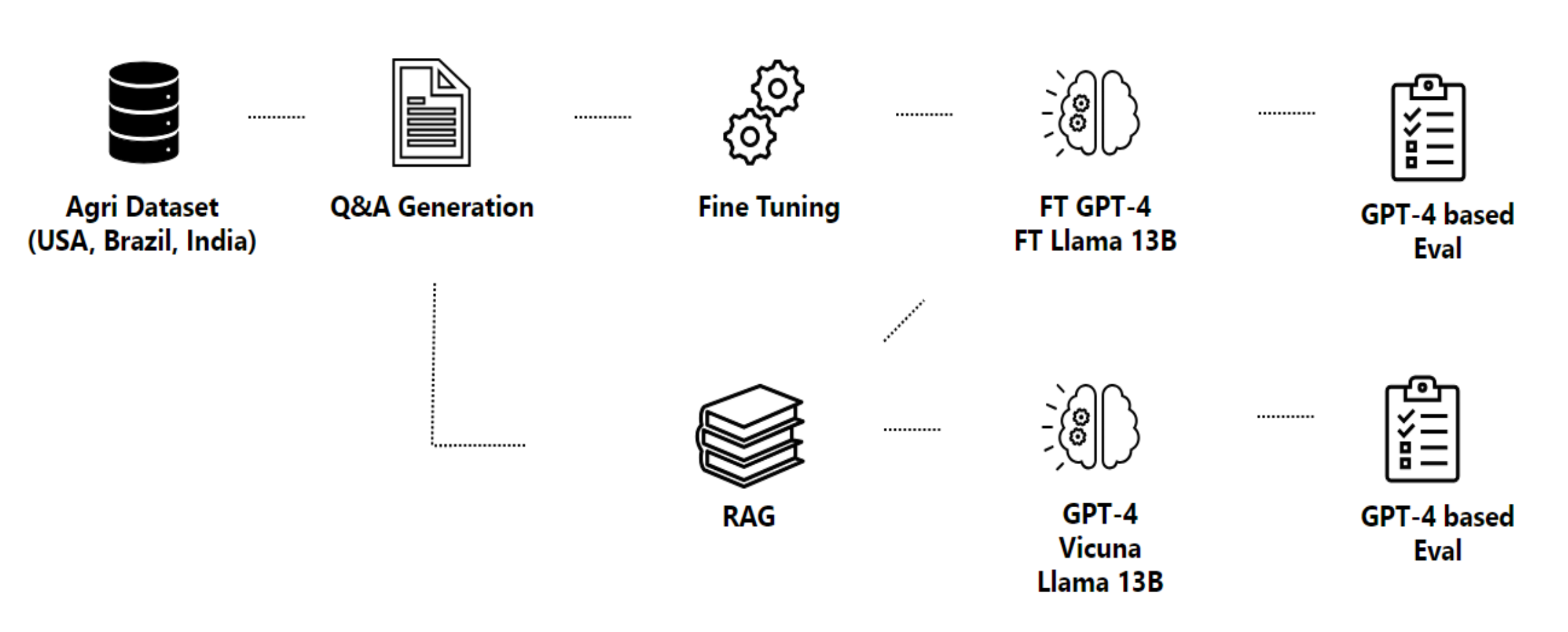
- 本文提出了一种结合RAG与微调的多阶段管道,旨在优化大型语言模型在农业领域的应用,特别是提供位置特定的农作建议。
- 实验结果显示,微调模型的准确率提升超过6个百分点,结合RAG后进一步提升5个百分点,显著提高了模型的回答相似度。
📝 摘要(中文)
在构建大型语言模型(LLMs)应用时,开发者通常采用两种方式来整合专有和领域特定数据:检索增强生成(RAG)和微调。RAG通过外部数据增强提示,而微调则将额外知识融入模型中。本文提出了一种RAG与微调的管道,并分析了多种流行LLM(如Llama2-13B、GPT-3.5和GPT-4)的优缺点。我们的方法包括从PDF中提取信息、生成问答、用于微调,并利用GPT-4评估结果。通过对农业数据集的深入研究,我们展示了该管道在捕捉地理特定知识方面的有效性,并量化了RAG与微调的优势。微调模型的准确率提高超过6个百分点,而RAG进一步提升5个百分点,展示了LLMs在特定行业的适应性和潜在应用。
🔬 方法详解
问题定义:本文旨在解决现有RAG与微调方法在整合领域特定数据时的优缺点不明确的问题,尤其是在农业领域的应用效果不足。
核心思路:通过提出一种结合RAG与微调的管道,优化大型语言模型在农业领域的应用,提供更精准的地理特定建议。
技术框架:整体架构包括多个阶段:信息从PDF中提取、生成问答、用于微调、以及利用GPT-4进行结果评估。每个阶段都有明确的目标和方法。
关键创新:最重要的创新在于提出了一种新颖的管道结构,系统性地结合了RAG与微调,能够更有效地捕捉和利用领域特定知识。
关键设计:在管道设计中,采用了特定的参数设置和损失函数,以确保模型在微调和RAG阶段的有效性,同时确保生成的问答质量高。具体的网络结构和评估指标也经过精心设计,以适应农业数据集的特点。
🖼️ 关键图片
📊 实验亮点
实验结果表明,微调模型的准确率提高超过6个百分点,结合RAG后进一步提升5个百分点。在特定实验中,模型回答的相似度从47%提升至72%,显示出显著的性能提升。
🎯 应用场景
该研究的潜在应用领域包括农业智能化,特别是在提供基于地理位置的农作建议方面。通过结合RAG与微调的方法,能够为农民提供更精准的决策支持,推动农业领域的AI应用发展,具有重要的实际价值和未来影响。
📄 摘要(原文)
There are two common ways in which developers are incorporating proprietary and domain-specific data when building applications of Large Language Models (LLMs): Retrieval-Augmented Generation (RAG) and Fine-Tuning. RAG augments the prompt with the external data, while fine-Tuning incorporates the additional knowledge into the model itself. However, the pros and cons of both approaches are not well understood. In this paper, we propose a pipeline for fine-tuning and RAG, and present the tradeoffs of both for multiple popular LLMs, including Llama2-13B, GPT-3.5, and GPT-4. Our pipeline consists of multiple stages, including extracting information from PDFs, generating questions and answers, using them for fine-tuning, and leveraging GPT-4 for evaluating the results. We propose metrics to assess the performance of different stages of the RAG and fine-Tuning pipeline. We conduct an in-depth study on an agricultural dataset. Agriculture as an industry has not seen much penetration of AI, and we study a potentially disruptive application - what if we could provide location-specific insights to a farmer? Our results show the effectiveness of our dataset generation pipeline in capturing geographic-specific knowledge, and the quantitative and qualitative benefits of RAG and fine-tuning. We see an accuracy increase of over 6 p.p. when fine-tuning the model and this is cumulative with RAG, which increases accuracy by 5 p.p. further. In one particular experiment, we also demonstrate that the fine-tuned model leverages information from across geographies to answer specific questions, increasing answer similarity from 47% to 72%. Overall, the results point to how systems built using LLMs can be adapted to respond and incorporate knowledge across a dimension that is critical for a specific industry, paving the way for further applications of LLMs in other industrial domains.