Health-LLM: Large Language Models for Health Prediction via Wearable Sensor Data
作者: Yubin Kim, Xuhai Xu, Daniel McDuff, Cynthia Breazeal, Hae Won Park
分类: cs.CL, cs.AI, cs.LG
发布日期: 2024-01-12 (更新: 2024-04-27)
💡 一句话要点
提出Health-LLM以利用可穿戴传感器数据进行健康预测
🎯 匹配领域: 支柱九:具身大模型 (Embodied Foundation Models)
关键词: 健康预测 大型语言模型 可穿戴传感器 上下文增强 微调技术 多模态数据 心理健康评估
📋 核心要点
- 现有的健康预测方法在处理领域特定和非语言数据时存在不足,难以充分利用上下文信息。
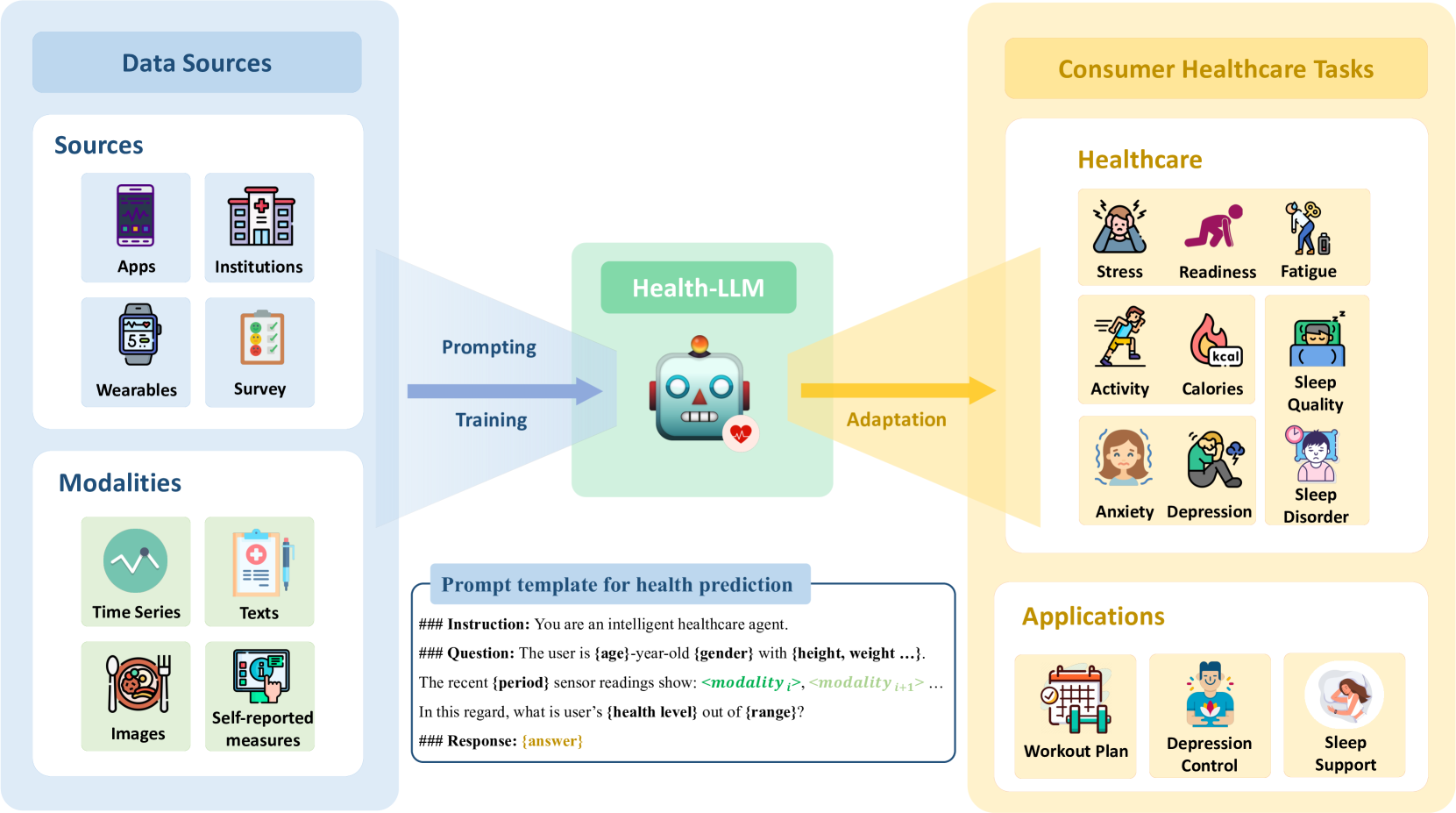
- 本文提出了一种基于大型语言模型的健康预测方法,通过结合用户上下文、健康知识和生理数据进行推断。
- 实验结果表明,微调后的HealthAlpaca在10个健康预测任务中表现优异,尤其在8项任务中超越了更大模型的性能。
📝 摘要(中文)
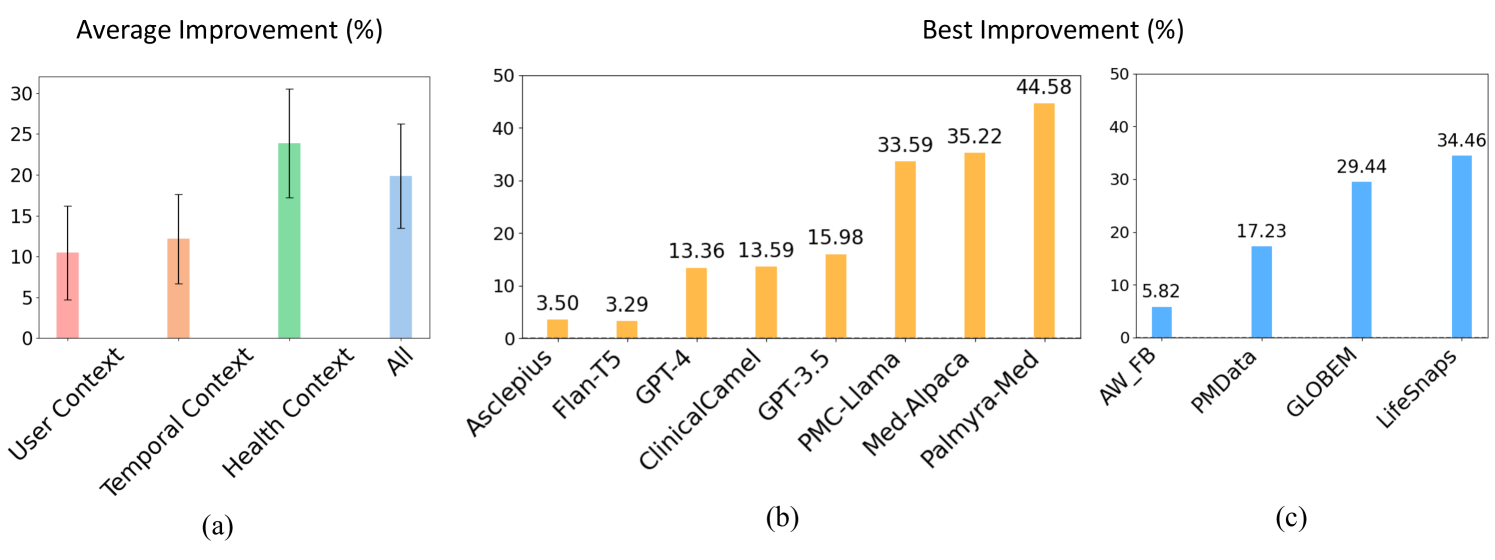
大型语言模型(LLMs)在自然语言任务中表现出色,但在健康应用中,理解领域特定和非语言数据至关重要。本文研究了LLMs在基于上下文信息(如用户人口统计、健康知识)和生理数据(如静息心率、睡眠时间)进行健康推断的能力。我们对12种最先进的LLMs进行了全面评估,涵盖了10个消费者健康预测任务。经过微调的HealthAlpaca在10项任务中表现优异,尤其在8项任务中表现最佳,且上下文增强策略显著提升了性能,最高可达23.8%的改善。
🔬 方法详解
问题定义:本文旨在解决现有健康预测方法在处理上下文信息和非语言数据时的不足,尤其是在健康领域的推断能力。
核心思路:通过结合用户的上下文信息、健康知识和生理数据,构建上下文丰富的提示,以提高LLMs在健康预测中的表现。
技术框架:整体架构包括数据收集、模型选择、提示设计和微调等阶段,重点在于如何有效整合多种信息源以增强模型的推断能力。
关键创新:本文的主要创新在于提出了一种上下文增强策略,显著提升了模型在健康预测任务中的性能,与传统方法相比,能够更好地利用多模态信息。
关键设计:在模型微调过程中,采用了特定的损失函数和参数设置,以确保模型能够有效学习上下文信息的相关性,同时设计了多种提示格式以测试其对性能的影响。
🖼️ 关键图片
📊 实验亮点
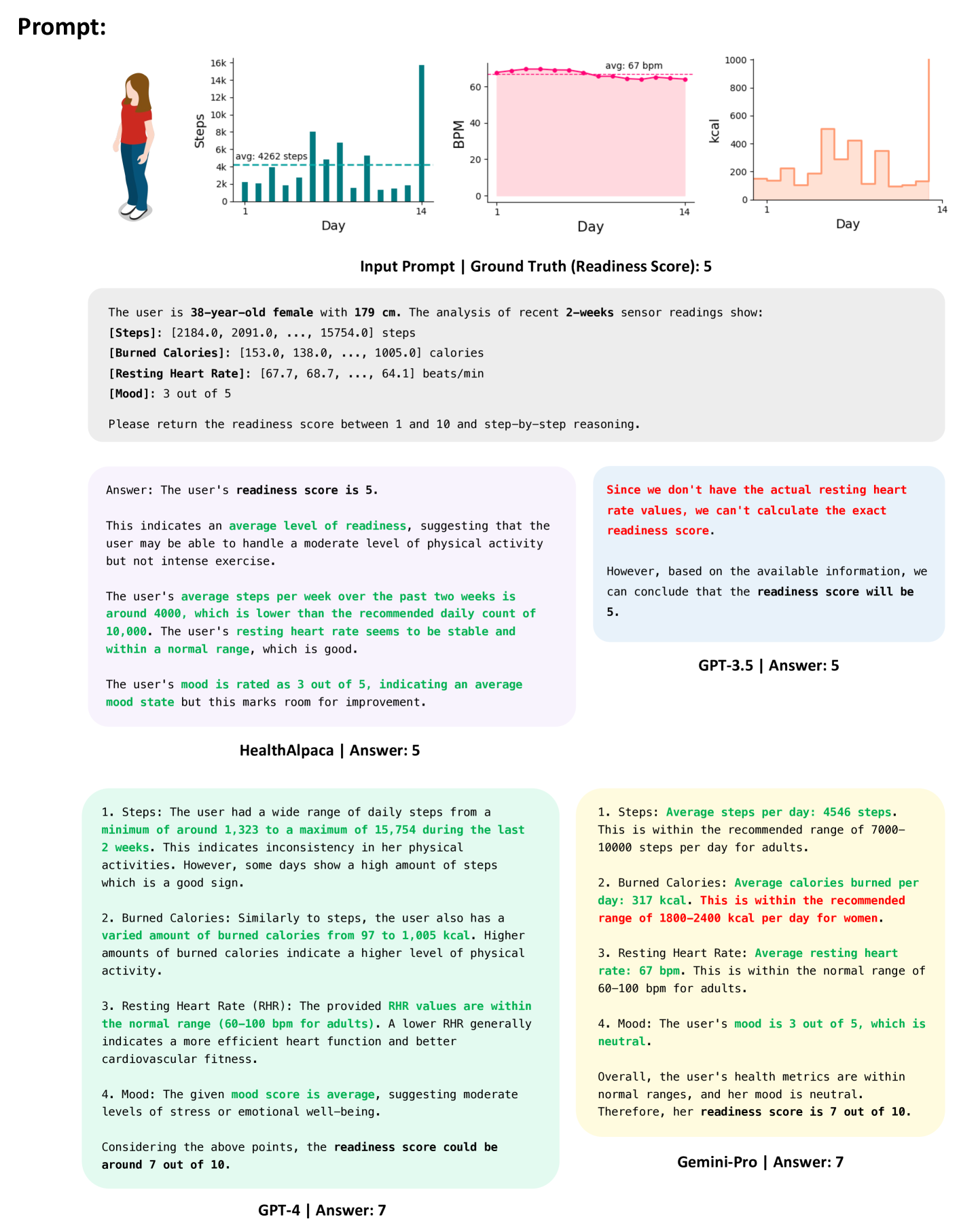
实验结果显示,微调后的HealthAlpaca在10个健康预测任务中表现优异,特别是在8项任务中超越了GPT-3.5、GPT-4和Gemini-Pro等更大模型,性能提升幅度最高可达23.8%。
🎯 应用场景
该研究的潜在应用领域包括个性化健康管理、远程医疗监测和心理健康评估等。通过利用可穿戴传感器数据,Health-LLM能够为用户提供更精准的健康预测和建议,具有重要的实际价值和未来影响。
📄 摘要(原文)
Large language models (LLMs) are capable of many natural language tasks, yet they are far from perfect. In health applications, grounding and interpreting domain-specific and non-linguistic data is crucial. This paper investigates the capacity of LLMs to make inferences about health based on contextual information (e.g. user demographics, health knowledge) and physiological data (e.g. resting heart rate, sleep minutes). We present a comprehensive evaluation of 12 state-of-the-art LLMs with prompting and fine-tuning techniques on four public health datasets (PMData, LifeSnaps, GLOBEM and AW_FB). Our experiments cover 10 consumer health prediction tasks in mental health, activity, metabolic, and sleep assessment. Our fine-tuned model, HealthAlpaca exhibits comparable performance to much larger models (GPT-3.5, GPT-4 and Gemini-Pro), achieving the best performance in 8 out of 10 tasks. Ablation studies highlight the effectiveness of context enhancement strategies. Notably, we observe that our context enhancement can yield up to 23.8% improvement in performance. While constructing contextually rich prompts (combining user context, health knowledge and temporal information) exhibits synergistic improvement, the inclusion of health knowledge context in prompts significantly enhances overall performance.