Mission: Impossible Language Models
作者: Julie Kallini, Isabel Papadimitriou, Richard Futrell, Kyle Mahowald, Christopher Potts
分类: cs.CL, cs.AI, cs.LG
发布日期: 2024-01-12 (更新: 2024-08-02)
💡 一句话要点
提出合成不可能语言以挑战大语言模型的学习能力
🎯 匹配领域: 支柱九:具身大模型 (Embodied Foundation Models)
关键词: 大型语言模型 不可能语言 语言学习 GPT-2 认知科学 语言学 实验研究
📋 核心要点
- 现有研究缺乏对大型语言模型学习不可能语言能力的实验证据,导致相关理论的争议。
- 本文通过构建合成的不可能语言,系统性地评估GPT-2模型在学习这些语言时的表现。
- 实验结果表明,GPT-2在学习不可能语言时显著低于英语的学习能力,挑战了相关理论的有效性。
📝 摘要(中文)
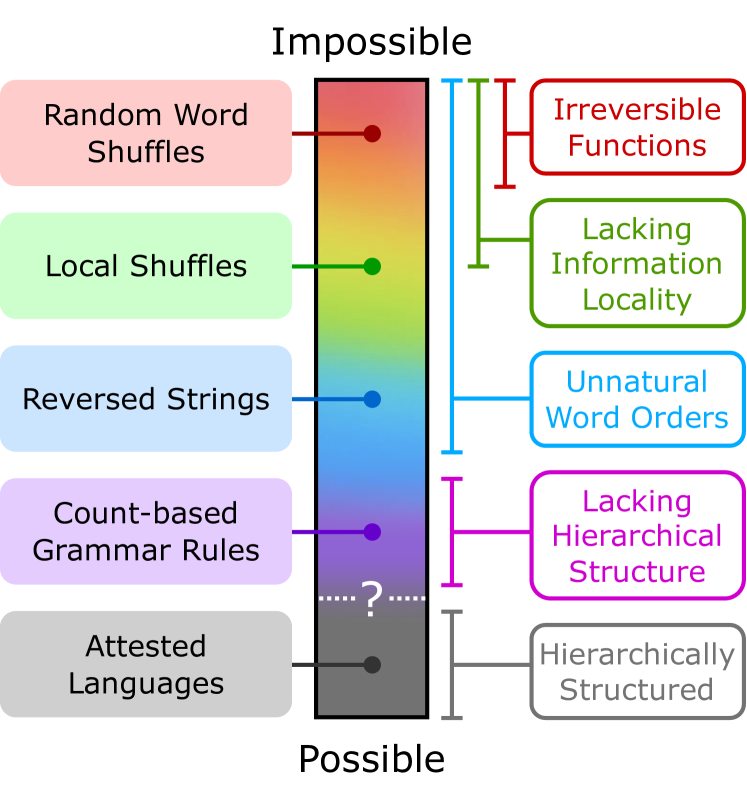
乔姆斯基等人声称大型语言模型(LLMs)能够学习人类无法掌握的语言,但缺乏实验证据支持。本文开发了一系列合成的不可能语言,通过系统性地改变英语数据的单词顺序和语法规则,构建了一个不可能性连续体。我们评估了GPT-2小型模型在学习这些语言的能力,发现其在学习不可能语言方面表现不佳,挑战了这一核心主张。希望本研究为不同LLM架构在不可能语言上的测试开辟新的研究方向,以深入了解LLMs在认知和类型学研究中的应用。
🔬 方法详解
问题定义:本文旨在探讨大型语言模型(LLMs)是否能够学习人类无法掌握的语言,现有方法缺乏实证支持,导致理论争议。
核心思路:通过设计一系列合成的不可能语言,系统性地改变英语的单词顺序和语法规则,评估GPT-2模型的学习能力。
技术框架:研究分为几个阶段,首先构建不可能语言,然后在不同训练阶段评估GPT-2模型的学习效果,最后进行结果分析与比较。
关键创新:本文的创新在于系统性地定义和构建不可能语言,并通过多阶段评估方法揭示GPT-2在学习这些语言时的局限性。
关键设计:在实验中,使用了不同复杂度的合成语言,设置了多种评估指标,以比较模型在学习不可能语言与英语之间的差异。
🖼️ 关键图片


📊 实验亮点
实验结果显示,GPT-2在学习不可能语言时的表现明显低于学习英语的表现,具体数据表明其学习能力存在显著差距,挑战了现有理论的有效性。
🎯 应用场景
该研究为语言学、认知科学和人工智能领域提供了新的视角,尤其是在理解语言学习能力的边界方面。未来可在教育、语言处理和认知模型构建等领域应用这些发现,推动相关研究的发展。
📄 摘要(原文)
Chomsky and others have very directly claimed that large language models (LLMs) are equally capable of learning languages that are possible and impossible for humans to learn. However, there is very little published experimental evidence to support such a claim. Here, we develop a set of synthetic impossible languages of differing complexity, each designed by systematically altering English data with unnatural word orders and grammar rules. These languages lie on an impossibility continuum: at one end are languages that are inherently impossible, such as random and irreversible shuffles of English words, and on the other, languages that may not be intuitively impossible but are often considered so in linguistics, particularly those with rules based on counting word positions. We report on a wide range of evaluations to assess the capacity of GPT-2 small models to learn these uncontroversially impossible languages, and crucially, we perform these assessments at various stages throughout training to compare the learning process for each language. Our core finding is that GPT-2 struggles to learn impossible languages when compared to English as a control, challenging the core claim. More importantly, we hope our approach opens up a productive line of inquiry in which different LLM architectures are tested on a variety of impossible languages in an effort to learn more about how LLMs can be used as tools for these cognitive and typological investigations.