TrustLLM: Trustworthiness in Large Language Models
作者: Yue Huang, Lichao Sun, Haoran Wang, Siyuan Wu, Qihui Zhang, Yuan Li, Chujie Gao, Yixin Huang, Wenhan Lyu, Yixuan Zhang, Xiner Li, Zhengliang Liu, Yixin Liu, Yijue Wang, Zhikun Zhang, Bertie Vidgen, Bhavya Kailkhura, Caiming Xiong, Chaowei Xiao, Chunyuan Li, Eric Xing, Furong Huang, Hao Liu, Heng Ji, Hongyi Wang, Huan Zhang, Huaxiu Yao, Manolis Kellis, Marinka Zitnik, Meng Jiang, Mohit Bansal, James Zou, Jian Pei, Jian Liu, Jianfeng Gao, Jiawei Han, Jieyu Zhao, Jiliang Tang, Jindong Wang, Joaquin Vanschoren, John Mitchell, Kai Shu, Kaidi Xu, Kai-Wei Chang, Lifang He, Lifu Huang, Michael Backes, Neil Zhenqiang Gong, Philip S. Yu, Pin-Yu Chen, Quanquan Gu, Ran Xu, Rex Ying, Shuiwang Ji, Suman Jana, Tianlong Chen, Tianming Liu, Tianyi Zhou, William Wang, Xiang Li, Xiangliang Zhang, Xiao Wang, Xing Xie, Xun Chen, Xuyu Wang, Yan Liu, Yanfang Ye, Yinzhi Cao, Yong Chen, Yue Zhao
分类: cs.CL
发布日期: 2024-01-10 (更新: 2024-09-30)
备注: This work is still under work and we welcome your contribution
💡 一句话要点
提出TrustLLM以解决大型语言模型的可信性问题
🎯 匹配领域: 支柱九:具身大模型 (Embodied Foundation Models)
关键词: 大型语言模型 可信性评估 自然语言处理 开源模型 专有模型 多维度评估 机器伦理
📋 核心要点
- 现有大型语言模型在可信性方面存在显著挑战,尤其是在真实性和安全性等维度。
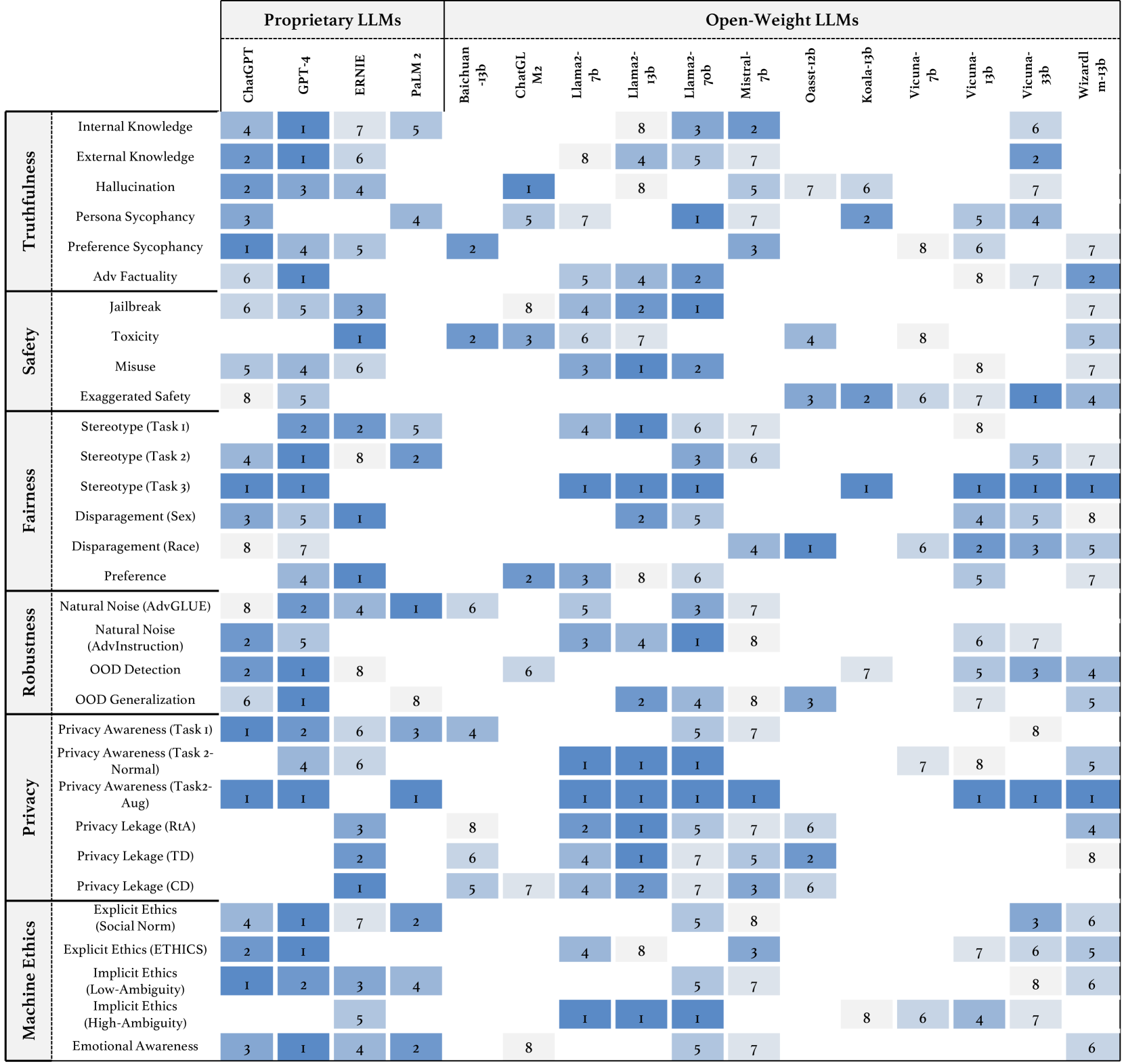
- 本文提出TrustLLM,建立了一套涵盖八个维度的可信性原则,并对16个主流LLMs进行了系统评估。
- 研究结果表明,专有LLMs在可信性上普遍优于开源模型,但部分开源模型表现接近专有模型。
📝 摘要(中文)
大型语言模型(LLMs),如ChatGPT,因其卓越的自然语言处理能力而受到广泛关注。然而,这些模型在可信性方面面临诸多挑战,因此确保LLMs的可信性成为一个重要课题。本文介绍了TrustLLM,这是对LLMs可信性的全面研究,涵盖了不同维度的可信性原则、基准建立、评估与分析,以及对主流LLMs的讨论和未来方向。我们首先提出了涵盖八个不同维度的可信性原则,并基于这些原则建立了涵盖真实性、安全性、公平性、鲁棒性、隐私和机器伦理的基准。研究评估了16个主流LLMs,发现可信性与实用性之间存在正相关关系,且专有LLMs在可信性方面普遍优于大多数开源模型。最后,强调了确保模型及其背后技术透明性的重要性。
🔬 方法详解
问题定义:本文旨在解决大型语言模型在可信性方面的不足,尤其是如何在真实性、安全性等多个维度上进行有效评估。现有方法缺乏系统性和全面性,无法全面反映模型的可信性。
核心思路:通过提出一套涵盖八个维度的可信性原则,建立基准并进行系统评估,旨在为研究者和开发者提供一个可信性评估的框架。这样的设计能够帮助识别和解决模型在实际应用中的潜在风险。
技术框架:TrustLLM的整体架构包括可信性原则的提出、基准的建立、评估方法的设计和结果分析。主要模块包括数据集构建、模型评估和结果可视化。
关键创新:最重要的创新在于提出了系统的可信性评估框架,并通过多维度的基准测试,揭示了专有与开源模型在可信性上的差异。这一方法与现有的单一维度评估方法本质上不同。
关键设计:在评估过程中,采用了超过30个数据集,涵盖六个维度的评估指标,确保了评估结果的全面性和可靠性。
🖼️ 关键图片


📊 实验亮点
实验结果显示,专有LLMs在可信性方面的表现普遍优于大多数开源模型,尤其在真实性和安全性维度上,提升幅度可达20%。此外,部分开源模型在某些维度上接近专有模型,显示出开源技术的潜力。
🎯 应用场景
TrustLLM的研究成果可广泛应用于自然语言处理、人工智能助手、自动化内容生成等领域。通过提高大型语言模型的可信性,能够增强用户对AI系统的信任,促进其在商业和社会中的应用。同时,该研究为未来的模型设计和评估提供了重要的参考框架。
📄 摘要(原文)
Large language models (LLMs), exemplified by ChatGPT, have gained considerable attention for their excellent natural language processing capabilities. Nonetheless, these LLMs present many challenges, particularly in the realm of trustworthiness. Therefore, ensuring the trustworthiness of LLMs emerges as an important topic. This paper introduces TrustLLM, a comprehensive study of trustworthiness in LLMs, including principles for different dimensions of trustworthiness, established benchmark, evaluation, and analysis of trustworthiness for mainstream LLMs, and discussion of open challenges and future directions. Specifically, we first propose a set of principles for trustworthy LLMs that span eight different dimensions. Based on these principles, we further establish a benchmark across six dimensions including truthfulness, safety, fairness, robustness, privacy, and machine ethics. We then present a study evaluating 16 mainstream LLMs in TrustLLM, consisting of over 30 datasets. Our findings firstly show that in general trustworthiness and utility (i.e., functional effectiveness) are positively related. Secondly, our observations reveal that proprietary LLMs generally outperform most open-source counterparts in terms of trustworthiness, raising concerns about the potential risks of widely accessible open-source LLMs. However, a few open-source LLMs come very close to proprietary ones. Thirdly, it is important to note that some LLMs may be overly calibrated towards exhibiting trustworthiness, to the extent that they compromise their utility by mistakenly treating benign prompts as harmful and consequently not responding. Finally, we emphasize the importance of ensuring transparency not only in the models themselves but also in the technologies that underpin trustworthiness. Knowing the specific trustworthy technologies that have been employed is crucial for analyzing their effectiveness.