Lightning Attention-2: A Free Lunch for Handling Unlimited Sequence Lengths in Large Language Models
作者: Zhen Qin, Weigao Sun, Dong Li, Xuyang Shen, Weixuan Sun, Yiran Zhong
分类: cs.CL, cs.AI
发布日期: 2024-01-09 (更新: 2024-01-15)
备注: Technical Report. Yiran Zhong is the corresponding author. The source code is available at https://github.com/OpenNLPLab/lightning-attention
🔗 代码/项目: GITHUB
💡 一句话要点
提出Lightning Attention-2以解决线性注意力的因果设置问题
🎯 匹配领域: 支柱二:RL算法与架构 (RL & Architecture) 支柱九:具身大模型 (Embodied Foundation Models)
关键词: 线性注意力 长序列处理 大规模语言模型 GPU优化 自然语言处理
📋 核心要点
- 现有线性注意力算法在因果设置中无法充分利用其理论优势,限制了其应用。
- 论文提出的Lightning Attention-2通过分块处理,结合传统和线性注意力机制,解决了这一问题。
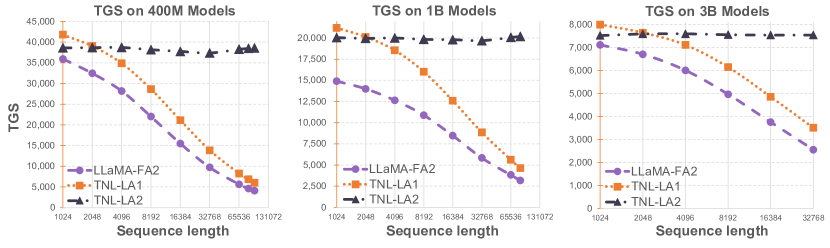
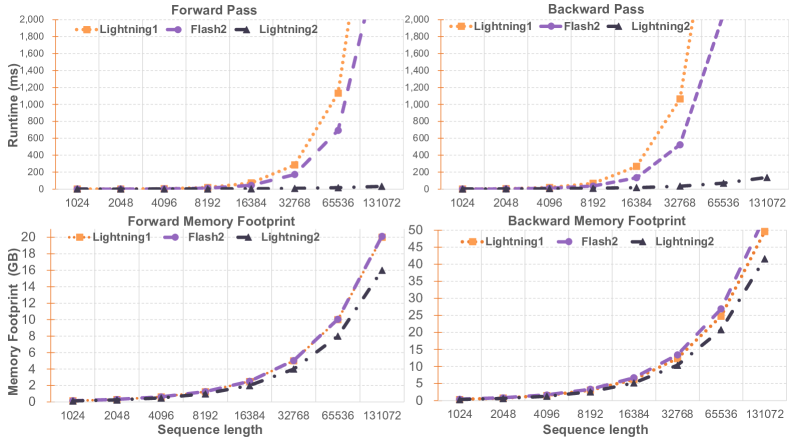
- 实验结果表明,Lightning Attention-2在不同序列长度下保持一致的速度,且显著快于其他机制。
📝 摘要(中文)
线性注意力是一种高效的注意力机制,能够以线性计算复杂度处理无限长度的序列。然而,现有线性注意力算法在因果设置中无法展现其理论优势。本文提出Lightning Attention-2,首次实现了线性注意力的理论计算优势。通过分块处理和利用传统注意力机制与线性注意力核技巧的结合,Lightning Attention-2在不同模型和序列长度下保持一致的训练和推理速度,显著快于其他注意力机制。
🔬 方法详解
问题定义:本文旨在解决现有线性注意力算法在因果设置中无法展现其理论优势的问题。现有方法在处理长序列时,计算复杂度和速度存在瓶颈。
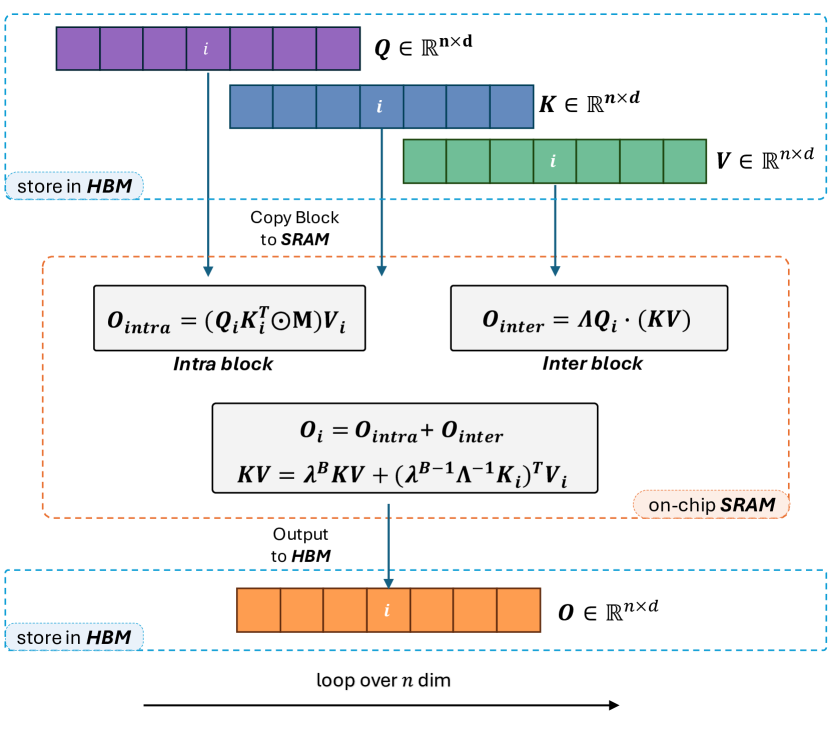
核心思路:Lightning Attention-2的核心思路是通过分块处理,将注意力计算分为内部块和外部块,分别采用传统注意力机制和线性注意力核技巧,以实现理论计算优势。
技术框架:整体架构包括两个主要阶段:首先,在内部块中使用传统注意力计算;其次,在外部块中应用线性注意力核技巧。通过这种分块策略,充分利用GPU硬件的计算能力。
关键创新:Lightning Attention-2的最大创新在于其分块处理方法,使得线性注意力能够在因果设置中有效工作。这一设计与现有方法的根本区别在于其能够在保持速度的同时处理无限长度的序列。
关键设计:在实现过程中,采用了Triton框架以优化输入输出性能,并在前向和反向过程中应用了分块技术,确保了算法的硬件友好性和高效性。
🖼️ 关键图片
📊 实验亮点
实验结果显示,Lightning Attention-2在不同模型规模和序列长度下,训练和推理速度保持一致,且相比于传统注意力机制,速度提升幅度显著,具体性能数据未详述,但实验表明其在处理长序列时的优势明显。
🎯 应用场景
Lightning Attention-2的研究成果在自然语言处理、长序列建模等领域具有广泛的应用潜力。其高效的计算能力和处理无限长度序列的能力,能够推动大规模语言模型的发展,提升模型在实际应用中的响应速度和效率。
📄 摘要(原文)
Linear attention is an efficient attention mechanism that has recently emerged as a promising alternative to conventional softmax attention. With its ability to process tokens in linear computational complexities, linear attention, in theory, can handle sequences of unlimited length without sacrificing speed, i.e., maintaining a constant training speed for various sequence lengths with a fixed memory consumption. However, due to the issue with cumulative summation (cumsum), current linear attention algorithms cannot demonstrate their theoretical advantage in a causal setting. In this paper, we present Lightning Attention-2, the first linear attention implementation that enables linear attention to realize its theoretical computational benefits. To achieve this, we leverage the thought of tiling, separately handling the intra-block and inter-block components in linear attention calculation. Specifically, we utilize the conventional attention computation mechanism for the intra-blocks and apply linear attention kernel tricks for the inter-blocks. A tiling technique is adopted through both forward and backward procedures to take full advantage of the GPU hardware. We implement our algorithm in Triton to make it IO-aware and hardware-friendly. Various experiments are conducted on different model sizes and sequence lengths. Lightning Attention-2 retains consistent training and inference speed regardless of input sequence length and is significantly faster than other attention mechanisms. The source code is available at https://github.com/OpenNLPLab/lightning-attention.