Grimoire is All You Need for Enhancing Large Language Models
作者: Ding Chen, Shichao Song, Qingchen Yu, Zhiyu Li, Wenjin Wang, Feiyu Xiong, Bo Tang
分类: cs.CL
发布日期: 2024-01-07 (更新: 2024-01-10)
备注: 9 pages
💡 一句话要点
提出SLEICL方法以提升弱语言模型的学习能力
🎯 匹配领域: 支柱九:具身大模型 (Embodied Foundation Models)
关键词: 上下文学习 弱语言模型 强语言模型 知识转移 性能提升
📋 核心要点
- 现有方法在不同类型模型的上下文学习能力上存在显著差异,尤其是弱语言模型的表现较差。
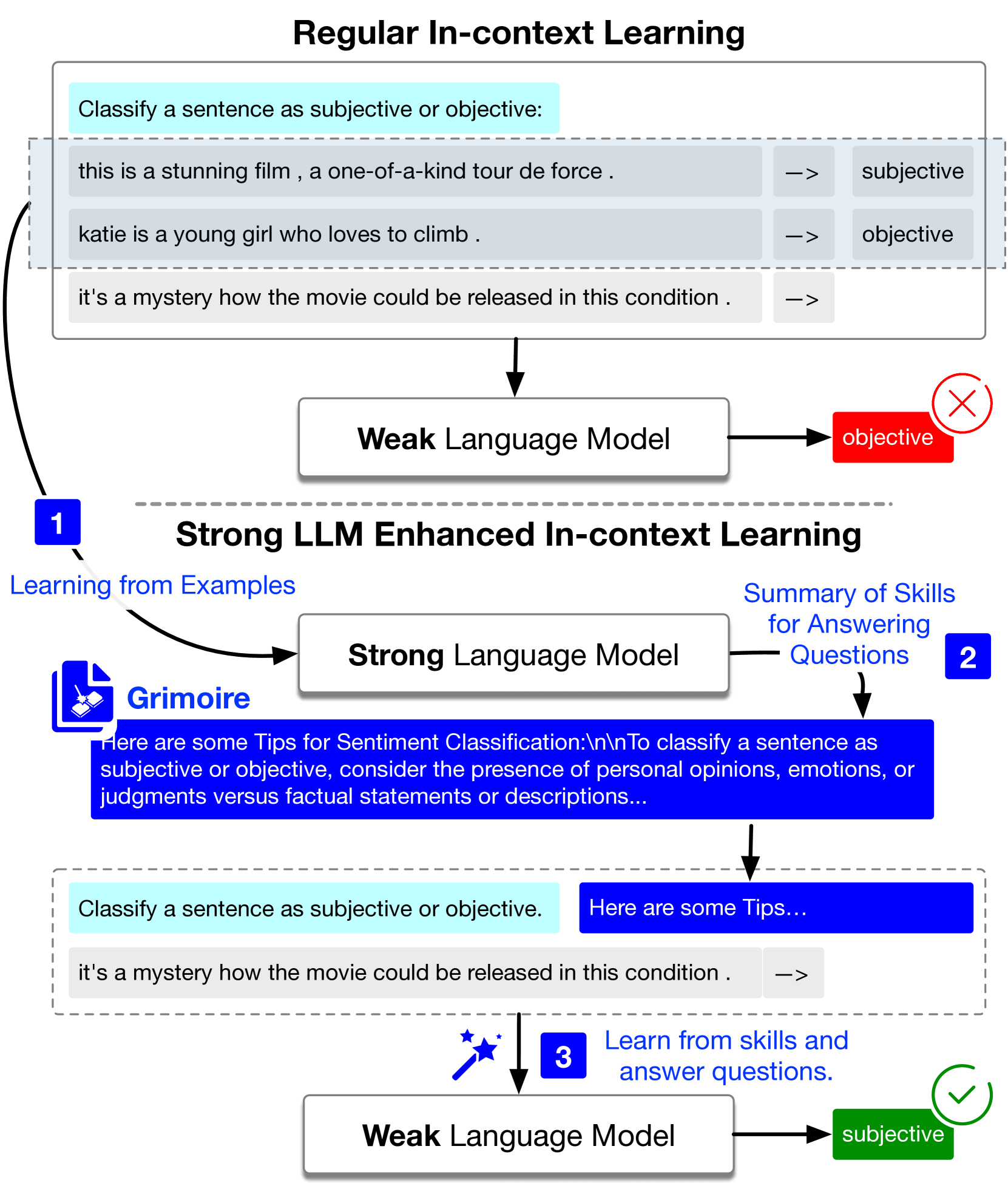
- SLEICL方法通过强语言模型学习示例,并将学习到的技能转移到弱语言模型,降低了ICL的难度。
- 实验结果显示,弱语言模型在使用SLEICL后,性能普遍提升,部分模型超越了GPT4-1106-preview的零-shot能力。
📝 摘要(中文)
在上下文学习(ICL)中,通过提供少量示例来增强大型语言模型在特定任务上的性能。然而,不同模型的ICL能力存在显著差异,受模型架构、学习数据量和参数规模等因素影响。本文提出了一种SLEICL方法,通过强语言模型学习示例并将其总结和转移到弱语言模型,从而确保ICL的稳定性和有效性。实验表明,使用SLEICL方法的弱语言模型在零-shot或few-shot能力上均有一致提升,部分模型甚至超越了GPT4-1106-preview的表现。
🔬 方法详解
问题定义:本文旨在解决弱语言模型在上下文学习(ICL)中的能力不足问题。现有方法直接让弱模型从提示示例中学习,导致学习效果不佳。
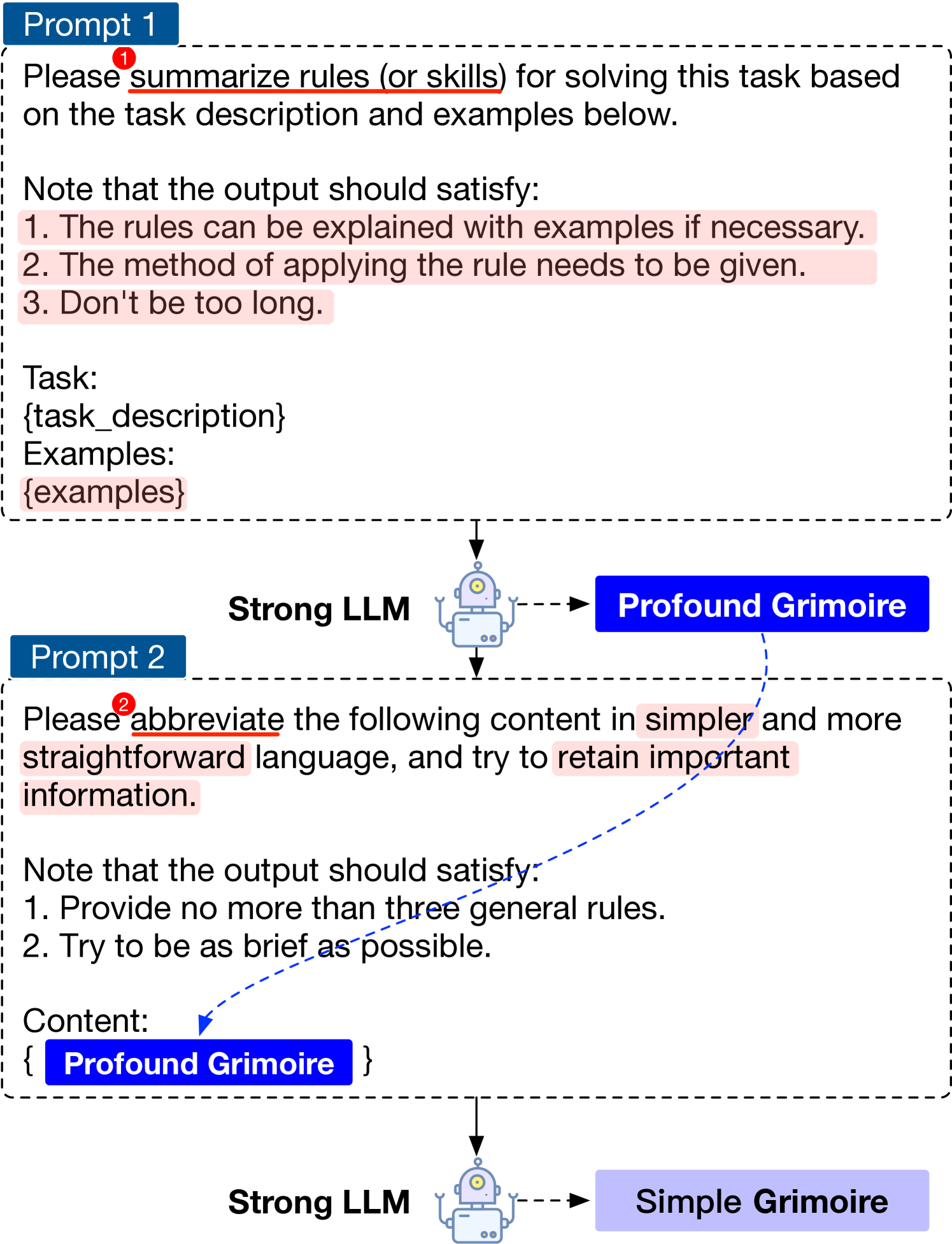
核心思路:SLEICL方法的核心在于利用强语言模型进行示例学习,然后将这些学习到的技能总结并转移到弱语言模型,以提高其推理和应用能力。这样的设计确保了ICL的稳定性和有效性。
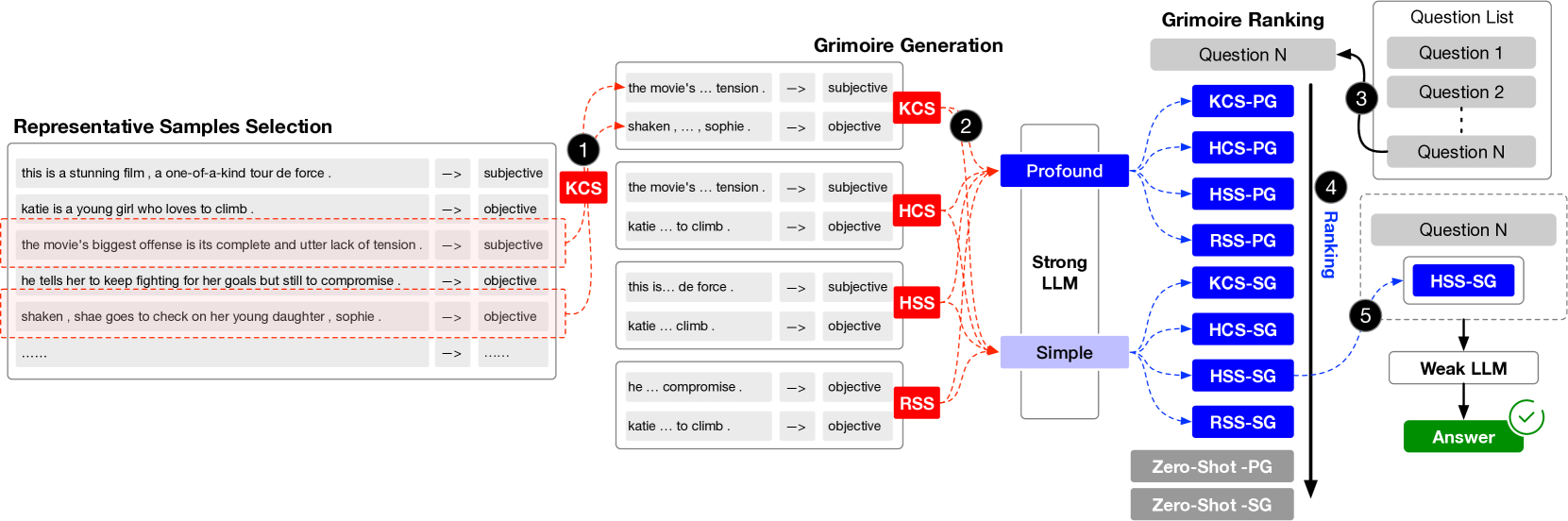
技术框架:SLEICL的整体架构包括两个主要阶段:首先,强语言模型从给定的示例中学习并提取知识;其次,将提取的知识转移到弱语言模型中进行推理。
关键创新:SLEICL的最大创新在于通过强模型的学习能力来增强弱模型的表现,这与传统方法直接让弱模型学习示例的方式有本质区别。
关键设计:在SLEICL中,关键设计包括选择合适的强语言模型进行示例学习,以及如何有效地总结和转移知识到弱模型的具体策略。
🖼️ 关键图片
📊 实验亮点
实验结果显示,使用SLEICL方法的弱语言模型在多个数据集上均实现了显著提升,部分模型的性能超越了GPT4-1106-preview的零-shot能力,展示了SLEICL在提升模型能力方面的有效性。
🎯 应用场景
该研究的潜在应用领域包括自然语言处理、对话系统和文本生成等。通过提升弱语言模型的学习能力,SLEICL方法可以在资源有限的情况下,帮助这些模型在特定任务上取得更好的表现,具有重要的实际价值和未来影响。
📄 摘要(原文)
In-context Learning (ICL) is one of the key methods for enhancing the performance of large language models on specific tasks by providing a set of few-shot examples. However, the ICL capability of different types of models shows significant variation due to factors such as model architecture, volume of learning data, and the size of parameters. Generally, the larger the model's parameter size and the more extensive the learning data, the stronger its ICL capability. In this paper, we propose a method SLEICL that involves learning from examples using strong language models and then summarizing and transferring these learned skills to weak language models for inference and application. This ensures the stability and effectiveness of ICL. Compared to directly enabling weak language models to learn from prompt examples, SLEICL reduces the difficulty of ICL for these models. Our experiments, conducted on up to eight datasets with five language models, demonstrate that weak language models achieve consistent improvement over their own zero-shot or few-shot capabilities using the SLEICL method. Some weak language models even surpass the performance of GPT4-1106-preview (zero-shot) with the aid of SLEICL.