Large Language Models in Mental Health Care: a Scoping Review
作者: Yining Hua, Fenglin Liu, Kailai Yang, Zehan Li, Hongbin Na, Yi-han Sheu, Peilin Zhou, Lauren V. Moran, Sophia Ananiadou, David A. Clifton, Andrew Beam, John Torous
分类: cs.CL, cs.AI
发布日期: 2024-01-01 (更新: 2025-07-11)
💡 一句话要点
评估大型语言模型在心理健康护理中的应用潜力
🎯 匹配领域: 支柱九:具身大模型 (Embodied Foundation Models)
关键词: 大型语言模型 心理健康 数据可用性 伦理考量 临床应用 系统综述
📋 核心要点
- 现有方法在心理健康护理中面临数据可用性和可靠性不足、心理状态处理复杂等挑战。
- 论文通过系统评估LLMs在心理健康护理中的应用,提出了针对数据和伦理问题的解决思路。
- 研究结果显示,LLMs在诊断和治疗方面具有潜力,但临床适用性和伦理问题仍需进一步解决。
📝 摘要(中文)
本综述旨在全面分析大型语言模型(LLMs)在心理健康护理中的应用,评估其有效性,识别挑战,并探索未来应用的潜力。通过对多个数据库的系统搜索,纳入了2019年10月1日至2023年12月2日间的相关研究。最终选取了34篇与LLMs在心理健康护理中的应用相关的文章,发现其在诊断、治疗和增强患者参与等方面的应用潜力。同时,数据可用性、心理状态的细致处理和有效评估方法等挑战也被强调。尽管LLMs在提高准确性和可及性方面展现出潜力,但在临床适用性和伦理考量上仍存在显著差距。
🔬 方法详解
问题定义:本论文旨在解决大型语言模型在心理健康护理中的应用效果评估及其面临的挑战,现有方法在数据可用性和伦理考量方面存在不足。
核心思路:通过系统综述方法,分析LLMs在心理健康领域的应用,识别其有效性与挑战,提出未来改进的方向。
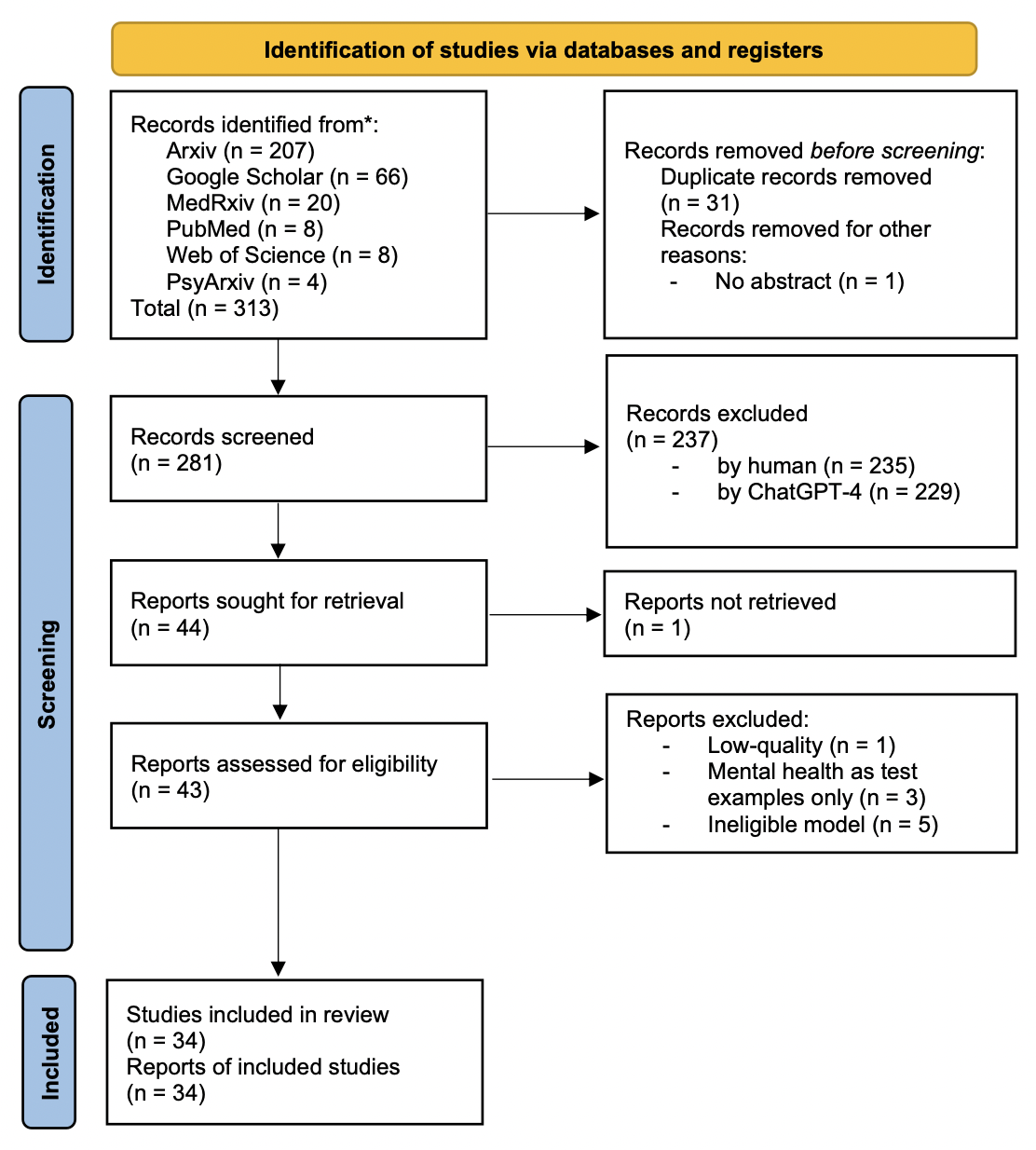
技术框架:研究采用系统搜索策略,涵盖多个数据库,筛选出相关文献,分析其应用场景和效果,形成综合评估。
关键创新:本研究的创新点在于系统性地整合了LLMs在心理健康护理中的应用案例,强调了数据和伦理问题的重要性,与传统方法相比,更加关注实际应用中的挑战。
关键设计:在文献筛选过程中,采用了无语言限制的标准,确保涵盖多种LLMs的研究,关注其在诊断、治疗和患者参与等方面的具体应用。
🖼️ 关键图片
📊 实验亮点
研究结果表明,LLMs在心理健康护理中的应用显示出显著的潜力,尤其是在提高诊断准确性和患者参与度方面。然而,临床适用性和伦理问题仍需进一步研究和解决。
🎯 应用场景
该研究的潜在应用领域包括心理健康诊断、治疗方案的个性化制定以及患者与医疗服务提供者之间的互动。通过利用LLMs,可以提高心理健康服务的可及性和效率,未来可能在临床实践中发挥重要作用。
📄 摘要(原文)
Objectieve:This review aims to deliver a comprehensive analysis of Large Language Models (LLMs) utilization in mental health care, evaluating their effectiveness, identifying challenges, and exploring their potential for future application. Materials and Methods: A systematic search was performed across multiple databases including PubMed, Web of Science, Google Scholar, arXiv, medRxiv, and PsyArXiv in November 2023. The review includes all types of original research, regardless of peer-review status, published or disseminated between October 1, 2019, and December 2, 2023. Studies were included without language restrictions if they employed LLMs developed after T5 and directly investigated research questions within mental health care settings. Results: Out of an initial 313 articles, 34 were selected based on their relevance to LLMs applications in mental health care and the rigor of their reported outcomes. The review identified various LLMs applications in mental health care, including diagnostics, therapy, and enhancing patient engagement. Key challenges highlighted were related to data availability and reliability, the nuanced handling of mental states, and effective evaluation methods. While LLMs showed promise in improving accuracy and accessibility, significant gaps in clinical applicability and ethical considerations were noted. Conclusion: LLMs hold substantial promise for enhancing mental health care. For their full potential to be realized, emphasis must be placed on developing robust datasets, development and evaluation frameworks, ethical guidelines, and interdisciplinary collaborations to address current limitations.