Improving the Robustness of Transformer-based Large Language Models with Dynamic Attention
作者: Lujia Shen, Yuwen Pu, Shouling Ji, Changjiang Li, Xuhong Zhang, Chunpeng Ge, Ting Wang
分类: cs.CL, cs.CR, cs.LG
发布日期: 2023-11-29 (更新: 2023-11-30)
💡 一句话要点
提出动态注意力以增强Transformer模型对对抗攻击的鲁棒性
🎯 匹配领域: 支柱九:具身大模型 (Embodied Foundation Models)
关键词: 动态注意力 对抗攻击 Transformer模型 自然语言处理 模型鲁棒性 注意力机制 深度学习
📋 核心要点
- 现有的对抗攻击防御方法往往需要大量资源,或仅提供有限的保护效果。
- 本文提出的动态注意力方法通过注意力值的调整和动态建模来增强模型的鲁棒性。
- 实验结果表明,动态注意力在对抗攻击下的性能提升可达33%,并能与其他防御方法结合使用。
📝 摘要(中文)
基于Transformer的模型,如BERT和GPT,因其卓越的性能在自然语言处理领域被广泛采用。然而,近期研究表明,这些模型在面对文本对抗攻击时存在脆弱性,模型输出可能被故意操控的文本输入误导。尽管已有多种方法旨在增强模型的鲁棒性,但许多方法消耗资源较大或保护效果有限。本文提出了一种新方法——动态注意力,旨在增强模型自身对各种对抗攻击的内在鲁棒性。该方法无需下游任务知识,也不产生额外成本。通过大量实验,动态注意力显著减轻了对抗攻击的影响,性能提升可达33%。
🔬 方法详解
问题定义:本文旨在解决基于Transformer的语言模型在面对对抗攻击时的脆弱性。现有方法如对抗训练和防御性dropout要么资源消耗大,要么保护效果有限。
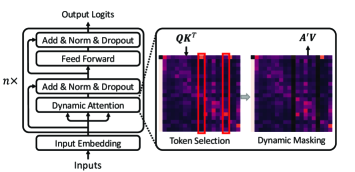
核心思路:提出的动态注意力方法通过两个模块——注意力修正和动态建模,来增强模型的内在鲁棒性。注意力修正通过掩蔽或削弱特定token的注意力值,动态建模则根据输入动态构建候选token集合。
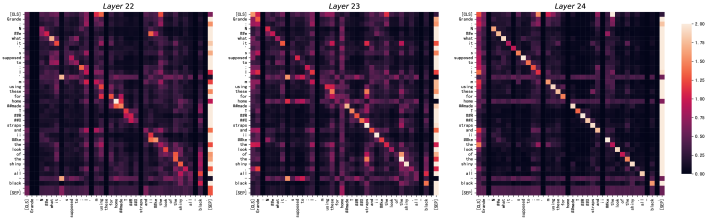
技术框架:动态注意力方法包括两个主要模块:1) 注意力修正模块,负责调整注意力值;2) 动态建模模块,实时生成候选token集合。整体流程是通过输入文本生成注意力矩阵,并在此基础上进行动态调整。
关键创新:动态注意力的最大创新在于其无需额外的下游任务知识,且不增加计算成本,能够有效提升模型对抗攻击的鲁棒性。与传统方法相比,动态注意力在模型设计层面提供了更灵活的防御机制。
关键设计:在动态注意力的实现中,注意力修正模块通过设定阈值来选择需要调整的token,而动态建模模块则通过算法动态选择候选token,确保模型在不同输入下的适应性。
🖼️ 关键图片

📊 实验亮点
实验结果显示,动态注意力在对抗攻击下的性能提升可达33%,显著优于现有的防御方法。此外,该方法能够与其他防御技术(如对抗训练)结合使用,进一步增强模型的鲁棒性。
🎯 应用场景
该研究的潜在应用领域包括自然语言处理中的文本分类、情感分析和对话系统等。通过增强模型的鲁棒性,可以提高这些应用在面对恶意输入时的安全性和可靠性,具有重要的实际价值和未来影响。
📄 摘要(原文)
Transformer-based models, such as BERT and GPT, have been widely adopted in natural language processing (NLP) due to their exceptional performance. However, recent studies show their vulnerability to textual adversarial attacks where the model's output can be misled by intentionally manipulating the text inputs. Despite various methods that have been proposed to enhance the model's robustness and mitigate this vulnerability, many require heavy consumption resources (e.g., adversarial training) or only provide limited protection (e.g., defensive dropout). In this paper, we propose a novel method called dynamic attention, tailored for the transformer architecture, to enhance the inherent robustness of the model itself against various adversarial attacks. Our method requires no downstream task knowledge and does not incur additional costs. The proposed dynamic attention consists of two modules: (I) attention rectification, which masks or weakens the attention value of the chosen tokens, and (ii) dynamic modeling, which dynamically builds the set of candidate tokens. Extensive experiments demonstrate that dynamic attention significantly mitigates the impact of adversarial attacks, improving up to 33\% better performance than previous methods against widely-used adversarial attacks. The model-level design of dynamic attention enables it to be easily combined with other defense methods (e.g., adversarial training) to further enhance the model's robustness. Furthermore, we demonstrate that dynamic attention preserves the state-of-the-art robustness space of the original model compared to other dynamic modeling methods.