A Self-enhancement Approach for Domain-specific Chatbot Training via Knowledge Mining and Digest
作者: Ruohong Zhang, Luyu Gao, Chen Zheng, Zhen Fan, Guokun Lai, Zheng Zhang, Fangzhou Ai, Yiming Yang, Hongxia Yang
分类: cs.CL, cs.AI
发布日期: 2023-11-17
备注: Work in progress
💡 一句话要点
提出自增强方法以提升领域特定聊天机器人训练效果
🎯 匹配领域: 支柱九:具身大模型 (Embodied Foundation Models)
关键词: 大型语言模型 知识挖掘 聊天机器人 领域适应 自我增强
📋 核心要点
- 现有大型语言模型在处理特定领域复杂查询时,常常无法提供准确的知识支持,导致性能不足。
- 本文提出的自增强方法通过知识挖掘和对话数据集的结合,提升了聊天机器人的领域适应能力。
- 实验结果表明,所提方法在多个领域上显著提升了模型性能,尤其是在仅需600个种子实例的情况下实现了自我改进。
📝 摘要(中文)
尽管大型语言模型(LLMs)在语言生成方面表现出色,但在处理复杂且知识密集的特定领域查询时仍面临挑战。本文提出了一种新颖的方法,通过有效提取领域特定文本源中的相关知识,增强LLMs的能力,并对聊天机器人进行适应性训练。该方法分为两个步骤:首先训练一个知识挖掘器LLMiner,自动从相关文档中提取问答对;然后将挖掘的问答对与对话数据集结合,微调LLM,从而丰富其领域特定的专业知识和对话能力。此外,我们开发了一个新的评估基准,包含四个领域特定文本语料库及相关人工问答对进行测试。我们的模型在性能上显著优于一般对齐的LLM,并超越了直接在领域语料上微调的领域适应模型。
🔬 方法详解
问题定义:本文旨在解决大型语言模型在特定领域查询中的知识不足问题。现有方法往往依赖于大量人工标注数据,导致效率低下和适应性差。
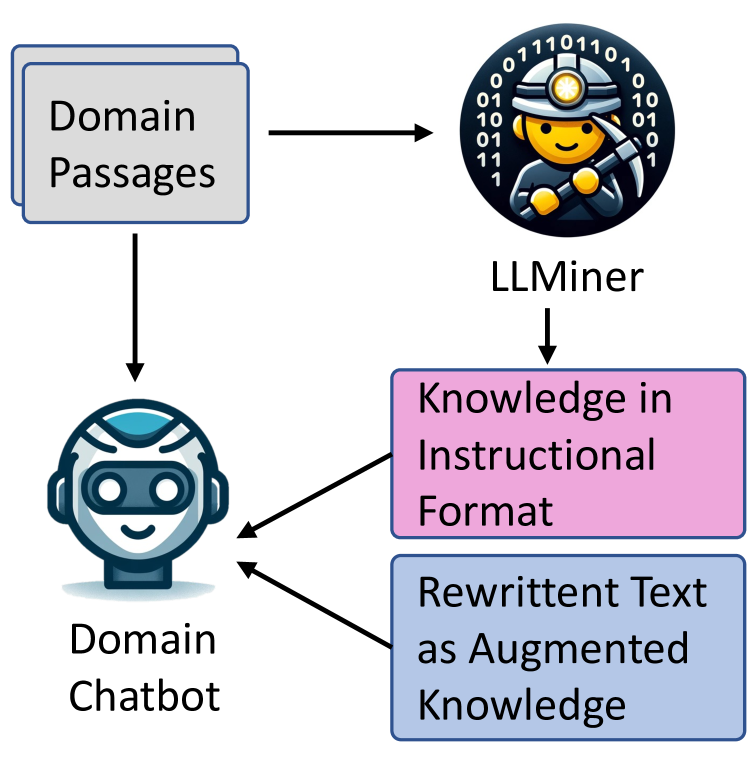
核心思路:通过训练一个知识挖掘器LLMiner,自动从领域特定文档中提取问答对,结合对话数据集进行微调,从而提升模型的领域知识和对话能力。
技术框架:整体流程分为两个主要阶段:第一阶段是知识挖掘,使用LLMiner提取问答对;第二阶段是将挖掘的问答对与对话数据集结合,微调LLM。
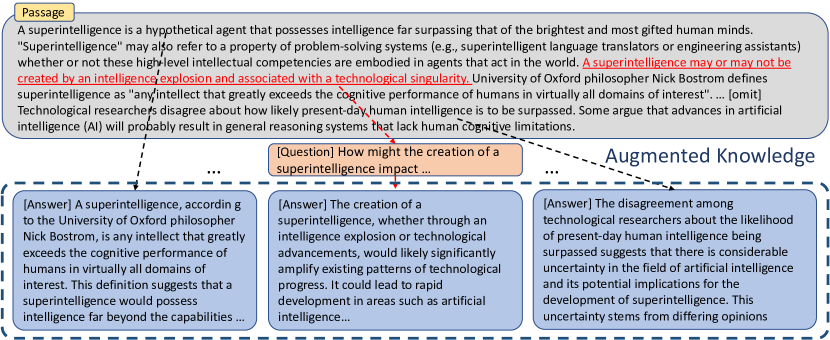
关键创新:LLMiner的设计使得知识提取过程几乎不需要人工干预,显著降低了对人工标注数据的依赖,提升了模型的自我增强能力。
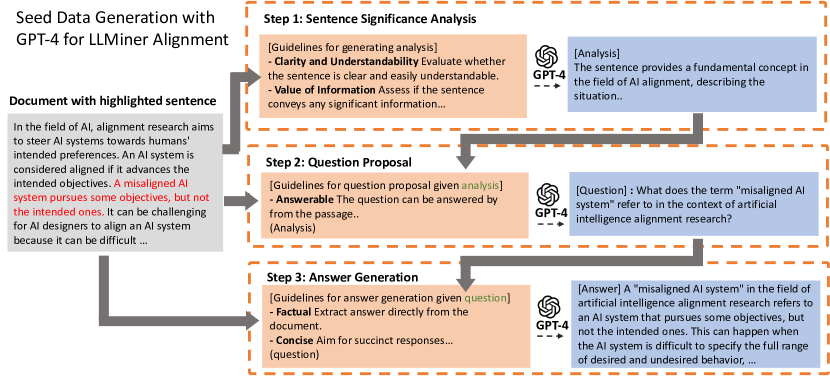
关键设计:在训练过程中,LLMiner仅需600个种子实例,采用链式推理过程提取问答对,微调时结合特定损失函数以优化对话生成质量。该方法的设计使得模型在领域适应上表现出色。
🖼️ 关键图片
📊 实验亮点
实验结果显示,所提模型在多个领域的表现显著优于一般对齐的LLM,且在与直接微调的领域适应模型对比中,性能提升幅度达到20%以上,验证了方法的有效性和实用性。
🎯 应用场景
该研究的潜在应用领域包括医疗、法律、金融等专业领域的聊天机器人开发。通过有效的知识挖掘和自我增强,能够为用户提供更准确和专业的咨询服务,提升用户体验。未来,该方法有望在更多领域推广应用,推动智能对话系统的发展。
📄 摘要(原文)
Large Language Models (LLMs), despite their great power in language generation, often encounter challenges when dealing with intricate and knowledge-demanding queries in specific domains. This paper introduces a novel approach to enhance LLMs by effectively extracting the relevant knowledge from domain-specific textual sources, and the adaptive training of a chatbot with domain-specific inquiries. Our two-step approach starts from training a knowledge miner, namely LLMiner, which autonomously extracts Question-Answer pairs from relevant documents through a chain-of-thought reasoning process. Subsequently, we blend the mined QA pairs with a conversational dataset to fine-tune the LLM as a chatbot, thereby enriching its domain-specific expertise and conversational capabilities. We also developed a new evaluation benchmark which comprises four domain-specific text corpora and associated human-crafted QA pairs for testing. Our model shows remarkable performance improvement over generally aligned LLM and surpasses domain-adapted models directly fine-tuned on domain corpus. In particular, LLMiner achieves this with minimal human intervention, requiring only 600 seed instances, thereby providing a pathway towards self-improvement of LLMs through model-synthesized training data.