Self-Contradictory Reasoning Evaluation and Detection
作者: Ziyi Liu, Soumya Sanyal, Isabelle Lee, Yongkang Du, Rahul Gupta, Yang Liu, Jieyu Zhao
分类: cs.CL
发布日期: 2023-11-16 (更新: 2024-10-21)
💡 一句话要点
提出自我矛盾推理评估与检测方法以提升LLM的推理可靠性
🎯 匹配领域: 支柱九:具身大模型 (Embodied Foundation Models)
关键词: 自我矛盾推理 大型语言模型 推理一致性 模型检测 自然语言处理
📋 核心要点
- 现有大型语言模型在推理任务中表现出色,但往往缺乏一致性,导致推理结果不可靠。
- 本文提出了一种新的评估方法,专注于自我矛盾推理的检测,旨在提高模型的推理一致性。
- 实验结果显示,GPT-4在识别自我矛盾推理方面的F1分数为52.2%,低于人类的66.7%,表明模型仍需改进。
📝 摘要(中文)
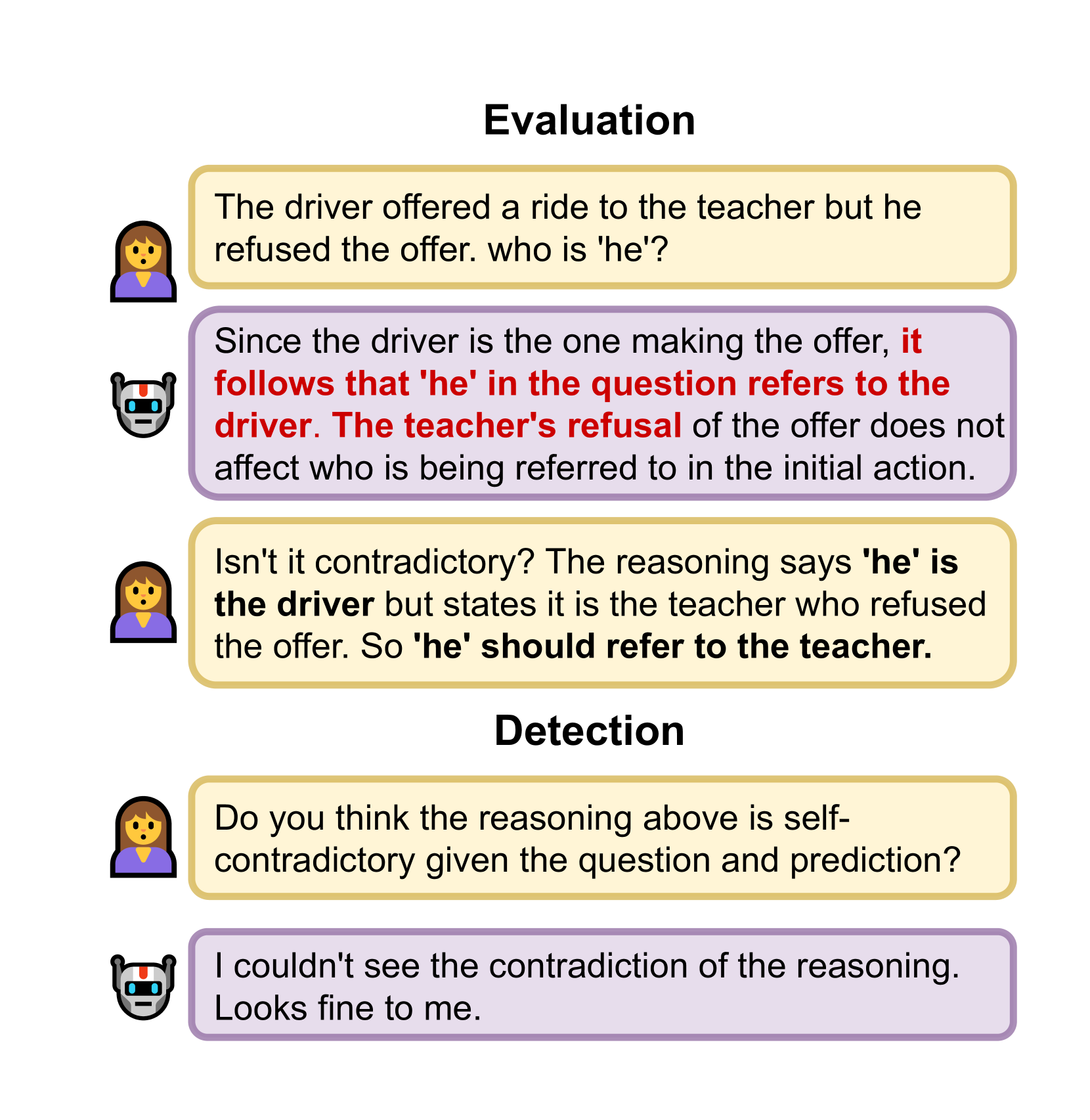
在大量近期研究中,大型语言模型(LLMs)展现了令人印象深刻的推理能力,但许多下游推理任务仅关注最终答案。本文探讨自我矛盾推理(Self-Contra),即模型推理与其答案不一致的问题。我们定义并评估了三个数据集上的Self-Contra率,并深入分析了Self-Contra推理的细分类别。研究发现,LLMs在涉及上下文理解或常识的推理任务中经常自相矛盾。我们还让最先进的模型GPT-4识别Self-Contra推理,发现细分类别的检测能力提升了GPT-4的检测能力,但其F1分数仅为52.2%,远低于人类的66.7%。结果表明,当前LLMs缺乏可靠推理所需的稳健性,亟需建立综合推理评估的最佳实践。
🔬 方法详解
问题定义:本文旨在解决大型语言模型在推理过程中出现的自我矛盾问题。现有方法往往只关注最终答案,忽视推理过程的一致性和可靠性。
核心思路:论文通过定义自我矛盾推理(Self-Contra)并评估其发生率,探讨如何提高模型对推理过程的理解和检测能力。通过细分推理错误类型,增强模型的检测能力。
技术框架:研究采用了三个不同的数据集来评估Self-Contra率,并利用GPT-4模型进行自我矛盾推理的识别。整体流程包括数据集构建、推理评估和模型检测三个主要模块。
关键创新:论文的创新点在于首次系统性地定义和评估自我矛盾推理,提出了细分类别的检测方法,显著提升了对推理一致性的理解。
关键设计:在实验中,采用了多种数据集和评估指标,特别关注细分类别的推理错误,以提高模型的检测能力。
🖼️ 关键图片


📊 实验亮点
实验结果显示,GPT-4在识别自我矛盾推理方面的F1分数为52.2%,而人类的F1分数为66.7%。这一发现表明,尽管模型在推理任务中表现良好,但在一致性和可靠性方面仍有显著差距,亟需改进。
🎯 应用场景
该研究的潜在应用领域包括自然语言处理、智能问答系统和自动推理工具等。通过提高大型语言模型的推理一致性和可靠性,可以在更广泛的场景中应用这些模型,提升人机交互的智能化水平。
📄 摘要(原文)
In a plethora of recent work, large language models (LLMs) demonstrated impressive reasoning ability, but many proposed downstream reasoning tasks only focus on final answers. Two fundamental questions persist: 1) how consistent is the reasoning, and 2) can models detect unreliable reasoning? In this paper, we investigate self-contradictory (Self-Contra) reasoning, where the model reasoning does not support its answers. To answer 1), we define and assess the Self-Contra rate across three datasets and delve into finer-grained categories of Self-Contra reasoning. We find that LLMs often contradict themselves in reasoning tasks involving contextual information understanding or commonsense. The model may generate correct answers by taking shortcuts in reasoning or overlooking contextual evidence, leading to compromised reasoning. For 2), we task the state-of-the-art model GPT-4 with identifying Self-Contra reasoning and finer-grained fallacies. We find that finer-grained categories enhanced detection can improve GPT-4's ability to detect Self-Contra. However, it is only able to detect Self-Contra with a 52.2% F1 score, much lower compared to 66.7% for humans. Our results indicate that current LLMs lack the robustness necessary for reliable reasoning and we emphasize the urgent need for establishing best practices in comprehensive reasoning evaluations beyond pure performance-based metrics.