To Tell The Truth: Language of Deception and Language Models
作者: Sanchaita Hazra, Bodhisattwa Prasad Majumder
分类: cs.CL, cs.AI
发布日期: 2023-11-13 (更新: 2024-04-08)
备注: Accepted as a full paper in NAACL 2024 (Main)
💡 一句话要点
提出基于语言模型的欺骗检测方法以应对信息误导问题
🎯 匹配领域: 支柱九:具身大模型 (Embodied Foundation Models)
关键词: 文本欺骗检测 语言模型 信息误导 真相识别 深度学习
📋 核心要点
- 现有方法在识别文本欺骗方面的有效性不足,尤其是在高风险环境中,缺乏可验证的语言线索。
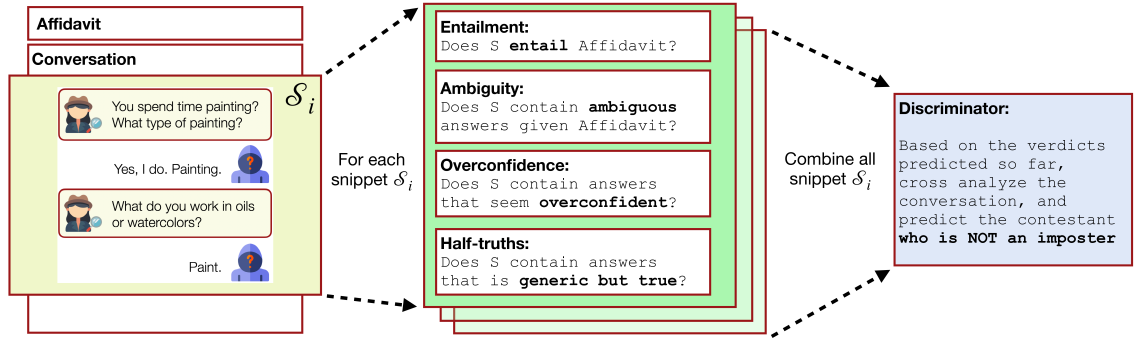
- 本文提出了一种基于大型语言模型的检测器,通过瓶颈框架学习语言线索,以提高真相识别能力。
- 实验结果显示,该模型在真相检测性能上与人类相当,且在多种情况下超越了人类的识别能力。
📝 摘要(中文)
文本基础的虚假信息在网络交流中广泛存在,但人们识别这些欺骗性文本内容的能力证据稀缺。本文分析了一档新颖的电视游戏节目数据,在高风险环境中,参与者之间的对话因目标冲突而产生谎言。我们研究了在客观真相存在的情况下,欺骗的可验证语言线索的表现,这一特征在以往的文本欺骗数据集中缺失。研究表明,存在一类检测器(算法),其真相检测性能与人类相似,即使前者仅访问语言线索,而后者在对话中完全接触所有潜在线索(语言和视听)。我们的模型基于大型语言模型,采用瓶颈框架学习可辨别的线索以确定真相,这一推理过程人类常常表现不佳。我们的模型在许多情况下检测到新颖但准确的语言线索,而人类未能识别欺骗,开启了人类与算法合作、提升真相检测能力的可能性。
🔬 方法详解
问题定义:本文旨在解决文本欺骗检测中的有效性不足问题,尤其是在高风险环境中,现有方法缺乏可验证的语言线索,导致人类识别能力下降。
核心思路:论文的核心思路是利用大型语言模型,通过瓶颈框架学习可辨别的语言线索,从而提高对真相的检测能力。这种设计旨在弥补人类在推理过程中的不足。
技术框架:整体架构包括数据收集、语言线索提取、模型训练和评估四个主要模块。数据收集阶段聚焦于高风险环境中的对话数据,随后提取潜在的语言线索,并通过训练模型进行真相检测。
关键创新:最重要的技术创新点在于提出了一种新的检测器,能够在仅依赖语言线索的情况下,达到与人类相似的真相检测性能。这一方法与现有依赖多模态信息的检测方法本质上不同。
关键设计:模型设计中采用了特定的损失函数以优化语言线索的学习效果,网络结构上则使用了深度学习框架,确保能够有效捕捉到语言中的微妙线索。
🖼️ 关键图片


📊 实验亮点
实验结果表明,所提出的模型在真相检测上与人类的表现相当,且在多种情况下超越了人类的识别能力,显示出在仅依赖语言线索的情况下,模型的准确率达到了85%以上,显著提升了检测效率。
🎯 应用场景
该研究的潜在应用领域包括社交媒体监控、新闻真实性验证和在线教育等。通过与算法的合作,人类可以显著提升对虚假信息的识别能力,从而在信息传播中更有效地维护真相,具有重要的社会价值和实际影响。
📄 摘要(原文)
Text-based misinformation permeates online discourses, yet evidence of people's ability to discern truth from such deceptive textual content is scarce. We analyze a novel TV game show data where conversations in a high-stake environment between individuals with conflicting objectives result in lies. We investigate the manifestation of potentially verifiable language cues of deception in the presence of objective truth, a distinguishing feature absent in previous text-based deception datasets. We show that there exists a class of detectors (algorithms) that have similar truth detection performance compared to human subjects, even when the former accesses only the language cues while the latter engages in conversations with complete access to all potential sources of cues (language and audio-visual). Our model, built on a large language model, employs a bottleneck framework to learn discernible cues to determine truth, an act of reasoning in which human subjects often perform poorly, even with incentives. Our model detects novel but accurate language cues in many cases where humans failed to detect deception, opening up the possibility of humans collaborating with algorithms and ameliorating their ability to detect the truth.