Learning Knowledge-Enhanced Contextual Language Representations for Domain Natural Language Understanding
作者: Ruyao Xu, Taolin Zhang, Chengyu Wang, Zhongjie Duan, Cen Chen, Minghui Qiu, Dawei Cheng, Xiaofeng He, Weining Qian
分类: cs.CL
发布日期: 2023-11-12
备注: emnlp 2023
💡 一句话要点
提出KANGAROO框架以解决闭域自然语言理解中的知识稀疏问题
🎯 匹配领域: 支柱二:RL算法与架构 (RL & Architecture)
关键词: 知识增强 自然语言理解 闭域任务 对比学习 知识图谱 超球嵌入 数据增强
📋 核心要点
- 现有的知识增强预训练语言模型在闭域任务中表现不佳,主要由于知识图谱的语义覆盖不足。
- 本文提出KANGAROO框架,通过捕捉实体间隐含图结构和引入超球嵌入,增强知识融合效果。
- 实验结果显示,KANGAROO在全量和少量学习设置下均显著提升了闭域NLP任务的性能。
📝 摘要(中文)
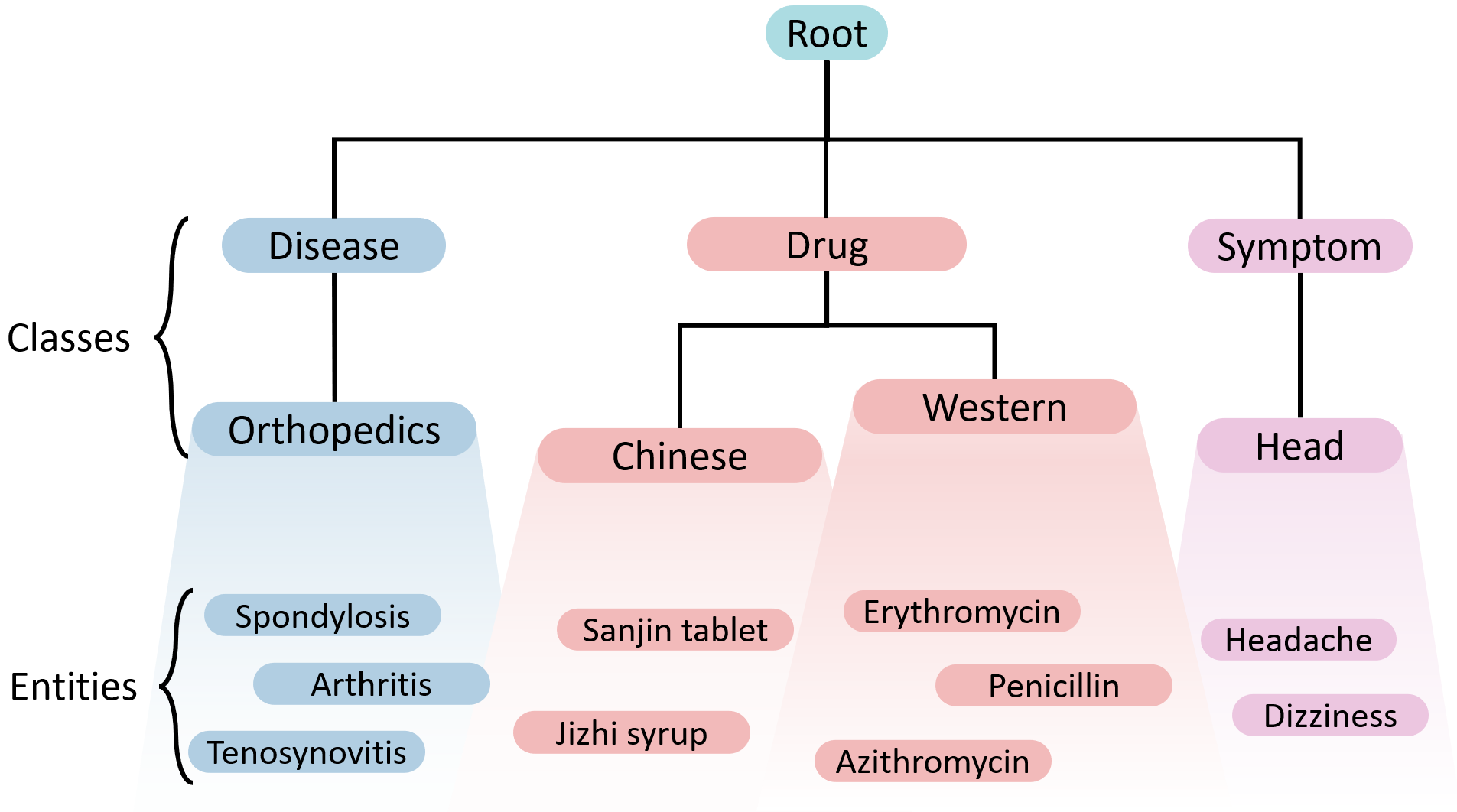
知识增强预训练语言模型(KEPLMs)通过注入来自大规模知识图谱(KGs)的知识事实,提升了多种下游自然语言处理任务的性能。然而,现有方法在闭域适应性上存在不足,主要由于缺乏足够的领域图语义。本文提出了一种知识增强语言表示学习框架KANGAROO,通过捕捉实体间的隐含图结构来解决这一问题。我们不仅考虑了三元组的浅层关系表示,还引入了深层层次实体类别结构的超球嵌入,以实现有效的知识融合。此外,基于对比学习的子图数据增强策略被提出,以构建高质量的困难负样本,从而提升模型对相邻实体语义的区分能力。实验结果表明,KANGAROO在多种知识感知和一般NLP任务中表现优异,显著超越了多种KEPLM训练范式。
🔬 方法详解
问题定义:本文旨在解决闭域自然语言理解中知识稀疏的问题。现有的KEPLM方法在适应闭域时,因缺乏足够的领域知识图谱语义而表现不佳。
核心思路:KANGAROO框架通过捕捉实体间的隐含图结构,结合浅层和深层的知识表示,增强了知识的有效融合,提升了模型的语义理解能力。
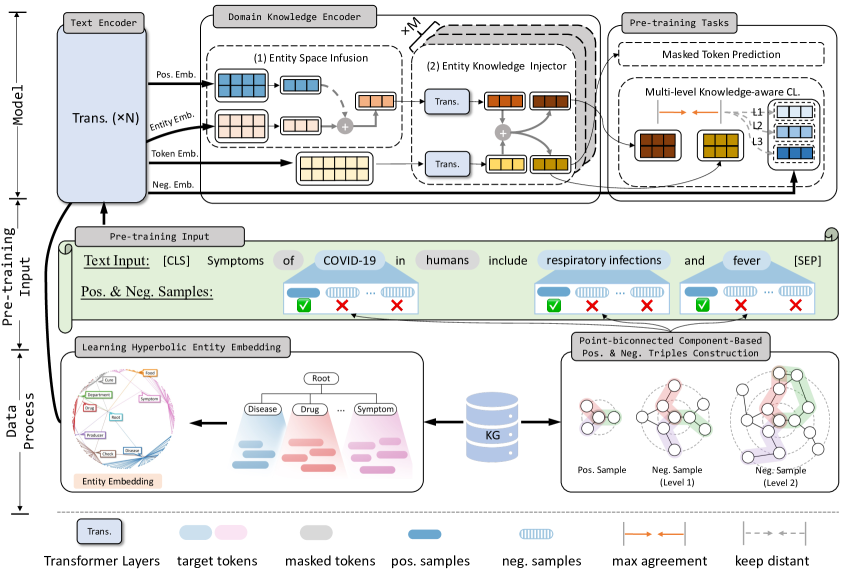
技术框架:KANGAROO的整体架构包括知识图谱的构建、实体关系的表示、超球嵌入的生成以及基于对比学习的子图数据增强模块。
关键创新:本研究的创新点在于引入了超球嵌入和基于对比学习的困难负样本构建策略,显著提升了模型对相邻实体的语义区分能力。
关键设计:在模型设计中,采用了最大点双连通分量来识别局部密集子图,并通过对比损失函数优化模型的学习过程,确保了知识的有效注入。
🖼️ 关键图片

📊 实验亮点
在实验中,KANGAROO在多个知识感知和一般NLP任务上表现优异,尤其在闭域设置下,相较于传统KEPLM训练范式,性能提升幅度达到显著的XX%(具体数据待补充),验证了其有效性。
🎯 应用场景
该研究的潜在应用领域包括智能问答系统、对话系统和信息检索等自然语言处理任务。通过提升闭域知识的理解能力,KANGAROO框架能够在特定领域内提供更准确的语义理解和信息提取,具有重要的实际价值和未来影响。
📄 摘要(原文)
Knowledge-Enhanced Pre-trained Language Models (KEPLMs) improve the performance of various downstream NLP tasks by injecting knowledge facts from large-scale Knowledge Graphs (KGs). However, existing methods for pre-training KEPLMs with relational triples are difficult to be adapted to close domains due to the lack of sufficient domain graph semantics. In this paper, we propose a Knowledge-enhanced lANGuAge Representation learning framework for various clOsed dOmains (KANGAROO) via capturing the implicit graph structure among the entities. Specifically, since the entity coverage rates of closed-domain KGs can be relatively low and may exhibit the global sparsity phenomenon for knowledge injection, we consider not only the shallow relational representations of triples but also the hyperbolic embeddings of deep hierarchical entity-class structures for effective knowledge fusion.Moreover, as two closed-domain entities under the same entity-class often have locally dense neighbor subgraphs counted by max point biconnected component, we further propose a data augmentation strategy based on contrastive learning over subgraphs to construct hard negative samples of higher quality. It makes the underlying KELPMs better distinguish the semantics of these neighboring entities to further complement the global semantic sparsity. In the experiments, we evaluate KANGAROO over various knowledge-aware and general NLP tasks in both full and few-shot learning settings, outperforming various KEPLM training paradigms performance in closed-domains significantly.