Unraveling Downstream Gender Bias from Large Language Models: A Study on AI Educational Writing Assistance
作者: Thiemo Wambsganss, Xiaotian Su, Vinitra Swamy, Seyed Parsa Neshaei, Roman Rietsche, Tanja Käser
分类: cs.CL, cs.CY
发布日期: 2023-11-06
备注: Accepted as a full paper at EMNLP Findings 2023
💡 一句话要点
研究AI写作辅助中的性别偏见转移问题
🎯 匹配领域: 支柱九:具身大模型 (Embodied Foundation Models)
关键词: 大型语言模型 性别偏见 写作辅助 教育技术 用户研究 AI应用 偏见分析
📋 核心要点
- 现有研究多集中于模型和数据中的偏见,未能充分探讨LLM偏见对人类写作的影响。
- 本文通过大规模用户研究,分析了AI写作支持管道中性别偏见的转移过程。
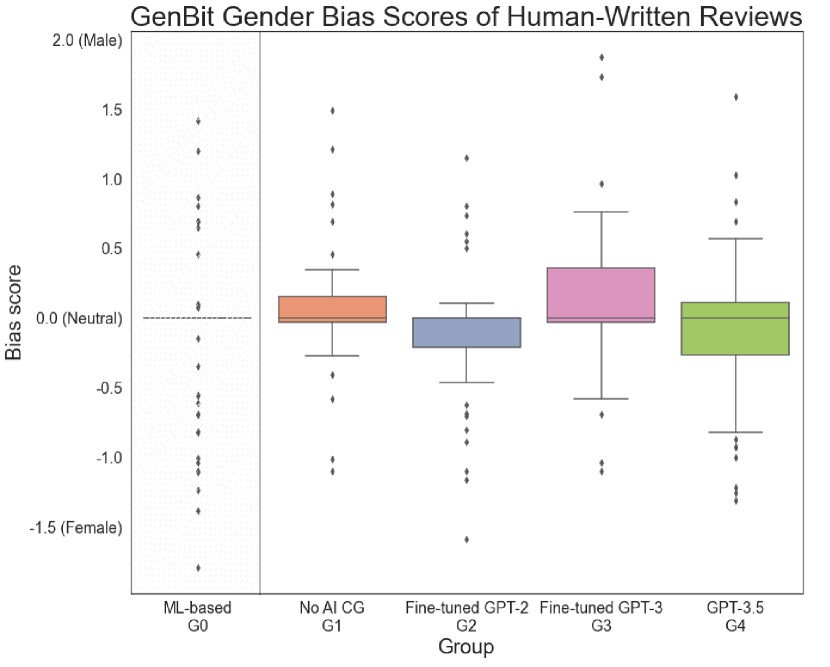
- 研究结果显示,使用LLM建议的学生与未使用建议的学生在性别偏见上无显著差异,表明AI写作支持的积极应用前景。
📝 摘要(中文)
大型语言模型(LLMs)在教育任务中越来越多地被用于为学生提供写作建议。尽管其潜力巨大,但LLMs已知存在固有偏见,可能对学习者产生负面影响。以往研究分别探讨了模型和数据表示中的偏见,忽视了LLM偏见对人类写作的潜在影响。本文通过对231名学生进行大规模用户研究,探讨了偏见如何通过AI写作支持管道转移。研究结果表明,使用LLM建议的学生与未使用建议的学生在同伴评审中的性别偏见没有显著差异,展示了在课堂中使用AI写作支持的乐观前景。
🔬 方法详解
问题定义:本文旨在解决大型语言模型在教育写作辅助中可能存在的性别偏见转移问题。现有方法未能有效探讨LLM偏见对学生写作的影响,导致对AI写作辅助的应用信心不足。
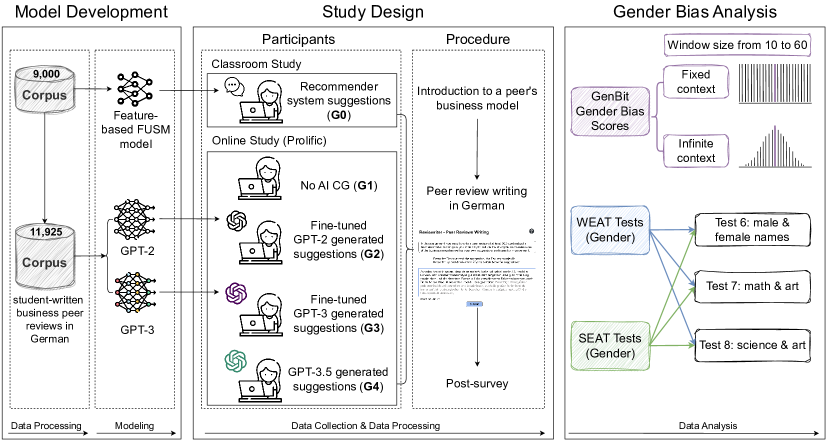
核心思路:通过对231名学生进行分组实验,评估不同类型的LLM建议对学生写作中性别偏见的影响,探索偏见在AI写作支持管道中的转移机制。
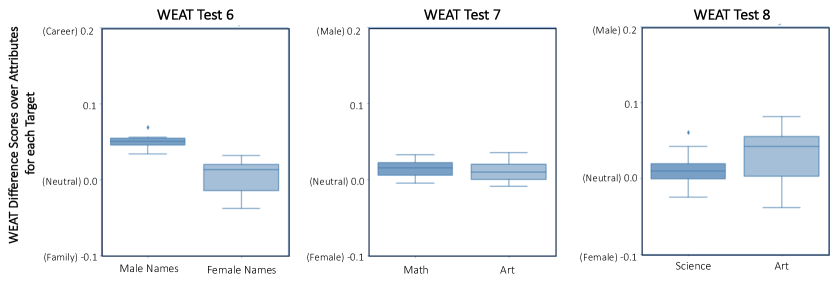
技术框架:研究采用GenBit性别偏见分析、词嵌入关联测试(WEAT)和句子嵌入关联测试(SEAT),在模型嵌入、生成建议和学生评审三个阶段评估性别偏见。
关键创新:本研究的创新在于首次系统性地分析了LLM偏见如何影响学生的写作,揭示了在特定上下文中,LLM的偏见并未转移至学生的反馈。
关键设计:实验设计中,学生被分为五组,分别接受不同程度的写作支持,使用的模型包括微调的GPT-2、GPT-3和预训练的GPT-3.5,确保了对比的有效性和结果的可靠性。
🖼️ 关键图片
📊 实验亮点
实验结果显示,使用LLM建议的学生与未使用建议的学生在性别偏见上没有显著差异,表明在特定教育场景下,LLM的偏见不会转移到学生的写作中。这一发现为AI写作辅助的应用提供了积极的证据,支持其在课堂中的使用。
🎯 应用场景
该研究的潜在应用领域包括教育技术、智能写作辅助工具和在线学习平台。通过理解和控制AI写作辅助中的偏见,教育者可以更有效地利用这些工具,提升学生的写作能力,同时减少潜在的偏见影响,促进公平的学习环境。未来,研究结果可能推动更广泛的AI应用于教育领域,提升学习效果。
📄 摘要(原文)
Large Language Models (LLMs) are increasingly utilized in educational tasks such as providing writing suggestions to students. Despite their potential, LLMs are known to harbor inherent biases which may negatively impact learners. Previous studies have investigated bias in models and data representations separately, neglecting the potential impact of LLM bias on human writing. In this paper, we investigate how bias transfers through an AI writing support pipeline. We conduct a large-scale user study with 231 students writing business case peer reviews in German. Students are divided into five groups with different levels of writing support: one classroom group with feature-based suggestions and four groups recruited from Prolific -- a control group with no assistance, two groups with suggestions from fine-tuned GPT-2 and GPT-3 models, and one group with suggestions from pre-trained GPT-3.5. Using GenBit gender bias analysis, Word Embedding Association Tests (WEAT), and Sentence Embedding Association Test (SEAT) we evaluate the gender bias at various stages of the pipeline: in model embeddings, in suggestions generated by the models, and in reviews written by students. Our results demonstrate that there is no significant difference in gender bias between the resulting peer reviews of groups with and without LLM suggestions. Our research is therefore optimistic about the use of AI writing support in the classroom, showcasing a context where bias in LLMs does not transfer to students' responses.