Don't Make Your LLM an Evaluation Benchmark Cheater
作者: Kun Zhou, Yutao Zhu, Zhipeng Chen, Wentong Chen, Wayne Xin Zhao, Xu Chen, Yankai Lin, Ji-Rong Wen, Jiawei Han
分类: cs.CL, cs.AI
发布日期: 2023-11-03
备注: 11 pages
💡 一句话要点
提出评估基准使用指南以解决LLM评估不公问题
🎯 匹配领域: 支柱九:具身大模型 (Embodied Foundation Models)
关键词: 大型语言模型 评估基准 基准泄漏 模型训练 性能评估 人工智能 数据管理
📋 核心要点
- 现有的评估基准在使用过程中存在不当利用和误解评估结果的风险,影响模型性能的公平比较。
- 论文提出了针对基准泄漏问题的解决方案,强调在模型训练中避免使用与评估集相关的数据。
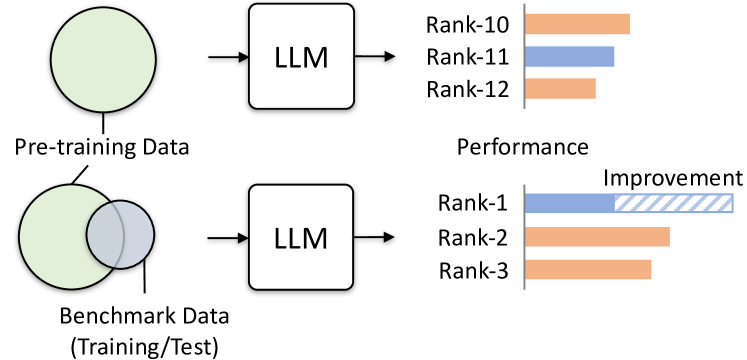
- 通过实验发现,基准泄漏会显著提升评估结果,导致对模型性能的误判,提出了改进现有评估基准的指导方针。
📝 摘要(中文)
大型语言模型(LLMs)在人工智能领域取得了显著进展,评估模型性能的常用方法是构建评估基准。然而,关于这些基准的适当使用和不同模型的公平比较的担忧日益增加。本文讨论了不当使用评估基准及误解评估结果的潜在风险,特别关注基准泄漏现象,即与评估集相关的数据被用于模型训练。通过大量实验,我们发现基准利用会显著提升评估结果,导致模型性能评估不可靠。最后,我们提出了针对LLM开发者和基准维护者的若干指导方针,希望引起对LLM训练和评估的适当关注。
🔬 方法详解
问题定义:本文要解决的问题是评估基准的不当使用,尤其是基准泄漏现象,这会导致模型性能评估的不可靠性。现有方法未能有效防止训练数据与评估数据的重叠,影响了评估的公正性。
核心思路:论文的核心思路是通过识别和避免基准泄漏,确保模型评估的准确性和可靠性。通过提出一系列指导方针,帮助开发者和维护者合理使用评估基准。
技术框架:整体架构包括评估基准的设计、模型训练过程和评估结果的分析。主要模块包括数据准备、模型训练、评估标准设定和结果解读。
关键创新:最重要的技术创新点在于系统性地识别基准泄漏问题,并提出相应的解决方案和指导方针。这与现有方法的本质区别在于强调了评估过程中的数据管理和透明度。
关键设计:在实验中,设置了不同的参数以模拟基准泄漏的影响,并设计了特定的损失函数以评估模型在不同条件下的表现。
🖼️ 关键图片

📊 实验亮点
实验结果显示,基准泄漏现象可以使模型的评估结果提升高达30%,这表明不当使用评估基准会导致对模型性能的严重误判。通过提出的指导方针,能够有效降低这种风险,确保评估结果的可靠性。
🎯 应用场景
该研究的潜在应用领域包括大型语言模型的开发与评估、人工智能系统的性能验证以及评估基准的设计与维护。通过提供合理的评估框架,可以提高模型的可信度和应用效果,促进AI技术的健康发展。
📄 摘要(原文)
Large language models~(LLMs) have greatly advanced the frontiers of artificial intelligence, attaining remarkable improvement in model capacity. To assess the model performance, a typical approach is to construct evaluation benchmarks for measuring the ability level of LLMs in different aspects. Despite that a number of high-quality benchmarks have been released, the concerns about the appropriate use of these benchmarks and the fair comparison of different models are increasingly growing. Considering these concerns, in this paper, we discuss the potential risk and impact of inappropriately using evaluation benchmarks and misleadingly interpreting the evaluation results. Specially, we focus on a special issue that would lead to inappropriate evaluation, \ie \emph{benchmark leakage}, referring that the data related to evaluation sets is occasionally used for model training. This phenomenon now becomes more common since pre-training data is often prepared ahead of model test. We conduct extensive experiments to study the effect of benchmark leverage, and find that it can dramatically boost the evaluation results, which would finally lead to an unreliable assessment of model performance. To improve the use of existing evaluation benchmarks, we finally present several guidelines for both LLM developers and benchmark maintainers. We hope this work can draw attention to appropriate training and evaluation of LLMs.