Playing 20 Question Game with Policy-Based Reinforcement Learning
作者: Huang Hu, Xianchao Wu, Bingfeng Luo, Chongyang Tao, Can Xu, Wei Wu, Zhan Chen
分类: cs.HC, cs.AI, cs.CL
发布日期: 2026-07-05
💡 一句话要点
提出基于策略的强化学习方法以优化20问游戏中的提问策略
🎯 匹配领域: 支柱二:RL算法与架构 (RL & Architecture)
关键词: 强化学习 20问游戏 提问策略 奖励网络 智能问答 噪声鲁棒性 深度学习
📋 核心要点
- 现有方法在20问游戏中难以推导出最佳提问策略,主要由于游戏环境的复杂性和不确定性。
- 本文提出了一种基于策略的强化学习方法,通过与用户的互动来学习最佳提问策略,并引入奖励网络以提高奖励的有效性。
- 实验结果显示,所提方法在处理噪声答案时表现出更强的鲁棒性,并在无噪声环境中超越了传统的熵基方法。
📝 摘要(中文)
20问游戏是一种鼓励推理和创造力的经典游戏。在该游戏中,回答者首先想到一个对象,提问者通过询问20个问题来猜测该对象。本文提出了一种新颖的基于策略的强化学习方法,使提问者代理能够通过与用户的持续互动学习最佳提问策略。为促进训练,本文还提出使用奖励网络来估计更具信息量的奖励。与以往方法相比,我们的强化学习方法对噪声答案具有鲁棒性,并且不依赖于对象的知识库。实验结果表明,我们的方法明显优于基于熵的工程系统,并在无噪声的仿真环境中表现出竞争力。
🔬 方法详解
问题定义:本文旨在解决20问游戏中提问者如何有效选择问题以猜测对象的挑战。现有方法在复杂和动态的游戏环境中难以获得最佳策略,且对噪声答案的处理能力不足。
核心思路:论文提出的核心思路是利用强化学习框架,使提问者代理通过与用户的持续互动来学习最佳提问策略。通过引入奖励网络,代理能够更准确地评估问题的有效性,从而优化提问过程。
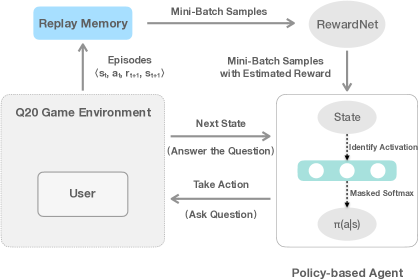
技术框架:整体架构包括两个主要模块:提问者代理和奖励网络。提问者代理负责选择问题,而奖励网络则根据用户的反馈评估问题的有效性。代理通过不断的试错学习来调整其提问策略。
关键创新:最重要的技术创新在于引入了奖励网络,使得代理能够在没有知识库的情况下,通过用户的反馈动态调整提问策略。这一设计使得方法在处理噪声答案时更加鲁棒。
关键设计:在参数设置上,奖励网络的结构经过精心设计,以确保能够准确捕捉用户反馈的有效性。此外,损失函数的选择也经过优化,以提高学习效率和策略的收敛速度。该方法的网络结构采用了深度学习技术,以增强其学习能力。
🖼️ 关键图片
📊 实验亮点
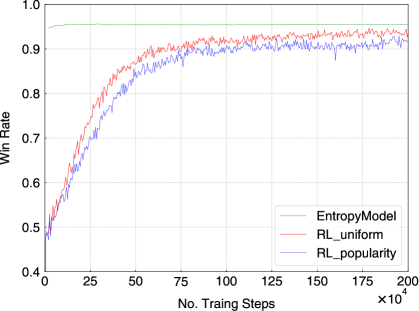
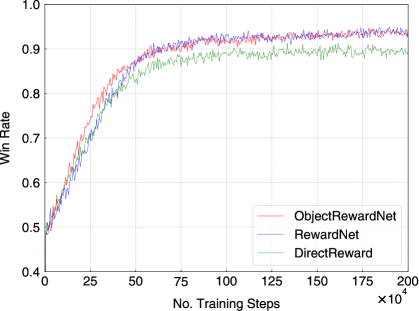
实验结果表明,所提强化学习方法在处理噪声答案时表现出显著的鲁棒性,且在无噪声的仿真环境中,其性能超过了基于熵的传统工程系统,提升幅度明显,展示了该方法的有效性和应用潜力。
🎯 应用场景
该研究的潜在应用领域包括智能问答系统、教育辅助工具和游戏AI等。通过优化提问策略,系统能够更有效地与用户互动,提升用户体验和满意度。未来,该方法还可以扩展到其他需要推理和决策的场景,如医疗诊断和客户服务等。
📄 摘要(原文)
The 20 Questions (Q20) game is a well known game which encourages deductive reasoning and creativity. In the game, the answerer first thinks of an object such as a famous person or a kind of animal. Then the questioner tries to guess the object by asking 20 questions. In a Q20 game system, the user is considered as the answerer while the system itself acts as the questioner which requires a good strategy of question selection to figure out the correct object and win the game. However, the optimal policy of question selection is hard to be derived due to the complexity and volatility of the game environment. In this paper, we propose a novel policy-based Reinforcement Learning (RL) method, which enables the questioner agent to learn the optimal policy of question selection through continuous interactions with users. To facilitate training, we also propose to use a reward network to estimate the more informative reward. Compared to previous methods, our RL method is robust to noisy answers and does not rely on the Knowledge Base of objects. Experimental results show that our RL method clearly outperforms an entropy-based engineering system and has competitive performance in a noisy-free simulation environment.