Artificial General Intelligence (AGI)-Native Wireless Systems: A Journey Beyond 6G
作者: Walid Saad, Omar Hashash, Christo Kurisummoottil Thomas, Christina Chaccour, Merouane Debbah, Narayan Mandayam, Zhu Han
分类: cs.AI, cs.LG, cs.NI
发布日期: 2024-04-29
💡 一句话要点
提出AGI原生无线系统以解决传统技术的局限性
🎯 匹配领域: 支柱二:RL算法与架构 (RL & Architecture)
关键词: 人工智能 无线系统 AGI 数字双胞胎 类比推理 超维计算 认知能力
📋 核心要点
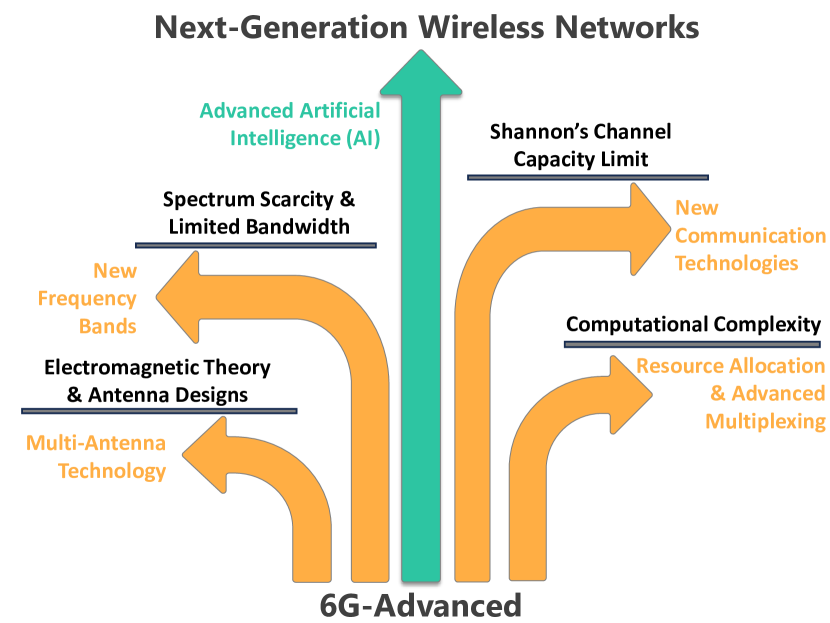
- 现有无线技术在支持复杂服务(如数字双胞胎)方面存在显著局限,传统方法难以满足不断增长的需求。
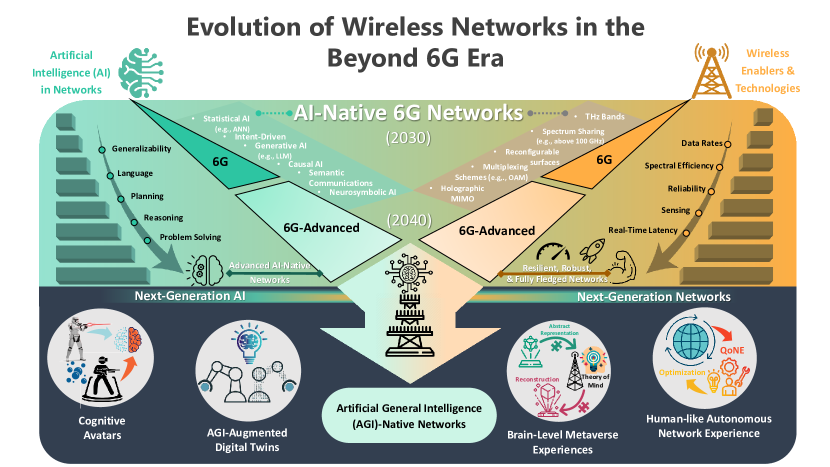
- 论文提出通过感知、类比和推理等认知能力,构建AGI原生无线系统,以应对复杂网络环境和新兴用例。
- 研究展示了AGI原生网络在类比推理、认知化身的同步体验及脑级元宇宙体验等方面的应用潜力。
📝 摘要(中文)
构建支持数字双胞胎等服务的未来无线系统面临挑战,传统技术如超表面难以满足需求。人工智能原生网络虽有潜力,但仍依赖神经网络等工具,难以应对复杂的网络环境和新兴用例的需求。本文重新审视AI原生无线系统,通过感知、类比和推理等认知能力赋予其常识,进而转变为AGI原生系统。我们展示了如何通过将现实元素抽象为可泛化的表示来构建感知模块,并基于因果关系和超维计算原则创建世界模型,以支持类比推理。最后,提出了一系列构建AGI原生系统的建议,展望超越6G时代的未来。
🔬 方法详解
问题定义:本文旨在解决传统无线系统在应对复杂服务需求时的局限性,现有方法主要依赖于神经网络,难以处理动态和复杂的网络环境。
核心思路:通过引入常识和认知能力,构建AGI原生无线系统,使其能够在未知场景中进行有效推理和决策。
技术框架:系统主要包括感知模块、世界模型和意图驱动的规划方法。感知模块将现实元素抽象为可泛化的表示,世界模型基于因果关系和超维计算,支持类比推理。
关键创新:最重要的创新在于将常识引入无线系统,使其能够进行类比推理和应对复杂场景,这与传统依赖于固定规则的系统有本质区别。
关键设计:在设计中,采用了集成信息理论来指导意图驱动和目标驱动的规划方法,确保系统能够灵活应对多变的环境。
🖼️ 关键图片
📊 实验亮点
研究表明,AGI原生网络在类比推理和复杂场景处理方面表现出显著优势,能够在动态环境中实现更高的决策准确性和响应速度,具体性能提升幅度尚未明确。
🎯 应用场景
该研究的潜在应用领域包括下一代数字双胞胎、认知化身的同步体验以及脑级元宇宙体验等。这些应用将极大提升人机交互的智能化和灵活性,推动无线通信技术的进步。
📄 摘要(原文)
Building future wireless systems that support services like digital twins (DTs) is challenging to achieve through advances to conventional technologies like meta-surfaces. While artificial intelligence (AI)-native networks promise to overcome some limitations of wireless technologies, developments still rely on AI tools like neural networks. Such tools struggle to cope with the non-trivial challenges of the network environment and the growing demands of emerging use cases. In this paper, we revisit the concept of AI-native wireless systems, equipping them with the common sense necessary to transform them into artificial general intelligence (AGI)-native systems. These systems acquire common sense by exploiting different cognitive abilities such as perception, analogy, and reasoning, that enable them to generalize and deal with unforeseen scenarios. Towards developing the components of such a system, we start by showing how the perception module can be built through abstracting real-world elements into generalizable representations. These representations are then used to create a world model, founded on principles of causality and hyper-dimensional (HD) computing, that aligns with intuitive physics and enables analogical reasoning, that define common sense. Then, we explain how methods such as integrated information theory play a role in the proposed intent-driven and objective-driven planning methods that maneuver the AGI-native network to take actions. Next, we discuss how an AGI-native network can enable use cases related to human and autonomous agents: a) analogical reasoning for next-generation DTs, b) synchronized and resilient experiences for cognitive avatars, and c) brain-level metaverse experiences like holographic teleportation. Finally, we conclude with a set of recommendations to build AGI-native systems. Ultimately, we envision this paper as a roadmap for the beyond 6G era.