Can AI Understand Our Universe? Test of Fine-Tuning GPT by Astrophysical Data
作者: Yu Wang, Shu-Rui Zhang, Aidin Momtaz, Rahim Moradi, Fatemeh Rastegarnia, Narek Sahakyan, Soroush Shakeri, Liang Li
分类: astro-ph.IM, astro-ph.GA, astro-ph.HE, cs.AI, cs.LG, physics.data-an
发布日期: 2024-04-14
备注: 27 pages, 7 figures. Comments welcome
💡 一句话要点
通过天文数据微调GPT以提升科学数据分析能力
🎯 匹配领域: 支柱九:具身大模型 (Embodied Foundation Models)
关键词: 大型语言模型 天文数据分析 GPT微调 科学研究 机器学习
📋 核心要点
- 现有的科学数据分析方法在处理复杂天文数据时存在局限性,难以有效提取有用信息。
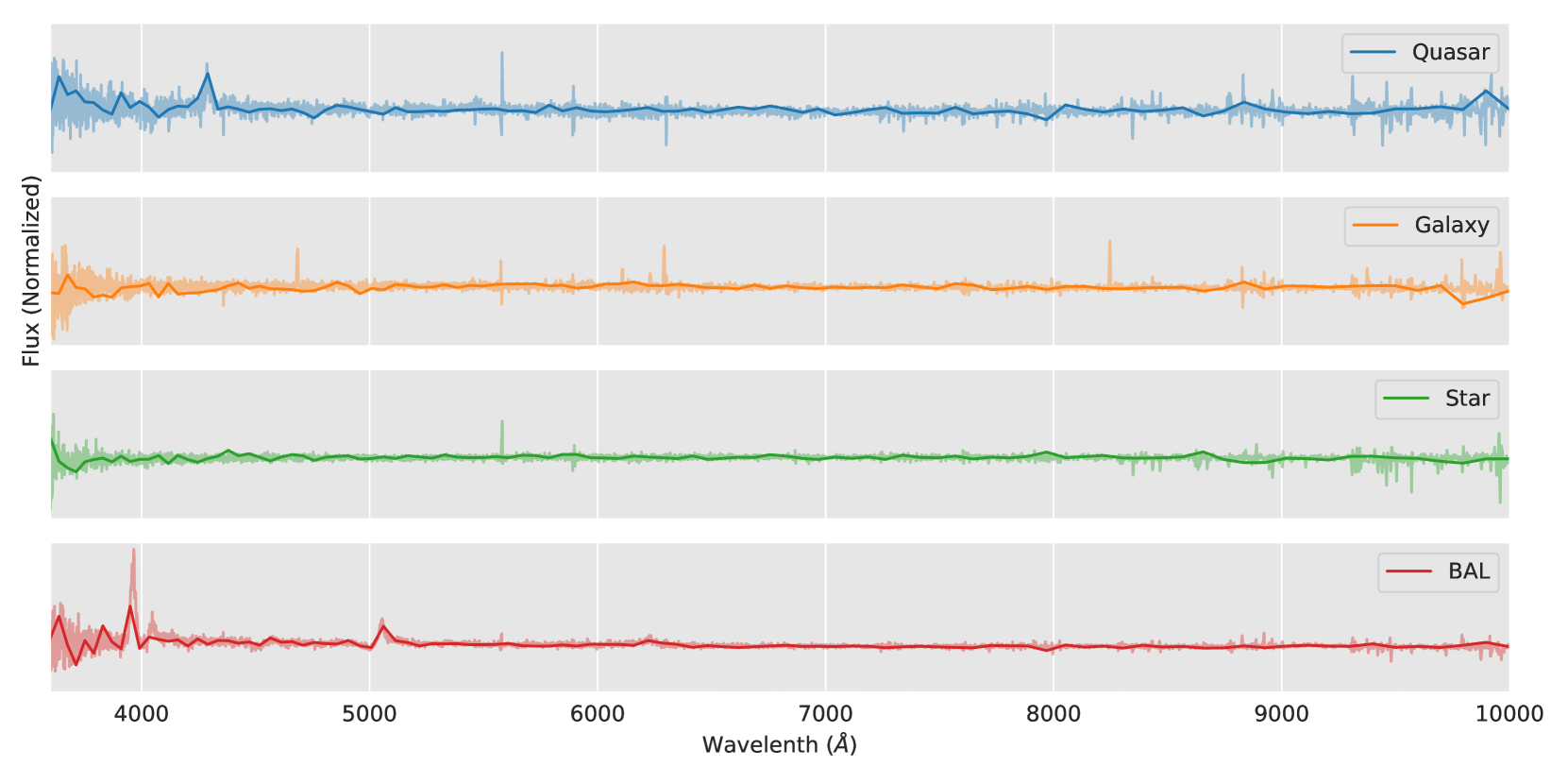
- 论文通过对GPT模型进行微调,利用天文观测数据来提升其在科学数据分析中的表现。
- 实验结果表明,微调后的模型能够准确分类天文现象,并在多个任务上超越传统方法的表现。
📝 摘要(中文)
ChatGPT在近期引发了广泛讨论,尤其是在科学数据分析领域。本文探讨了大型语言模型(LLMs)在分析天文数据方面的能力,研究者们通过对星系、类星体、恒星、伽马射线暴(GRBs)及黑洞(BHs)模拟数据的微调,验证了模型在分类天文现象、区分GRBs类型、推导类星体红移及估计黑洞参数方面的有效性。这一成功测试标志着LLMs在科学研究中的应用潜力,展望未来,随着多学科数据的增长和AI技术的进步,期待对宇宙的更深刻理解。文章还探讨了数据收集和AI设计的思考,并提出了一种系列扩展的方法,以期训练出超越人类的智能AI。
🔬 方法详解
问题定义:本文旨在解决大型语言模型在科学数据分析中的有效性问题,现有方法在处理复杂天文数据时常常无法提供准确的物理分析。
核心思路:通过微调GPT模型,使其能够利用天文观测数据进行科学分析,旨在提升模型对复杂天文现象的理解和分类能力。
技术框架:整体架构包括数据收集、模型微调和性能评估三个主要阶段。首先收集天文观测数据,然后对GPT模型进行针对性的微调,最后通过一系列实验评估模型的表现。
关键创新:最重要的技术创新在于将GPT模型与天文数据相结合,形成了一种新的数据驱动的科学分析方法,这与传统的物理模型分析方法有本质区别。
关键设计:在微调过程中,采用了特定的损失函数以优化模型在分类和参数估计任务中的表现,同时调整了模型的超参数以适应天文数据的特性。
🖼️ 关键图片


📊 实验亮点
实验结果显示,微调后的GPT模型在分类天文现象和推导红移等任务上表现优异,成功区分了两种类型的GRBs,并准确估计了黑洞参数,标志着其在科学研究中的有效性和潜力。
🎯 应用场景
该研究的潜在应用领域包括天文学、物理学及其他科学领域,能够帮助研究人员更高效地分析和理解复杂的天文数据,推动科学研究的进展。未来,随着AI技术的不断发展,该方法可能会在更多学科中得到应用,促进跨学科的研究合作。
📄 摘要(原文)
ChatGPT has been the most talked-about concept in recent months, captivating both professionals and the general public alike, and has sparked discussions about the changes that artificial intelligence (AI) will bring to the world. As physicists and astrophysicists, we are curious about if scientific data can be correctly analyzed by large language models (LLMs) and yield accurate physics. In this article, we fine-tune the generative pre-trained transformer (GPT) model by the astronomical data from the observations of galaxies, quasars, stars, gamma-ray bursts (GRBs), and the simulations of black holes (BHs), the fine-tuned model demonstrates its capability to classify astrophysical phenomena, distinguish between two types of GRBs, deduce the redshift of quasars, and estimate BH parameters. We regard this as a successful test, marking the LLM's proven efficacy in scientific research. With the ever-growing volume of multidisciplinary data and the advancement of AI technology, we look forward to the emergence of a more fundamental and comprehensive understanding of our universe. This article also shares some interesting thoughts on data collection and AI design. Using the approach of understanding the universe - looking outward at data and inward for fundamental building blocks - as a guideline, we propose a method of series expansion for AI, suggesting ways to train and control AI that is smarter than humans.