AIMDiT: Modality Augmentation and Interaction via Multimodal Dimension Transformation for Emotion Recognition in Conversations
作者: Sheng Wu, Jiaxing Liu, Longbiao Wang, Dongxiao He, Xiaobao Wang, Jianwu Dang
分类: cs.MM, cs.AI, cs.CL, eess.AS
发布日期: 2024-04-12
💡 一句话要点
提出AIMDiT以解决对话中的情感识别多模态融合问题
🎯 匹配领域: 支柱二:RL算法与架构 (RL & Architecture) 支柱九:具身大模型 (Embodied Foundation Models)
关键词: 情感识别 多模态融合 自然语言处理 深度学习 对话系统
📋 核心要点
- 现有方法主要关注上下文建模,缺乏有效的多模态融合策略,导致情感识别性能不足。
- 本文提出AIMDiT框架,通过模态增强网络和模态交互网络实现深度特征的有效融合。
- 在MELD数据集上的实验结果显示,AIMDiT在Acc-7和w-F1指标上分别提升了2.34%和2.87%。
📝 摘要(中文)
情感识别在对话中是自然语言处理中的一个热门任务,旨在识别说话者的情感状态。当前研究主要集中在上下文建模上,而对有效的多模态融合方法的研究相对较少。本文提出了一种新颖的框架AIMDiT,以解决深度特征的多模态融合问题。具体而言,我们设计了一个模态增强网络,通过不同模态的维度转换和参数高效的 inception 模块进行丰富的表示学习。同时,模态交互网络执行提取的跨模态特征和模态内特征的交互融合。在公共基准数据集MELD上的实验表明,AIMDiT在Acc-7和w-F1指标上分别比最先进的模型提高了2.34%和2.87%。
🔬 方法详解
问题定义:本文旨在解决对话中的情感识别任务,现有方法在多模态特征融合方面存在不足,影响了识别的准确性和鲁棒性。
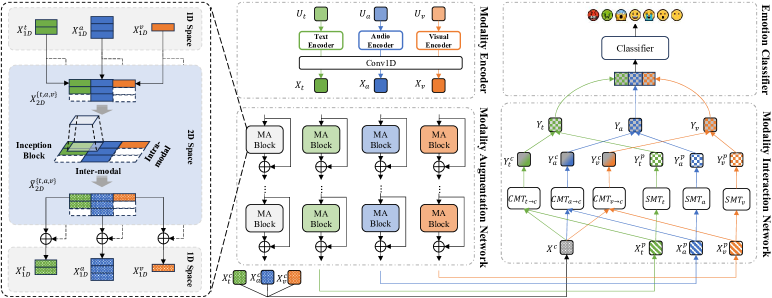
核心思路:AIMDiT框架通过模态增强网络和模态交互网络,分别实现对不同模态的表示学习和特征融合,从而提升情感识别的效果。
技术框架:整体架构包括模态增强网络和模态交互网络。模态增强网络负责通过维度转换和高效的inception模块进行特征提取,而模态交互网络则实现跨模态和模态内特征的融合。
关键创新:最重要的创新在于模态增强网络的设计,通过维度转换实现了不同模态间的丰富表示学习,这在现有方法中尚未得到充分探索。
关键设计:在网络结构上,采用了参数高效的inception模块,确保了模型的计算效率。同时,损失函数设计考虑了多模态特征的交互性,以优化情感识别的性能。
🖼️ 关键图片

📊 实验亮点
在MELD数据集上的实验结果显示,AIMDiT框架在Acc-7和w-F1指标上分别比最先进的模型提高了2.34%和2.87%,显示出显著的性能提升,验证了其有效性。
🎯 应用场景
该研究在情感识别、智能客服、社交机器人等领域具有广泛的应用潜力。通过提升对话中的情感理解能力,可以改善人机交互体验,推动情感计算的发展,并为未来的情感智能系统奠定基础。
📄 摘要(原文)
Emotion Recognition in Conversations (ERC) is a popular task in natural language processing, which aims to recognize the emotional state of the speaker in conversations. While current research primarily emphasizes contextual modeling, there exists a dearth of investigation into effective multimodal fusion methods. We propose a novel framework called AIMDiT to solve the problem of multimodal fusion of deep features. Specifically, we design a Modality Augmentation Network which performs rich representation learning through dimension transformation of different modalities and parameter-efficient inception block. On the other hand, the Modality Interaction Network performs interaction fusion of extracted inter-modal features and intra-modal features. Experiments conducted using our AIMDiT framework on the public benchmark dataset MELD reveal 2.34% and 2.87% improvements in terms of the Acc-7 and w-F1 metrics compared to the state-of-the-art (SOTA) models.