Instruction-Driven Game Engines on Large Language Models
作者: Hongqiu Wu, Yan Wang, Xingyuan Liu, Hai Zhao, Min Zhang
分类: cs.AI
发布日期: 2024-03-30 (更新: 2024-08-23)
💡 一句话要点
提出基于指令驱动的大型语言模型游戏引擎以简化游戏开发
🎯 匹配领域: 支柱九:具身大模型 (Embodied Foundation Models)
关键词: 指令驱动 大型语言模型 游戏引擎 自动生成 自然语言处理 游戏开发 扑克游戏 快速原型化
📋 核心要点
- 核心问题:现有游戏开发方法复杂,门槛高,缺乏灵活性和可定制性。
- 方法要点:通过指令驱动的方式,利用大型语言模型自动生成游戏过程,降低开发难度。
- 实验或效果:初步开发的扑克游戏引擎支持多种变体和高度自定义,展示了快速原型化的能力。
📝 摘要(中文)
指令驱动游戏引擎(IDGE)项目旨在通过使大型语言模型(LLM)能够遵循自由形式的游戏规则并自主生成游戏过程,从而实现游戏开发的民主化。用户可以通过简单的自然语言指令创建游戏,这大大降低了游戏开发的门槛。我们将IDGE的学习过程视为下一状态预测任务,模型自回归地预测给定玩家动作后的游戏状态。为了提高精确度,我们采用了逐步训练的方法,逐渐增加模型对复杂场景的接触。我们的初步进展是开发了一个支持多种扑克变体的IDGE,允许通过自然语言输入高度自定义规则,并支持从最小样本快速原型化新游戏。这项工作为未来的指令驱动游戏创作奠定了基础,可能会改变游戏设计和玩法的方式。
🔬 方法详解
问题定义:本论文旨在解决传统游戏开发中复杂性和高门槛的问题。现有方法往往需要专业知识和大量的时间投入,限制了普通用户的参与。
核心思路:论文提出通过指令驱动的方式,使大型语言模型能够理解并执行自然语言指令,从而自动生成游戏过程。这种设计旨在降低用户的技术门槛,使游戏开发更加民主化。
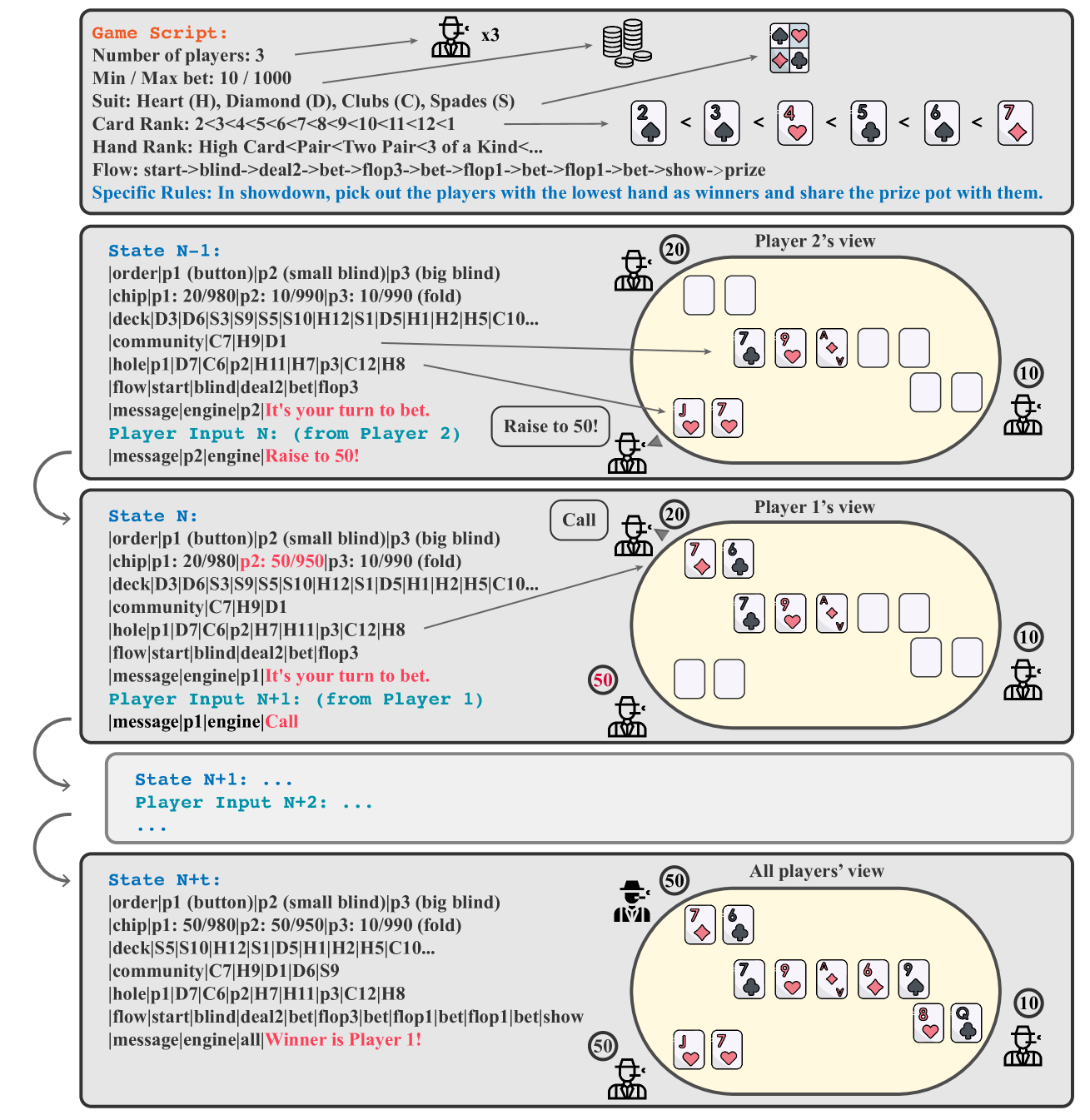
技术框架:整体架构包括自然语言处理模块、状态预测模块和游戏逻辑执行模块。用户通过自然语言输入指令,模型解析指令并预测下一游戏状态,最终执行游戏逻辑。
关键创新:最重要的技术创新在于将游戏状态预测视为自回归任务,并采用逐步训练的方法,逐渐增加模型对复杂场景的接触。这与传统的静态游戏开发方法有本质区别。
关键设计:在训练过程中,采用了特定的损失函数来确保游戏状态的精确预测,同时设计了灵活的网络结构以支持多种游戏规则的自定义。
🖼️ 关键图片

📊 实验亮点
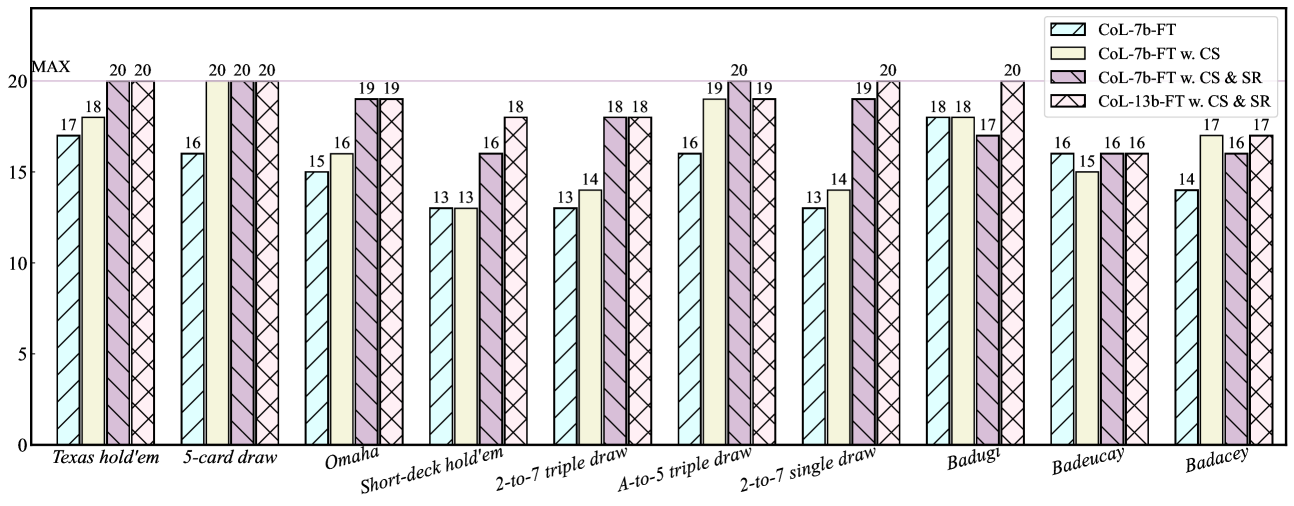
实验结果表明,开发的扑克游戏引擎能够支持多种扑克变体,并允许用户通过自然语言进行高度自定义。与传统方法相比,该引擎在快速原型化方面表现出显著优势,能够在最小样本下迅速生成可玩游戏。
🎯 应用场景
该研究的潜在应用场景包括独立游戏开发、教育游戏设计以及快速原型制作等领域。通过降低游戏开发的门槛,普通用户也能参与到游戏创作中,促进了游戏产业的多样性和创新性。未来,该技术可能会影响游戏设计的整体流程,改变玩家与游戏的互动方式。
📄 摘要(原文)
The Instruction-Driven Game Engine (IDGE) project aims to democratize game development by enabling a large language model (LLM) to follow free-form game rules and autonomously generate game-play processes. The IDGE allows users to create games by issuing simple natural language instructions, which significantly lowers the barrier for game development. We approach the learning process for IDGEs as a Next State Prediction task, wherein the model autoregressively predicts in-game states given player actions. It is a challenging task because the computation of in-game states must be precise; otherwise, slight errors could disrupt the game-play. To address this, we train the IDGE in a curriculum manner that progressively increases the model's exposure to complex scenarios. Our initial progress lies in developing an IDGE for Poker, a universally cherished card game. The engine we've designed not only supports a wide range of poker variants but also allows for high customization of rules through natural language inputs. Furthermore, it also favors rapid prototyping of new games from minimal samples, proposing an innovative paradigm in game development that relies on minimal prompt and data engineering. This work lays the groundwork for future advancements in instruction-driven game creation, potentially transforming how games are designed and played.