How Far Are We on the Decision-Making of LLMs? Evaluating LLMs' Gaming Ability in Multi-Agent Environments
作者: Jen-tse Huang, Eric John Li, Man Ho Lam, Tian Liang, Wenxuan Wang, Youliang Yuan, Wenxiang Jiao, Xing Wang, Zhaopeng Tu, Michael R. Lyu
分类: cs.AI, cs.CL
发布日期: 2024-03-18 (更新: 2025-03-06)
备注: Accepted to ICLR 2025; 11 pages of main text; 26 pages of appendices; Included models: GPT-3.5-{0613, 1106, 0125}, GPT-4-0125, GPT-4o-0806, Gemini-{1.0, 1.5)-Pro, LLaMA-3.1-{7, 70, 405}B, Mixtral-8x{7, 22}B, Qwen-2-72B
🔗 代码/项目: GITHUB
💡 一句话要点
提出GAMA(γ)-Bench框架以评估LLMs在多智能体环境中的决策能力
🎯 匹配领域: 支柱九:具身大模型 (Embodied Foundation Models)
关键词: 大型语言模型 博弈论 多智能体环境 动态评分 决策能力评估 模型泛化 智能系统
📋 核心要点
- 现有方法主要集中在双人博弈场景,缺乏对多智能体环境的全面评估,且测试集设计静态,存在泄漏问题。
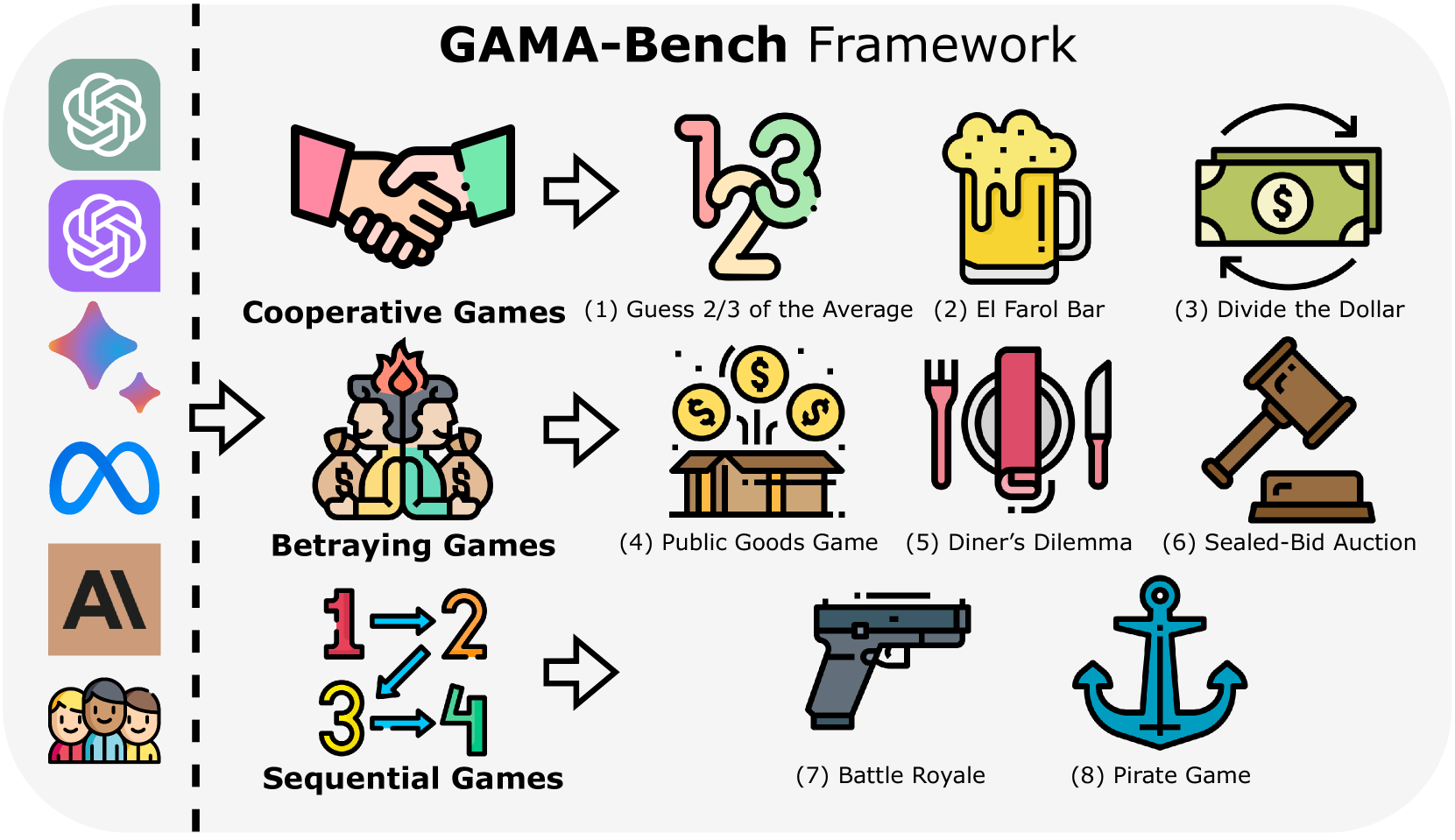
- 本文提出GAMA(γ)-Bench框架,包含八个经典博弈场景和动态评分机制,以定量评估LLMs的游戏能力。
- 实验结果显示,Gemini-1.5-Pro在13个LLMs中表现最佳,得分69.8,表明该框架有效提升了模型的评估能力。
📝 摘要(中文)
决策过程复杂,需要多种能力,因此是评估大型语言模型(LLMs)的良好框架。研究者通过博弈论考察LLMs的决策能力,但现有评估主要集中在双人场景,且测试集存在泄漏问题。本文引入GAMA(γ)-Bench,一个新的框架,用于评估LLMs在多智能体环境中的游戏能力,包含八个经典博弈论场景和动态评分机制,旨在定量评估LLMs的表现。实验结果表明,GPT-3.5展现出强大的鲁棒性,但泛化能力有限,通过链式思维等方法可增强其表现。我们评估了来自六个模型家族的13个LLMs,Gemini-1.5-Pro表现最佳,得分69.8,LLaMA-3.1-70B和Mixtral-8x22B分别得分65.9和62.4。
🔬 方法详解
问题定义:本文旨在解决现有LLMs决策能力评估方法的不足,尤其是在多智能体环境中的应用。现有方法多集中于双人博弈,且静态设计导致测试集泄漏,影响评估的有效性。
核心思路:提出GAMA(γ)-Bench框架,通过动态评分机制和多种博弈场景,全面评估LLMs在多智能体环境中的表现,增强评估的灵活性和准确性。
技术框架:GAMA(γ)-Bench框架包括八个经典博弈场景,采用动态评分系统,能够根据不同游戏参数调整评分方式,涵盖鲁棒性、泛化能力和策略改进等多个维度。
关键创新:最重要的创新在于动态评分机制的引入,使得评估不仅限于静态结果,能够适应不同的游戏设置,从而提供更全面的性能评估。
关键设计:框架设计中,关键参数包括动态评分的算法和博弈场景的选择,确保能够有效反映LLMs在复杂环境中的决策能力。
🖼️ 关键图片


📊 实验亮点
实验结果显示,Gemini-1.5-Pro在13个LLMs中表现最佳,得分69.8,显著高于其他模型,如LLaMA-3.1-70B(65.9)和Mixtral-8x22B(62.4),表明GAMA(γ)-Bench框架在评估LLMs性能方面的有效性。
🎯 应用场景
该研究的潜在应用领域包括智能游戏、自动化决策系统和多智能体协作等。通过评估LLMs在复杂环境中的表现,可以为未来的智能系统设计提供重要参考,推动人工智能在实际应用中的发展。
📄 摘要(原文)
Decision-making is a complex process requiring diverse abilities, making it an excellent framework for evaluating Large Language Models (LLMs). Researchers have examined LLMs' decision-making through the lens of Game Theory. However, existing evaluation mainly focus on two-player scenarios where an LLM competes against another. Additionally, previous benchmarks suffer from test set leakage due to their static design. We introduce GAMA($γ$)-Bench, a new framework for evaluating LLMs' Gaming Ability in Multi-Agent environments. It includes eight classical game theory scenarios and a dynamic scoring scheme specially designed to quantitatively assess LLMs' performance. $γ$-Bench allows flexible game settings and adapts the scoring system to different game parameters, enabling comprehensive evaluation of robustness, generalizability, and strategies for improvement. Our results indicate that GPT-3.5 demonstrates strong robustness but limited generalizability, which can be enhanced using methods like Chain-of-Thought. We also evaluate 13 LLMs from 6 model families, including GPT-3.5, GPT-4, Gemini, LLaMA-3.1, Mixtral, and Qwen-2. Gemini-1.5-Pro outperforms others, scoring of $69.8$ out of $100$, followed by LLaMA-3.1-70B ($65.9$) and Mixtral-8x22B ($62.4$). Our code and experimental results are publicly available at https://github.com/CUHK-ARISE/GAMABench.