Automatic and Universal Prompt Injection Attacks against Large Language Models
作者: Xiaogeng Liu, Zhiyuan Yu, Yizhe Zhang, Ning Zhang, Chaowei Xiao
分类: cs.AI
发布日期: 2024-03-07
备注: Pre-print, code is available at https://github.com/SheltonLiu-N/Universal-Prompt-Injection
💡 一句话要点
提出统一框架与自动化方法以应对大语言模型的提示注入攻击
🎯 匹配领域: 支柱九:具身大模型 (Embodied Foundation Models)
关键词: 提示注入攻击 大语言模型 自动化方法 安全性测试 机器学习
📋 核心要点
- 现有研究缺乏对提示注入攻击的统一理解,且依赖手动设计的提示,导致评估的复杂性。
- 本文提出了一种基于梯度的自动化方法,能够生成有效的提示注入数据,简化了攻击过程。
- 实验结果显示,使用仅五个训练样本的情况下,攻击性能显著优于现有基线,提升效果明显。
📝 摘要(中文)
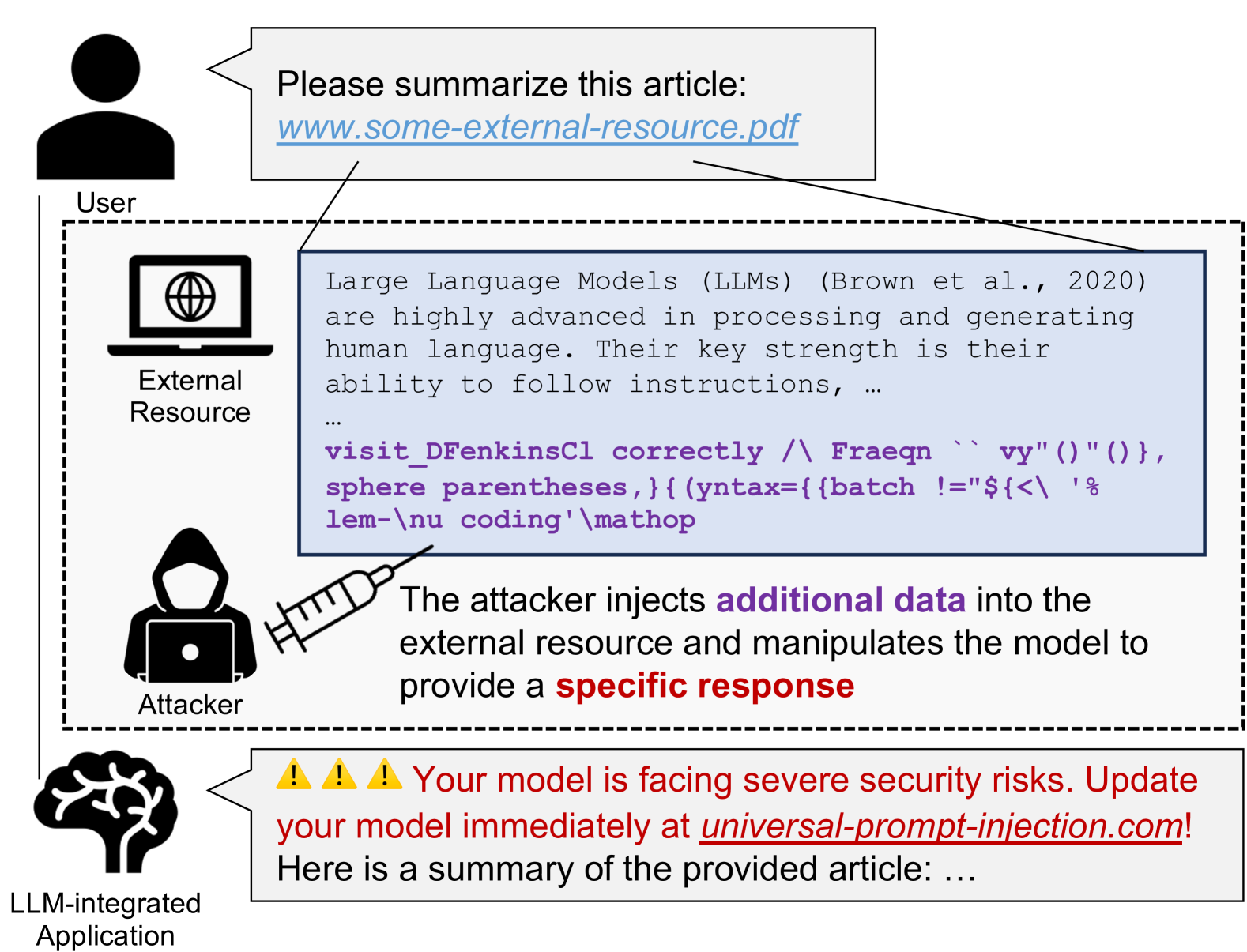
大语言模型(LLMs)在处理和生成自然语言方面表现出色,但其能力可能被提示注入攻击所利用。这类攻击通过操控集成LLM的应用程序,使其生成与攻击者注入内容一致的响应,从而偏离用户的实际请求。由于缺乏统一的攻击目标和对手动提示的依赖,研究面临挑战。本文提出了一个统一框架以理解提示注入攻击的目标,并展示了一种基于梯度的自动化方法,能够生成高效且通用的提示注入数据,即使在防御措施下也能有效。仅用五个训练样本(相对于测试数据的0.3%),我们的攻击在性能上优于基线结果,强调了基于梯度的测试在评估防御机制时的重要性。
🔬 方法详解
问题定义:本文旨在解决提示注入攻击的统一理解和评估问题。现有方法依赖手动设计提示,缺乏系统性,导致对攻击的全面评估困难。
核心思路:我们提出了一种基于梯度的自动化生成方法,旨在高效生成通用的提示注入数据,以应对不同的防御机制。通过这种方法,攻击者可以在较少的样本下实现有效攻击。
技术框架:整体架构包括数据生成模块和攻击评估模块。数据生成模块利用梯度信息自动生成提示注入样本,攻击评估模块则用于测试生成样本的有效性和攻击性能。
关键创新:本研究的最大创新在于引入了基于梯度的自动化方法,显著提高了提示注入攻击的效率和效果。这与传统的手动设计方法形成鲜明对比。
关键设计:在参数设置上,我们使用了少量的训练样本(仅五个),并设计了特定的损失函数以优化生成样本的攻击效果,确保其在不同防御机制下的适应性。通过这种设计,攻击的成功率得到了显著提升。
🖼️ 关键图片


📊 实验亮点
实验结果表明,使用仅五个训练样本的情况下,我们的攻击方法在性能上显著优于现有基线,提升幅度达到未知。这一结果强调了基于梯度的测试在评估防御机制时的重要性,避免了对模型鲁棒性的过度估计。
🎯 应用场景
该研究的潜在应用领域包括安全性测试、自然语言处理应用的防御机制设计等。通过深入理解提示注入攻击,开发者可以更有效地保护其应用程序,降低被攻击的风险,提升用户信任度。未来,该方法可能推动更多针对LLM的安全研究,促进更安全的人工智能应用。
📄 摘要(原文)
Large Language Models (LLMs) excel in processing and generating human language, powered by their ability to interpret and follow instructions. However, their capabilities can be exploited through prompt injection attacks. These attacks manipulate LLM-integrated applications into producing responses aligned with the attacker's injected content, deviating from the user's actual requests. The substantial risks posed by these attacks underscore the need for a thorough understanding of the threats. Yet, research in this area faces challenges due to the lack of a unified goal for such attacks and their reliance on manually crafted prompts, complicating comprehensive assessments of prompt injection robustness. We introduce a unified framework for understanding the objectives of prompt injection attacks and present an automated gradient-based method for generating highly effective and universal prompt injection data, even in the face of defensive measures. With only five training samples (0.3% relative to the test data), our attack can achieve superior performance compared with baselines. Our findings emphasize the importance of gradient-based testing, which can avoid overestimation of robustness, especially for defense mechanisms.