On the Essence and Prospect: An Investigation of Alignment Approaches for Big Models
作者: Xinpeng Wang, Shitong Duan, Xiaoyuan Yi, Jing Yao, Shanlin Zhou, Zhihua Wei, Peng Zhang, Dongkuan Xu, Maosong Sun, Xing Xie
分类: cs.AI, cs.CL
发布日期: 2024-03-07
备注: 23 pages, 7 figures
💡 一句话要点
全面调查大模型对齐方法以解决人类价值偏差问题
🎯 匹配领域: 支柱二:RL算法与架构 (RL & Architecture) 支柱九:具身大模型 (Embodied Foundation Models)
关键词: 大模型 对齐技术 强化学习 监督微调 上下文学习 个人对齐 多模态对齐
📋 核心要点
- 核心问题:现有对齐方法在数据成本和可扩展监督等方面存在挑战,如何实现最佳对齐仍是未解之题。
- 方法要点:本文通过回顾历史和数学本质,系统分析了现有的对齐方法,并探讨了个人和多模态对齐的前沿问题。
- 实验或效果:通过对比不同对齐方法的优缺点,帮助读者理解各方法的内在联系和适用场景。
📝 摘要(中文)
大模型在人工智能领域取得了革命性突破,但也带来了潜在的担忧。为了解决这些问题,引入了对齐技术,使模型符合人类的偏好和价值观。尽管过去一年取得了显著进展,但在建立最佳对齐策略方面仍面临诸多挑战,如数据成本和可扩展监督等。本文全面调查了价值对齐方法,回顾了对齐的历史背景,深入探讨了其数学本质,并详细审视了现有的对齐方法,帮助读者更好地理解这一研究领域。还讨论了个人对齐和多模态对齐等新兴主题,展望未来的对齐范式及其应对挑战的潜力。
🔬 方法详解
问题定义:本文旨在解决大模型对齐过程中存在的挑战,特别是如何使模型符合人类的价值观和偏好。现有方法在数据成本和监督可扩展性方面存在不足,导致对齐效果不理想。
核心思路:论文的核心思路是通过系统回顾和分析现有对齐技术,揭示其内在联系和局限性,从而为未来的研究提供指导。通过分类现有方法,帮助研究者更好地理解不同对齐策略的适用性。
技术框架:整体架构包括三个主要模块:强化学习、监督微调和上下文学习。每个模块都针对特定的对齐需求,提供不同的解决方案和技术路径。
关键创新:最重要的技术创新点在于对现有对齐方法的系统分类和深入分析,揭示了不同方法之间的内在联系及其优缺点,为未来的研究指明了方向。
关键设计:在方法设计中,论文强调了对齐策略的选择、损失函数的设计以及模型训练过程中的参数设置等技术细节,以确保对齐效果的优化。具体的参数设置和网络结构设计在不同方法中有所不同,需根据实际应用场景进行调整。
🖼️ 关键图片


📊 实验亮点
本文通过对比分析现有对齐方法,揭示了不同策略的优缺点,为未来的研究提供了重要参考。特别是在个人对齐和多模态对齐方面,提出了新的研究方向,展现了显著的理论价值和应用潜力。
🎯 应用场景
该研究的潜在应用领域包括人机交互、自动驾驶、智能助手等,能够有效提升大模型在实际应用中的安全性和可靠性。通过优化对齐策略,可以更好地满足用户需求,增强模型的社会适应性,推动人工智能技术的健康发展。
📄 摘要(原文)
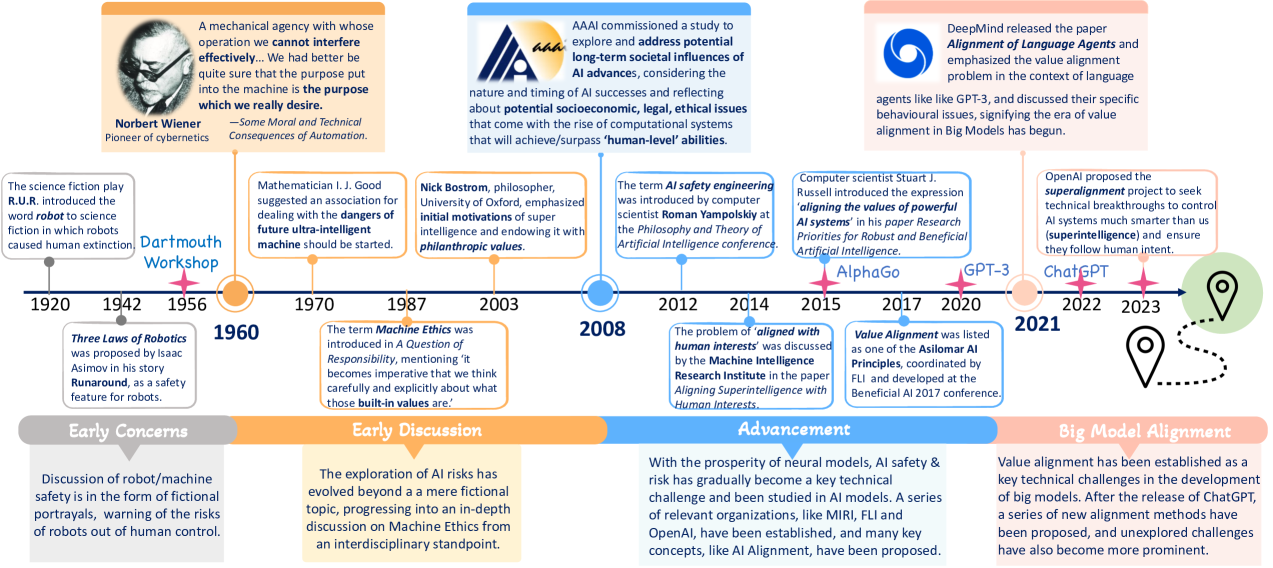
Big models have achieved revolutionary breakthroughs in the field of AI, but they might also pose potential concerns. Addressing such concerns, alignment technologies were introduced to make these models conform to human preferences and values. Despite considerable advancements in the past year, various challenges lie in establishing the optimal alignment strategy, such as data cost and scalable oversight, and how to align remains an open question. In this survey paper, we comprehensively investigate value alignment approaches. We first unpack the historical context of alignment tracing back to the 1920s (where it comes from), then delve into the mathematical essence of alignment (what it is), shedding light on the inherent challenges. Following this foundation, we provide a detailed examination of existing alignment methods, which fall into three categories: Reinforcement Learning, Supervised Fine-Tuning, and In-context Learning, and demonstrate their intrinsic connections, strengths, and limitations, helping readers better understand this research area. In addition, two emerging topics, personal alignment, and multimodal alignment, are also discussed as novel frontiers in this field. Looking forward, we discuss potential alignment paradigms and how they could handle remaining challenges, prospecting where future alignment will go.