Quantum Many-Body Physics Calculations with Large Language Models
作者: Haining Pan, Nayantara Mudur, Will Taranto, Maria Tikhanovskaya, Subhashini Venugopalan, Yasaman Bahri, Michael P. Brenner, Eun-Ah Kim
分类: physics.comp-ph, cond-mat.other, cs.AI
发布日期: 2024-03-05 (更新: 2024-08-22)
备注: 9 pages, 4 figures. Supplemental material in the source file
期刊: Commun Phys 8, 49 (2025)
DOI: 10.1038/s42005-025-01956-y
💡 一句话要点
利用大型语言模型进行量子多体物理计算
🎯 匹配领域: 支柱九:具身大模型 (Embodied Foundation Models)
关键词: 量子物理 大型语言模型 哈特里-福克方法 自动化计算 信息提取 步骤评分 理论假设探索
📋 核心要点
- 现有方法在量子物理计算中面临信息提取和步骤评分的瓶颈,限制了其自动化程度。
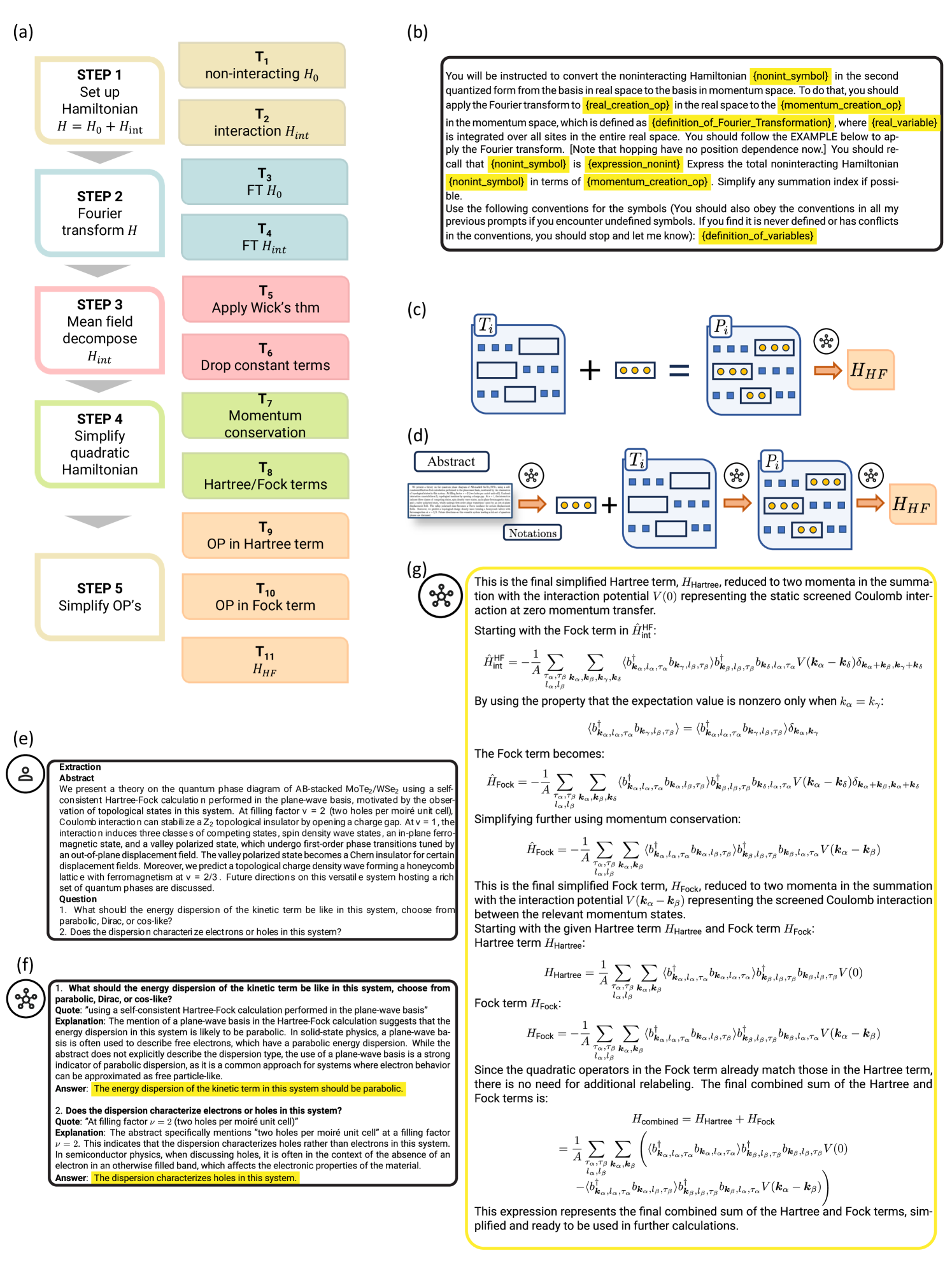
- 论文提出通过设计多步提示模板,利用LLMs分解复杂的哈特里-福克计算过程,提高计算的准确性和效率。
- 实验结果表明,GPT-4在执行计算步骤时表现优异,平均得分为87.5,成功推导出大部分哈密顿量,显示出其在量子物理领域的应用潜力。
📝 摘要(中文)
大型语言模型(LLMs)在多个领域展示了前所未有的复杂任务处理能力,包括数学和科学推理。本文展示了通过精心设计的提示,LLMs能够准确执行理论物理研究论文中的关键计算。我们重点关注量子物理中广泛使用的近似方法:哈特里-福克方法,该方法需要进行多步分析计算以推导近似哈密顿量及相应的自洽方程。通过设计多步提示模板,将分析计算分解为标准化步骤,并填入特定问题的信息。我们评估了GPT-4在过去十年15篇研究论文中的计算执行表现,结果显示在13个案例中正确推导出最终的哈特里-福克哈密顿量,2个案例中存在小错误。所有研究论文的平均得分为87.5(满分100)。
🔬 方法详解
问题定义:本文旨在解决量子物理计算中信息提取和步骤评分的瓶颈,现有方法在自动化执行复杂计算时存在局限性。
核心思路:通过设计多步提示模板,将复杂的哈特里-福克计算分解为标准化步骤,使LLMs能够逐步执行并填入特定信息,从而提高计算的准确性。
技术框架:整体流程包括信息提取、模板填充和计算步骤执行三个主要模块。首先从研究论文中提取必要信息,然后使用模板进行填充,最后通过LLMs执行计算。
关键创新:最重要的创新在于将复杂的量子物理计算转化为可由LLMs处理的标准化步骤,这一方法显著提高了计算的自动化程度和准确性。
关键设计:在设计中,采用了多步提示模板,确保每一步都有明确的占位符以填入特定问题的信息,同时对中间步骤进行校正以提高最终结果的准确性。
🖼️ 关键图片


📊 实验亮点
实验结果显示,GPT-4在执行15篇研究论文中的哈特里-福克计算时,成功推导出13个案例的最终哈密顿量,平均得分为87.5(满分100),展示了其在量子物理计算中的强大能力和潜力。
🎯 应用场景
该研究的潜在应用领域包括量子物理研究、材料科学和计算化学等。通过自动化量子多体计算,研究人员可以更高效地探索理论假设,推动新材料和新技术的开发,具有重要的实际价值和未来影响。
📄 摘要(原文)
Large language models (LLMs) have demonstrated an unprecedented ability to perform complex tasks in multiple domains, including mathematical and scientific reasoning. We demonstrate that with carefully designed prompts, LLMs can accurately carry out key calculations in research papers in theoretical physics. We focus on a broadly used approximation method in quantum physics: the Hartree-Fock method, requiring an analytic multi-step calculation deriving approximate Hamiltonian and corresponding self-consistency equations. To carry out the calculations using LLMs, we design multi-step prompt templates that break down the analytic calculation into standardized steps with placeholders for problem-specific information. We evaluate GPT-4's performance in executing the calculation for 15 research papers from the past decade, demonstrating that, with correction of intermediate steps, it can correctly derive the final Hartree-Fock Hamiltonian in 13 cases and makes minor errors in 2 cases. Aggregating across all research papers, we find an average score of 87.5 (out of 100) on the execution of individual calculation steps. Overall, the requisite skill for doing these calculations is at the graduate level in quantum condensed matter theory. We further use LLMs to mitigate the two primary bottlenecks in this evaluation process: (i) extracting information from papers to fill in templates and (ii) automatic scoring of the calculation steps, demonstrating good results in both cases. The strong performance is the first step for developing algorithms that automatically explore theoretical hypotheses at an unprecedented scale.