Word Importance Explains How Prompts Affect Language Model Outputs
作者: Stefan Hackmann, Haniyeh Mahmoudian, Mark Steadman, Michael Schmidt
分类: cs.AI, cs.CL
发布日期: 2024-03-05
💡 一句话要点
提出基于词重要性的方法以提升语言模型输出的可解释性
🎯 匹配领域: 支柱九:具身大模型 (Embodied Foundation Models)
关键词: 语言模型 可解释性 提示词重要性 统计影响 自然语言处理 模型透明性 偏见检测
📋 核心要点
- 现有大型语言模型的黑箱特性使得其决策过程难以理解,影响透明性和可靠性。
- 本研究提出通过变更提示中的单词来评估其对模型输出的影响,从而提升可解释性。
- 实验结果表明,词重要性评分与多种评分函数的预期后缀重要性密切相关,验证了方法的有效性。
📝 摘要(中文)
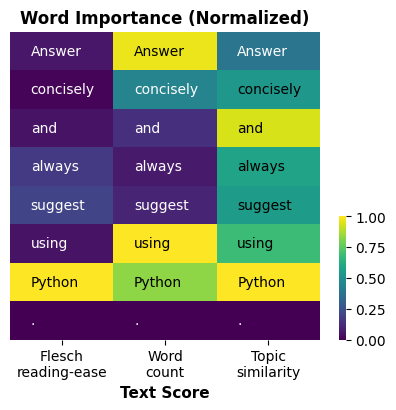
大型语言模型(LLMs)的出现彻底改变了多个行业的应用。然而,其“黑箱”特性常常妨碍对模型决策过程的理解,导致透明性、可靠性和伦理使用方面的担忧。本研究提出了一种通过改变提示中的单词来揭示其对模型输出的统计影响的方法。这种方法受到表格数据的置换重要性启发,通过掩盖系统提示中的每个单词,评估其对输出的影响。与传统注意力机制不同,词重要性测量可以将提示词的影响分解为特定的兴趣度量,包括偏见、阅读水平、冗长性等。这一过程还可以在注意力权重不可用时进行影响测量。
🔬 方法详解
问题定义:本研究旨在解决大型语言模型输出的可解释性问题,现有方法无法有效揭示提示词对模型决策的具体影响。
核心思路:通过掩盖系统提示中的单词,评估每个单词对模型输出的统计影响,从而揭示其重要性。这一方法灵感来源于表格数据的置换重要性。
技术框架:整体流程包括:1) 选择系统提示;2) 逐个掩盖提示中的单词;3) 计算并比较输出的变化;4) 汇总不同用户输入下的文本评分。
关键创新:本研究的创新点在于引入词重要性度量,能够在没有注意力权重的情况下,评估提示词对特定评分的影响,超越了传统的注意力机制。
关键设计:在实验中,采用多种后缀添加到不同的系统提示中,比较不同大型语言模型的生成结果,确保了评估的全面性和准确性。具体的参数设置和评分函数设计也经过精心选择,以确保结果的可靠性。
🖼️ 关键图片


📊 实验亮点
实验结果显示,词重要性评分与多种评分函数的预期后缀重要性高度相关,验证了该方法的有效性。通过对比不同大型语言模型的生成结果,研究表明该方法在提升模型输出可解释性方面具有显著效果,尤其是在处理复杂提示时。
🎯 应用场景
该研究的潜在应用领域包括自然语言处理中的模型透明性提升、用户交互优化以及偏见检测等。通过提高语言模型的可解释性,能够增强用户对模型输出的信任,促进其在更广泛的场景中的应用,尤其是在需要高可靠性的领域如医疗和法律。未来,该方法可能为其他类型的模型可解释性研究提供借鉴。
📄 摘要(原文)
The emergence of large language models (LLMs) has revolutionized numerous applications across industries. However, their "black box" nature often hinders the understanding of how they make specific decisions, raising concerns about their transparency, reliability, and ethical use. This study presents a method to improve the explainability of LLMs by varying individual words in prompts to uncover their statistical impact on the model outputs. This approach, inspired by permutation importance for tabular data, masks each word in the system prompt and evaluates its effect on the outputs based on the available text scores aggregated over multiple user inputs. Unlike classical attention, word importance measures the impact of prompt words on arbitrarily-defined text scores, which enables decomposing the importance of words into the specific measures of interest--including bias, reading level, verbosity, etc. This procedure also enables measuring impact when attention weights are not available. To test the fidelity of this approach, we explore the effect of adding different suffixes to multiple different system prompts and comparing subsequent generations with different large language models. Results show that word importance scores are closely related to the expected suffix importances for multiple scoring functions.