Towards Full Authorship with AI: Supporting Revision with AI-Generated Views
作者: Jiho Kim, Ray C. Flanagan, Noelle E. Haviland, ZeAi Sun, Souad N. Yakubu, Edom A. Maru, Kenneth C. Arnold
分类: cs.HC, cs.AI, cs.CY
发布日期: 2024-03-02
备注: 15 pages, 2 figures; Accepted to 5th Workshop on Human-AI Co-Creation with Generative Models (HAI-GEN) at ACM IUI 2024
💡 一句话要点
提出Textfocals以恢复用户在写作中的自主权
🎯 匹配领域: 支柱三:空间感知与语义 (Perception & Semantics) 支柱九:具身大模型 (Embodied Foundation Models)
关键词: 大型语言模型 写作工具 用户界面设计 创作自主权 人性化设计 写作支持 文本生成 用户研究
📋 核心要点
- 现有的写作工具在使用大型语言模型时,往往会削弱用户的创作控制权和自主性。
- 论文提出Textfocals,通过提供LLM生成的辅助信息,鼓励用户反思和自我修订,而非直接生成文本。
- 初步用户研究表明,Textfocals能够帮助用户发展想法并改善写作,但也暴露出设计上的一些挑战。
📝 摘要(中文)
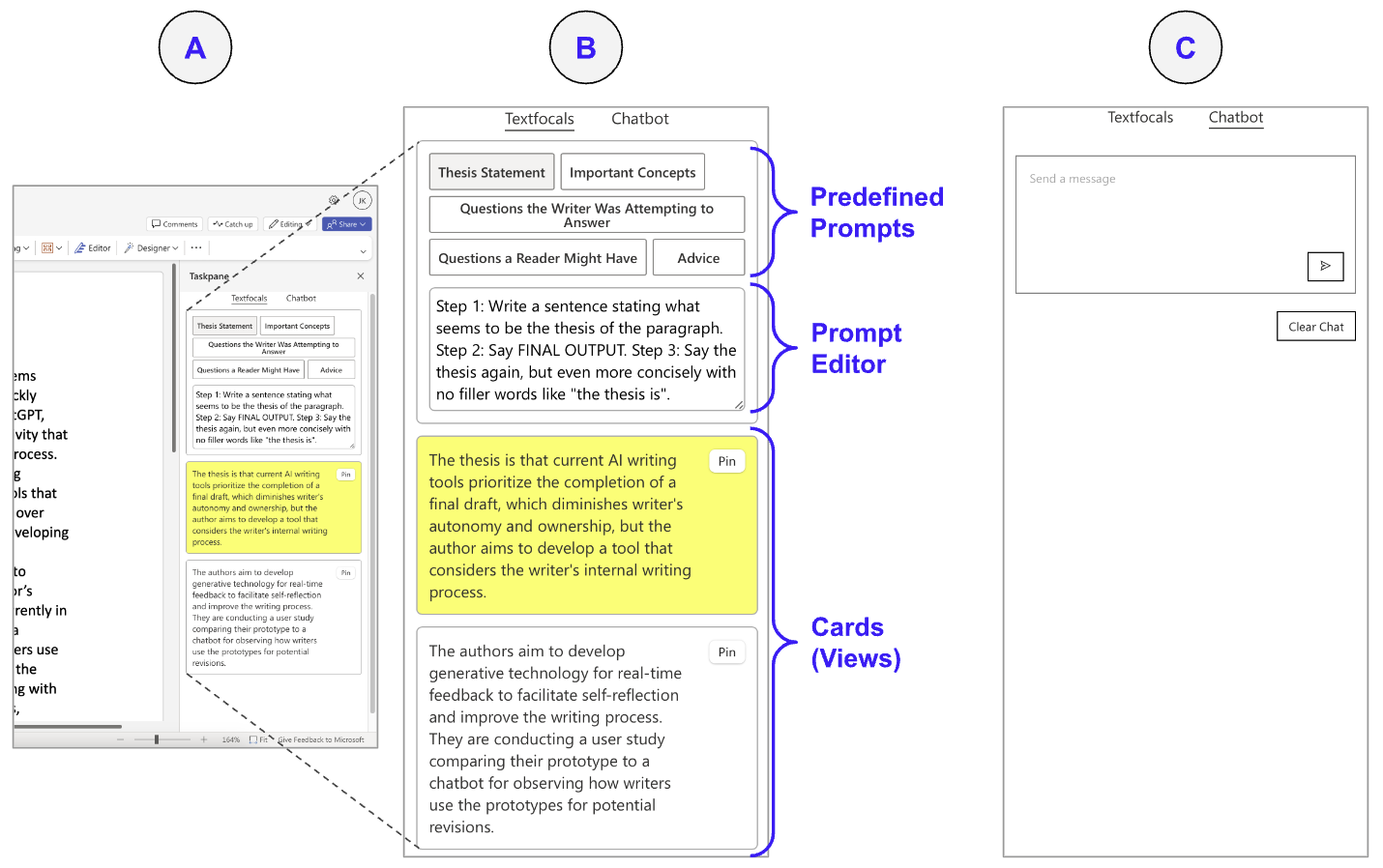
大型语言模型(LLMs)正在通过提示生成文本,改变写作工具的用户界面(UI)范式。这种范式将部分创作控制权从用户转移到系统,从而降低了用户在写作过程中的作者身份和自主性。为恢复自主性,我们提出了Textfocals,这是一个UI原型,旨在探讨以人为中心的方法,强调用户在写作中的角色。Textfocals通过在文本编辑器的侧边栏提供LLM生成的摘要、问题和建议(即LLM视图),支持写作过程,鼓励反思和自我驱动的修订,而不是直接生成文本。Textfocals的UI特性,包括上下文自适应视图和提示选择与定制的支架,提供了一种与LLMs互动的新方式,使用户保持对其写作的完全作者身份。对Textfocals的初步用户研究显示,这种方法可能帮助用户发展未充分发展的想法,迎合修辞受众,并澄清写作。然而,研究也显示出与文档导航、范围界定、提示工程和上下文管理相关的交互设计挑战。我们的工作强调了由生成AI驱动的写作支持界面的设计空间的广度,保持了作者身份的完整性。
🔬 方法详解
问题定义:论文要解决的问题是如何在使用大型语言模型的写作工具中恢复用户的创作自主权。现有方法往往使用户依赖系统生成文本,导致作者身份的弱化。
核心思路:论文的核心解决思路是设计Textfocals,一个侧重于用户角色的UI原型,通过提供生成的摘要、问题和建议,支持用户的写作过程,而不直接生成文本。
技术框架:Textfocals的整体架构包括一个文本编辑器的侧边栏,展示LLM生成的内容,用户可以根据这些内容进行反思和修订。主要模块包括上下文自适应视图、提示选择和定制支架。
关键创新:最重要的技术创新点在于通过侧边栏提供LLM视图,使用户在写作过程中保持完全的作者身份,这与现有方法的直接文本生成方式本质上不同。
关键设计:关键设计包括上下文自适应的视图展示、用户友好的提示选择界面,以及对用户输入的实时反馈机制,以增强用户的参与感和控制感。
🖼️ 关键图片

📊 实验亮点
初步用户研究表明,Textfocals能够有效帮助用户发展未充分发展的想法,改善写作的清晰度和针对性。尽管存在文档导航和上下文管理等设计挑战,但用户反馈显示出对这种新型写作支持工具的积极反应。
🎯 应用场景
该研究的潜在应用领域包括教育、创意写作和专业写作工具。通过提供更具人性化的写作支持,Textfocals能够帮助用户在写作过程中保持创作的自主性,提升写作质量,促进更深层次的思考与表达。未来,这种方法可能会影响写作工具的设计理念,推动更智能的写作辅助系统的发展。
📄 摘要(原文)
Large language models (LLMs) are shaping a new user interface (UI) paradigm in writing tools by enabling users to generate text through prompts. This paradigm shifts some creative control from the user to the system, thereby diminishing the user's authorship and autonomy in the writing process. To restore autonomy, we introduce Textfocals, a UI prototype designed to investigate a human-centered approach that emphasizes the user's role in writing. Textfocals supports the writing process by providing LLM-generated summaries, questions, and advice (i.e., LLM views) in a sidebar of a text editor, encouraging reflection and self-driven revision in writing without direct text generation. Textfocals' UI affordances, including contextually adaptive views and scaffolding for prompt selection and customization, offer a novel way to interact with LLMs where users maintain full authorship of their writing. A formative user study with Textfocals showed promising evidence that this approach might help users develop underdeveloped ideas, cater to the rhetorical audience, and clarify their writing. However, the study also showed interaction design challenges related to document navigation and scoping, prompt engineering, and context management. Our work highlights the breadth of the design space of writing support interfaces powered by generative AI that maintain authorship integrity.