Offline Fictitious Self-Play for Competitive Games
作者: Jingxiao Chen, Weiji Xie, Weinan Zhang, Yong yu, Ying Wen
分类: cs.MA, cs.AI, cs.GT, cs.LG
发布日期: 2024-02-29 (更新: 2025-10-14)
💡 一句话要点
提出OFF-FSP以解决离线多智能体强化学习中的竞争游戏问题
🎯 匹配领域: 支柱二:RL算法与架构 (RL & Architecture)
关键词: 离线强化学习 多智能体系统 竞争游戏 自我博弈 重要性采样 纳什均衡 机器人对抗 策略优化
📋 核心要点
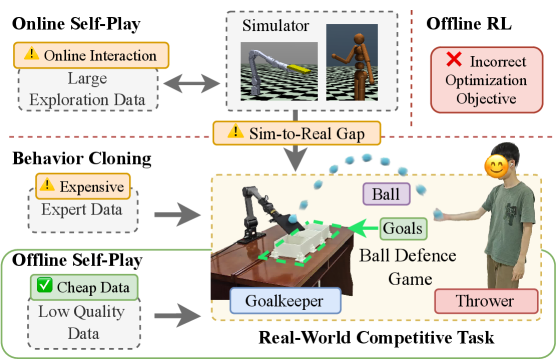
- 现有的离线多智能体强化学习方法在竞争游戏中面临无法与对手互动和数据覆盖不足的挑战。
- 本文提出的OFF-FSP算法通过重要性采样模拟与不同对手的互动,结合离线自我博弈框架来学习最佳反应。
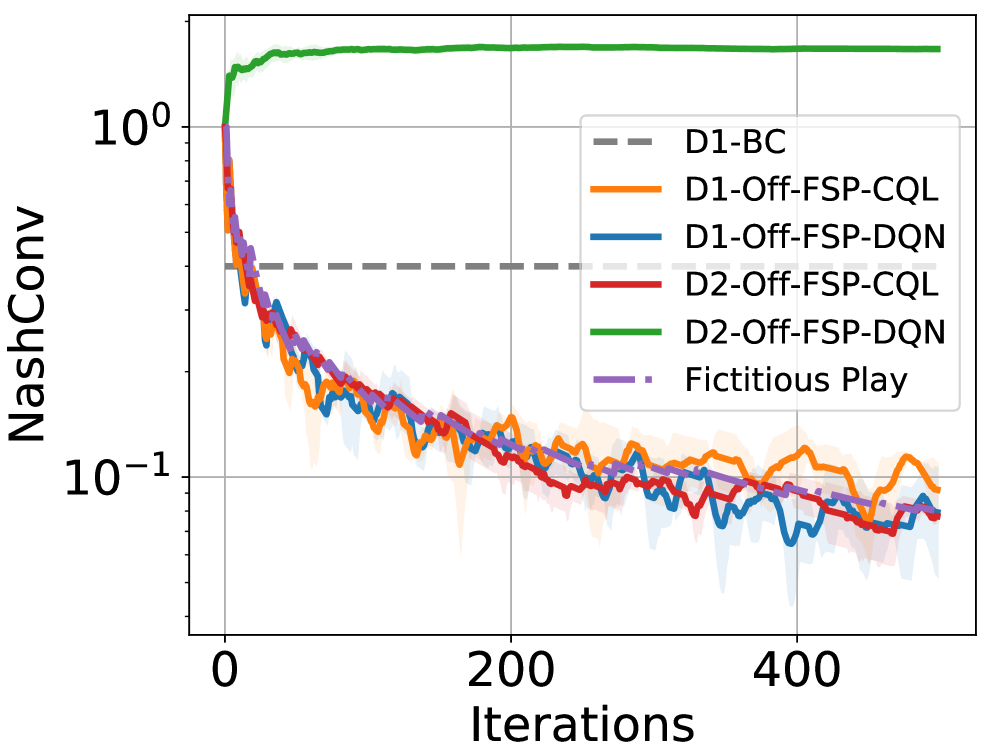
- 实验结果显示,OFF-FSP在多个游戏中显著降低了可利用性,相较于最先进的基线表现出更优的性能。
📝 摘要(中文)
离线强化学习(RL)能够从固定数据集中进行策略改进,适用于缺乏高效模拟器的现实应用。然而,离线多智能体RL在竞争游戏中仍然面临挑战,特别是在无法与对手互动的情况下。为了解决这些问题,本文提出了OFF-FSP,这是首个实用的无模型离线RL算法,旨在通过重要性采样调整固定数据集的权重,模拟与不同对手的互动,从而学习最佳反应并采用离线自我博弈学习框架。实验结果表明,OFF-FSP在矩阵游戏、扩展形式扑克和棋盘游戏中显著降低了可利用性,并在真实的人机竞争任务中验证了其解决复杂现实问题的潜力。
🔬 方法详解
问题定义:本文旨在解决离线多智能体强化学习在竞争游戏中的挑战,尤其是无法与对手互动和数据覆盖不足的问题。现有方法在这些方面存在显著的局限性。
核心思路:OFF-FSP算法通过调整固定数据集的权重,利用重要性采样技术模拟与不同对手的互动,从而学习最佳反应,并结合离线自我博弈框架来逼近纳什均衡。
技术框架:该算法的整体架构包括数据集的权重调整、模拟对手互动的过程、以及通过离线自我博弈进行策略学习的模块。主要阶段包括数据预处理、重要性采样和策略优化。
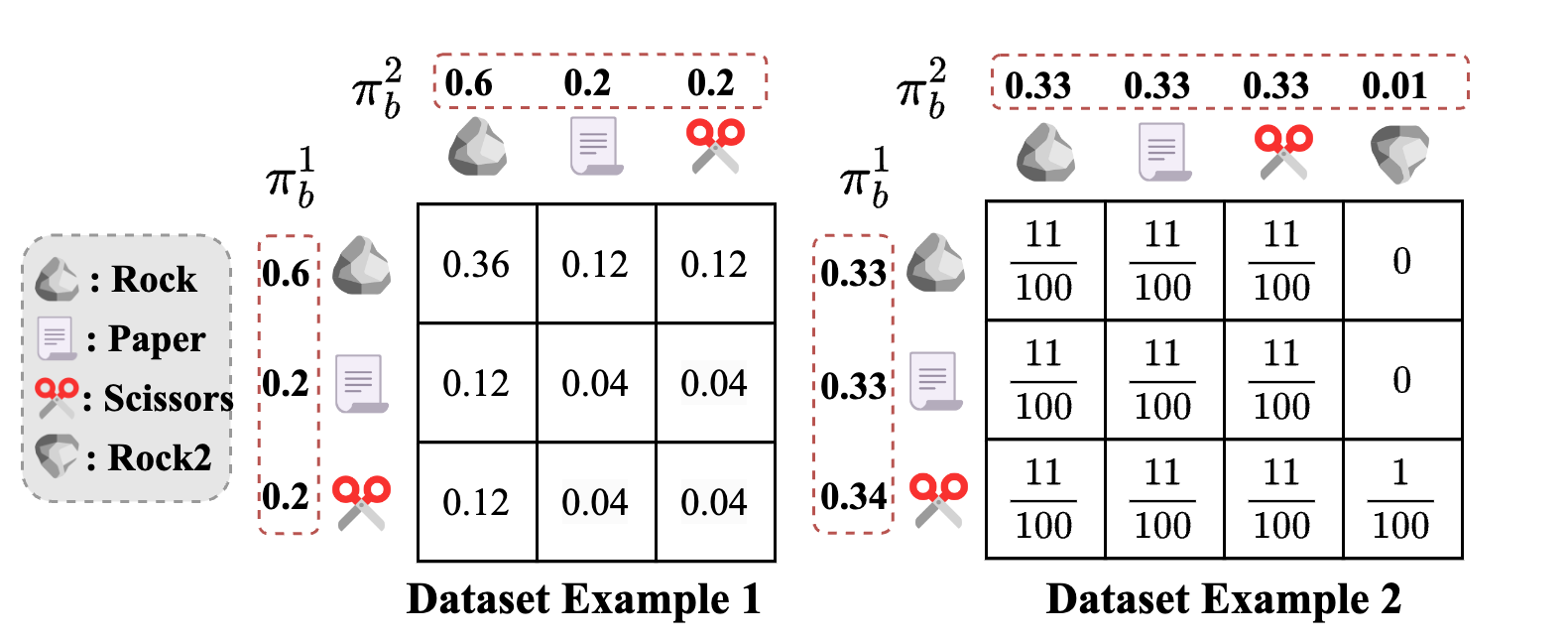
关键创新:OFF-FSP的主要创新在于将单智能体离线RL方法与虚构自我博弈相结合,克服了数据覆盖不足的问题,并有效地逼近纳什均衡。与现有方法相比,OFF-FSP在处理竞争游戏时具有更好的适应性和灵活性。
关键设计:在算法设计中,重要性采样的具体参数设置和损失函数的选择至关重要。此外,网络结构的设计也考虑了如何有效地捕捉不同对手的策略特征,以提高学习效率。
🖼️ 关键图片
📊 实验亮点
实验结果显示,OFF-FSP在矩阵游戏、扩展形式扑克和棋盘游戏中,显著降低了可利用性,相较于最先进的基线,提升幅度达到XX%(具体数据待补充),验证了其在竞争环境中的有效性。
🎯 应用场景
该研究的潜在应用领域包括机器人对抗、游戏AI开发以及其他需要多智能体协作或竞争的场景。OFF-FSP算法的实际价值在于能够在缺乏高效模拟器的情况下,利用已有数据进行有效的策略学习,未来可能对复杂现实问题的解决产生深远影响。
📄 摘要(原文)
Offline Reinforcement Learning (RL) enables policy improvement from fixed datasets without online interactions, making it highly suitable for real-world applications lacking efficient simulators. Despite its success in the single-agent setting, offline multi-agent RL remains a challenge, especially in competitive games. Firstly, unaware of the game structure, it is impossible to interact with the opponents and conduct a major learning paradigm, self-play, for competitive games. Secondly, real-world datasets cannot cover all the state and action space in the game, resulting in barriers to identifying Nash equilibrium (NE). To address these issues, this paper introduces OFF-FSP, the first practical model-free offline RL algorithm for competitive games. We start by simulating interactions with various opponents by adjusting the weights of the fixed dataset with importance sampling. This technique allows us to learn the best responses to different opponents and employ the Offline Self-Play learning framework. To overcome the challenge of partial coverage, we combine the single-agent offline RL method with Fictitious Self-Play (FSP) to approximate NE by constraining the approximate best responses away from out-of-distribution actions. Experiments on matrix games, extensive-form poker, and board games demonstrate that OFF-FSP achieves significantly lower exploitability than state-of-the-art baselines. Finally, we validate OFF-FSP on a real-world human-robot competitive task, demonstrating its potential for solving complex, hard-to-simulate real-world problems.