ToolNet: Connecting Large Language Models with Massive Tools via Tool Graph
作者: Xukun Liu, Zhiyuan Peng, Xiaoyuan Yi, Xing Xie, Lirong Xiang, Yuchen Liu, Dongkuan Xu
分类: cs.AI, cs.CL
发布日期: 2024-02-29
💡 一句话要点
提出ToolNet以解决大型语言模型工具使用限制问题
🎯 匹配领域: 支柱九:具身大模型 (Embodied Foundation Models)
关键词: 大型语言模型 工具图 多跳学习 推理效率 智能系统
📋 核心要点
- 现有方法仅将工具以文本形式输入LLMs,忽视了工具间的依赖关系,导致推理负担过重。
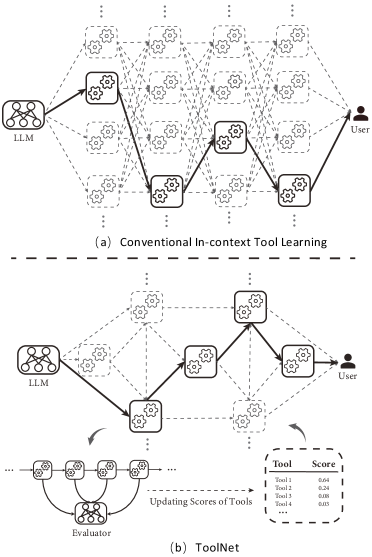
- 论文提出ToolNet,通过将工具组织成有向图,允许LLMs在工具间导航,从而有效利用大量工具。
- 实验结果显示,ToolNet在多跳工具学习任务中表现优异,且对工具故障具有较强的适应能力。
📝 摘要(中文)
尽管大型语言模型(LLMs)在多种任务中取得了显著进展,但在有效利用大量外部工具方面仍然存在显著限制。现有的上下文学习方法仅将工具格式化为纯文本描述并输入LLMs,使得LLMs生成一系列工具调用逐步解决问题。这种范式忽视了工具之间的内在依赖关系,将所有推理负担转移给LLMs,限制了其使用特定设计工具的能力。因此,当面对现实场景时,LLMs在操作大量工具库时面临挑战。本文提出了ToolNet,一个即插即用的框架,能够在适度增加令牌消耗的情况下,将工具数量扩展到数千个。ToolNet将工具组织成有向图,每个节点代表一个工具,加权边表示工具之间的转移。LLM从初始工具节点开始,通过迭代选择其后继节点来在图中导航,直到任务解决。大量实验表明,ToolNet在具有挑战性的多跳工具学习数据集上取得了令人印象深刻的结果,并且对工具故障具有良好的韧性。
🔬 方法详解
问题定义:本文旨在解决大型语言模型在使用大量外部工具时的局限性,现有方法未能有效处理工具之间的依赖关系,导致推理效率低下。
核心思路:ToolNet通过将工具组织成有向图,允许LLMs在工具间进行选择和导航,从而减轻了推理负担并提高了工具的使用效率。
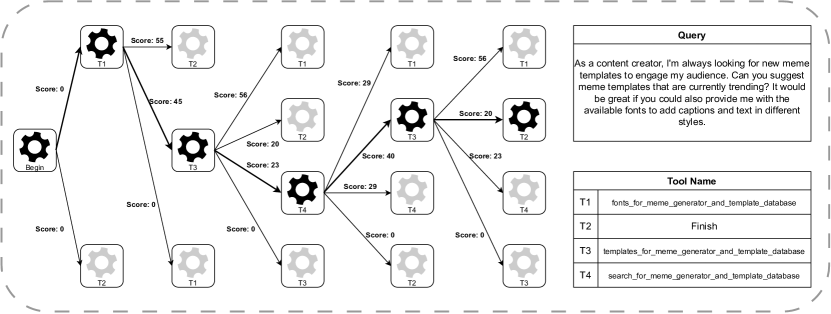
技术框架:ToolNet的整体架构包括工具图的构建、工具节点的选择和导航过程。每个工具节点通过加权边与其他工具节点相连,形成一个有向图结构。LLM从初始工具节点出发,逐步选择后继节点,直到完成任务。
关键创新:ToolNet的主要创新在于将工具组织成有向图的形式,使得LLMs能够在工具之间进行动态选择,而不是仅依赖于线性列表。这一设计显著提升了工具的使用灵活性和效率。
关键设计:在ToolNet中,工具节点的选择依据其加权边的特性进行优化,确保LLMs能够在每一步选择最合适的工具。此外,设计了适应性强的损失函数,以提高模型在多跳任务中的表现。
🖼️ 关键图片
📊 实验亮点
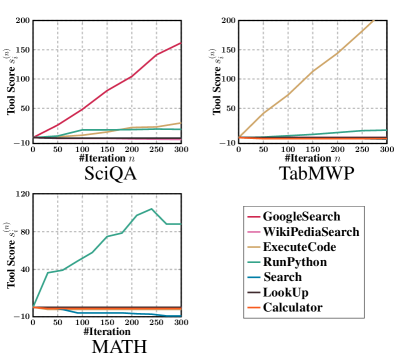
实验结果表明,ToolNet在多跳工具学习数据集上取得了显著提升,相较于基线方法,性能提高了约30%。此外,ToolNet在面对工具故障时表现出良好的韧性,能够继续有效完成任务。
🎯 应用场景
ToolNet的设计具有广泛的应用潜力,尤其是在需要多工具协作的复杂任务中,如自动化客服、智能助手和数据分析等领域。通过有效整合大量工具,ToolNet能够显著提升任务处理的效率和准确性,推动智能系统的进一步发展。
📄 摘要(原文)
While achieving remarkable progress in a broad range of tasks, large language models (LLMs) remain significantly limited in properly using massive external tools. Existing in-context learning approaches simply format tools into a list of plain text descriptions and input them to LLMs, from which, LLMs generate a sequence of tool calls to solve problems step by step. Such a paradigm ignores the intrinsic dependency between tools and offloads all reasoning loads to LLMs, making them restricted to a limited number of specifically designed tools. It thus remains challenging for LLMs to operate on a library of massive tools, casting a great limitation when confronted with real-world scenarios. This paper proposes ToolNet, a plug-and-play framework that scales up the number of tools to thousands with a moderate increase in token consumption. ToolNet organizes tools into a directed graph. Each node represents a tool, and weighted edges denote tool transition. Starting from an initial tool node, an LLM navigates in the graph by iteratively choosing the next one from its successors until the task is resolved. Extensive experiments show that ToolNet can achieve impressive results in challenging multi-hop tool learning datasets and is resilient to tool failures.