Case-Based or Rule-Based: How Do Transformers Do the Math?
作者: Yi Hu, Xiaojuan Tang, Haotong Yang, Muhan Zhang
分类: cs.AI, cs.CL
发布日期: 2024-02-27 (更新: 2024-06-26)
💡 一句话要点
提出规则跟随微调技术以解决变换器数学推理问题
🎯 匹配领域: 支柱九:具身大模型 (Embodied Foundation Models)
关键词: 规则推理 案例推理 变换器 微调技术 数学问题 人工智能 机器学习
📋 核心要点
- 现代大型语言模型在处理简单数学问题时表现不佳,主要依赖于训练语料中的相似案例,而非系统性规则。
- 提出规则跟随微调(RFFT)技术,通过提供明确的规则指导变换器逐步进行推理,以促进规则基础的推理能力。
- 实验表明,经过RFFT微调的模型在12位数加法任务上取得了超过95%的准确率,显著优于传统方法。
📝 摘要(中文)
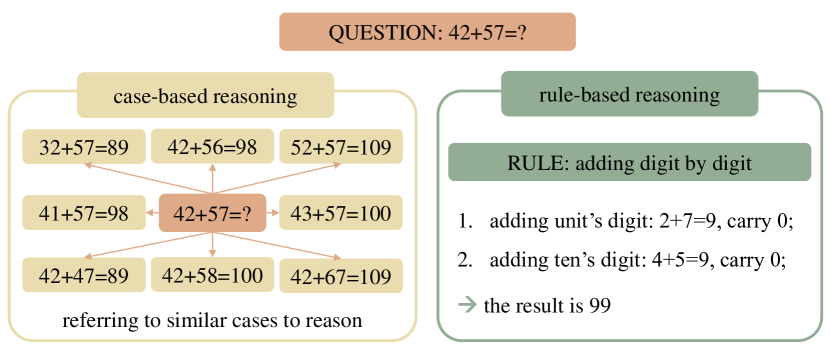
尽管现代大型语言模型在多种复杂任务中表现出色,但在处理一些简单的数学问题时仍然存在困难。本文定义了“基于规则的推理”和“基于案例的推理”两种不同的推理机制,并通过实验确认变换器在数学问题上主要依赖于基于案例的推理。为了解决这一问题,本文提出了一种规则跟随微调(RFFT)技术,通过明确的规则指导变换器逐步进行推理。实验结果表明,经过RFFT微调的模型在1-5位数加法上能够推广到12位数加法,准确率超过95%,比使用草稿纸的方法提高了40%以上。
🔬 方法详解
问题定义:本文旨在解决变换器在数学问题上依赖案例推理而非规则推理的局限性。现有方法在处理简单数学问题时,无法有效进行系统性推理,导致性能不足。
核心思路:通过引入规则跟随微调(RFFT)技术,明确提供数学规则并指导变换器逐步遵循这些规则,从而提升其规则基础的推理能力。
技术框架:整体架构包括输入明确的数学规则、变换器模型的逐步推理过程,以及最终的输出结果。主要模块包括规则输入模块、推理过程模块和结果评估模块。
关键创新:最重要的创新点在于通过RFFT技术显著提升变换器的规则推理能力,使其能够在更复杂的数学任务中实现更高的准确率。这与传统依赖案例推理的方法本质上不同。
关键设计:在RFFT中,设计了明确的规则输入格式,并采用逐步推理的方式进行训练,确保模型能够理解并遵循规则。损失函数和网络结构经过调整,以适应新的推理任务。
🖼️ 关键图片

📊 实验亮点
实验结果显示,经过规则跟随微调的模型在1-5位数加法任务上成功推广到12位数加法,准确率超过95%,相比于使用草稿纸的传统方法提升了40%以上。这一显著的性能提升验证了规则基础推理的重要性。
🎯 应用场景
该研究的潜在应用领域包括教育技术、智能辅导系统和自动化数学问题解决工具。通过提升模型的规则推理能力,可以在更广泛的数学任务中实现更高的准确性,从而为学生和教育工作者提供更有效的支持。未来,这一技术有望扩展到其他领域的推理任务中。
📄 摘要(原文)
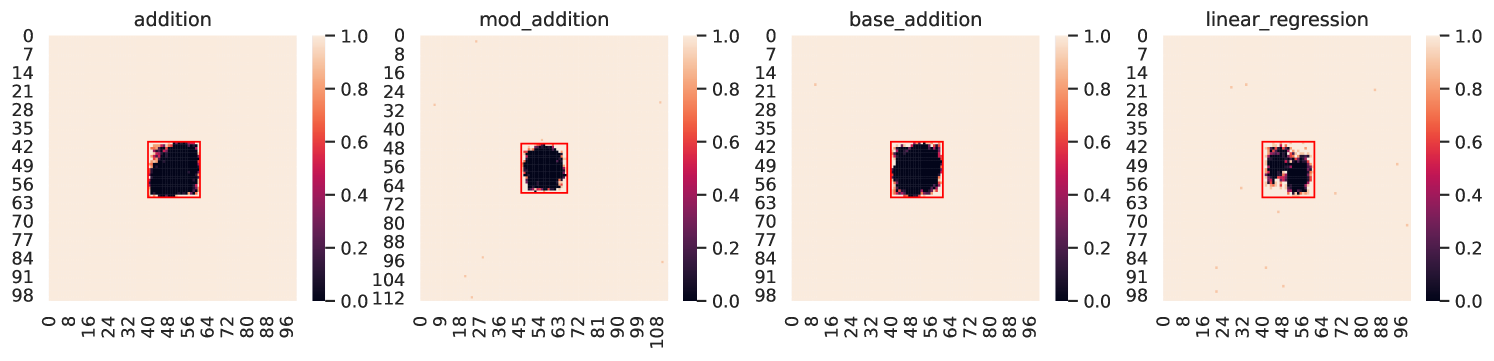
Despite the impressive performance in a variety of complex tasks, modern large language models (LLMs) still have trouble dealing with some math problems that are simple and intuitive for humans, such as addition. While we can easily learn basic rules of addition and apply them to new problems of any length, LLMs struggle to do the same. Instead, they may rely on similar cases seen in the training corpus for help. We define these two different reasoning mechanisms as "rule-based reasoning" and "case-based reasoning". Since rule-based reasoning is essential for acquiring systematic generalization ability, we aim to explore exactly whether transformers use rule-based or case-based reasoning for math problems. Through carefully designed intervention experiments on five math tasks, we confirm that transformers are performing case-based reasoning, no matter whether scratchpad is used, which aligns with the previous observations that transformers use subgraph matching/shortcut learning to reason. To mitigate such problems, we propose a Rule-Following Fine-Tuning (RFFT) technique to teach transformers to perform rule-based reasoning. Specifically, we provide explicit rules in the input and then instruct transformers to recite and follow the rules step by step. Through RFFT, we successfully enable LLMs fine-tuned on 1-5 digit addition to generalize to up to 12-digit addition with over 95% accuracy, which is over 40% higher than scratchpad. The significant improvement demonstrates that teaching LLMs to use rules explicitly helps them learn rule-based reasoning and generalize better in length.