Reinforcement Learning Jazz Improvisation: When Music Meets Game Theory
作者: Vedant Tapiavala, Joshua Piesner, Sourjyamoy Barman, Feng Fu
分类: physics.soc-ph, cs.AI, cs.LG, cs.SD, eess.AS
发布日期: 2024-02-25
备注: 16 pages, 4 figures
💡 一句话要点
提出基于强化学习的爵士即兴演奏模型以探索音乐与博弈论的结合
🎯 匹配领域: 支柱二:RL算法与架构 (RL & Architecture)
关键词: 爵士即兴演奏 强化学习 博弈论 音乐理论 计算建模 策略优化 人工智能
📋 核心要点
- 爵士即兴演奏的不可预测性使得现有的音乐理论和即兴方法研究面临挑战,缺乏系统化的理论框架。
- 本文提出了一种基于博弈论的数学模型,结合强化学习方法,探索多种即兴演奏策略及其效果。
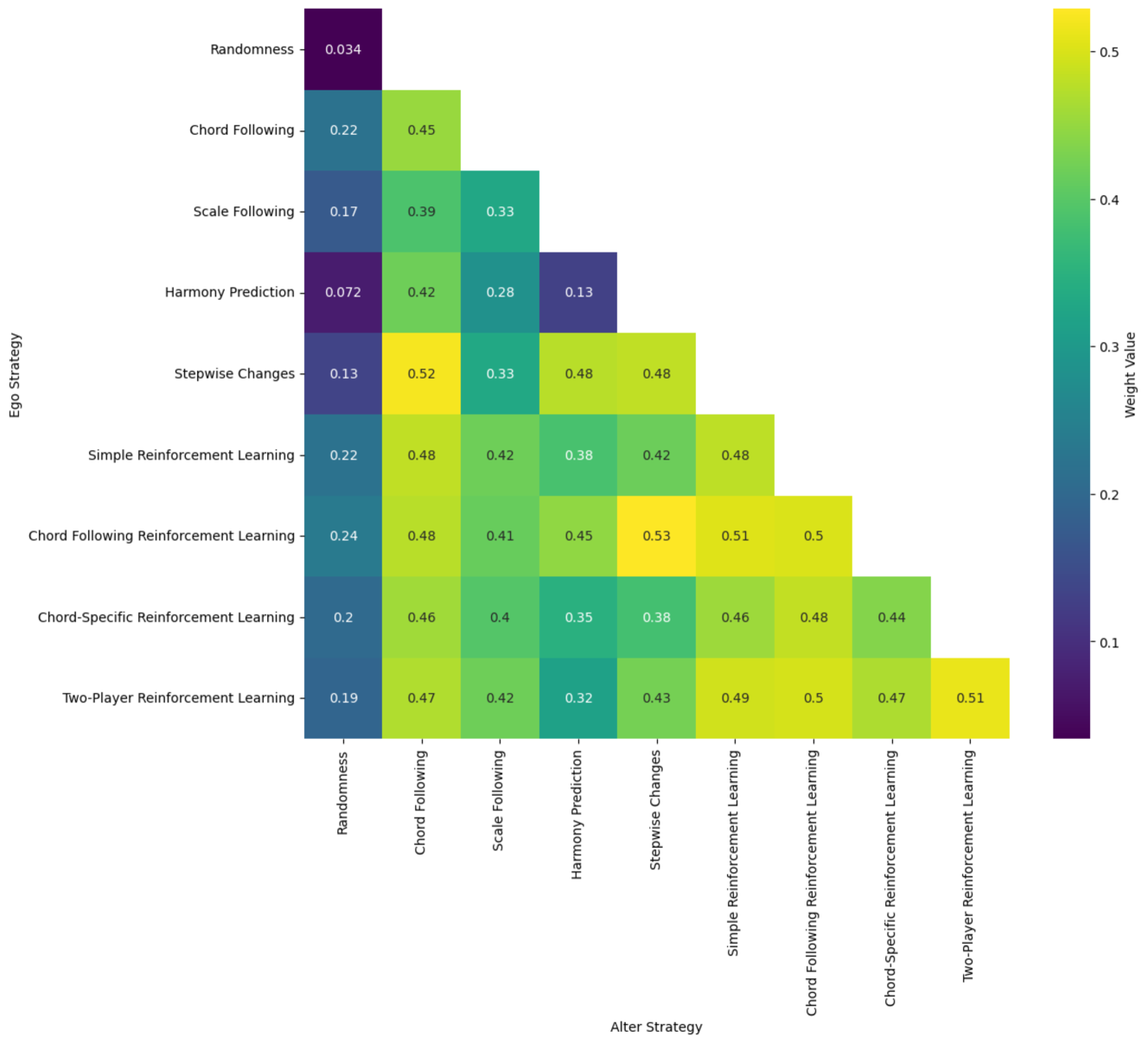
- 实验结果表明,和弦跟随强化学习策略的平均收益最高,而和声预测策略则表现不佳,显示出不同策略的有效性差异。
📝 摘要(中文)
现场音乐表演因即兴演奏的不可预测性而充满魅力,爵士即兴演奏是一个值得深入研究的例子。本文提出了一种新的数学博弈论模型,用于爵士即兴演奏,提供了研究音乐理论和即兴方法的框架。通过计算建模,主要使用强化学习,探索多种随机即兴策略及其表现。研究发现,最有效的策略对是基于最近收益反应的策略(逐步变化)与限制在给定和弦音符的强化学习策略(和弦跟随强化学习)。相反,基于合作者最后音符进行和声预测的策略对则表现最差,显示出不一致的结果。总体而言,和弦跟随强化学习策略的平均收益最高,而和声预测策略最低。该研究为超越爵士的应用奠定了基础,包括利用人工智能模型从音频片段提取数据以优化音乐奖励系统。
🔬 方法详解
问题定义:本文旨在解决爵士即兴演奏中缺乏系统化理论框架的问题,现有方法未能有效捕捉即兴演奏的动态互动特性。
核心思路:通过引入博弈论模型与强化学习相结合,探索不同即兴演奏策略的表现,旨在找到最优的策略组合以提高演奏效果。
技术框架:整体架构包括博弈论模型的构建、强化学习策略的设计与训练,以及对不同策略的实验评估,主要模块包括策略生成、收益计算和策略优化。
关键创新:最重要的技术创新在于提出了逐步变化与和弦跟随强化学习的结合策略,能够有效提升即兴演奏的表现,与传统方法相比,提供了更具动态适应性的解决方案。
关键设计:在参数设置上,强化学习策略限制在特定和弦音符内,损失函数设计为基于收益反馈进行动态调整,网络结构采用深度学习模型以捕捉复杂的音乐模式。
🖼️ 关键图片


📊 实验亮点
实验结果显示,和弦跟随强化学习策略的平均收益显著高于和声预测策略,前者的收益均值最高,而后者则表现出最低的收益和最高的标准差,表明不同策略在即兴演奏中的有效性差异。
🎯 应用场景
该研究的潜在应用领域包括音乐教育、人工智能音乐创作和实时音乐表演系统。通过优化即兴演奏策略,可以提升音乐创作的质量和互动性,未来可能对音乐行业产生深远影响。
📄 摘要(原文)
Live performances of music are always charming, with the unpredictability of improvisation due to the dynamic between musicians and interactions with the audience. Jazz improvisation is a particularly noteworthy example for further investigation from a theoretical perspective. Here, we introduce a novel mathematical game theory model for jazz improvisation, providing a framework for studying music theory and improvisational methodologies. We use computational modeling, mainly reinforcement learning, to explore diverse stochastic improvisational strategies and their paired performance on improvisation. We find that the most effective strategy pair is a strategy that reacts to the most recent payoff (Stepwise Changes) with a reinforcement learning strategy limited to notes in the given chord (Chord-Following Reinforcement Learning). Conversely, a strategy that reacts to the partner's last note and attempts to harmonize with it (Harmony Prediction) strategy pair yields the lowest non-control payoff and highest standard deviation, indicating that picking notes based on immediate reactions to the partner player can yield inconsistent outcomes. On average, the Chord-Following Reinforcement Learning strategy demonstrates the highest mean payoff, while Harmony Prediction exhibits the lowest. Our work lays the foundation for promising applications beyond jazz: including the use of artificial intelligence (AI) models to extract data from audio clips to refine musical reward systems, and training machine learning (ML) models on existing jazz solos to further refine strategies within the game.