Revealing the Relationship Between Publication Bias and Chemical Reactivity with Contrastive Learning
作者: Wenhao Gao, Priyanka Raghavan, Ron Shprints, Connor W. Coley
分类: physics.chem-ph, cs.AI, cs.LG, q-bio.BM
发布日期: 2024-02-19 (更新: 2025-02-20)
💡 一句话要点
提出基于对比学习的策略以揭示出版偏见与化学反应性的关系
🎯 匹配领域: 支柱二:RL算法与架构 (RL & Architecture)
关键词: 化学反应性 出版偏见 对比学习 机器学习 底物范围 数据驱动 反应建模
📋 核心要点
- 现有的底物选择方法存在出版偏见,导致低产率和不成功的实验结果被忽视,影响了化学反应性的全面理解。
- 本文提出了一种底物范围对比学习的策略,通过将已报道和未报道的底物进行对比,学习底物的嵌入表示。
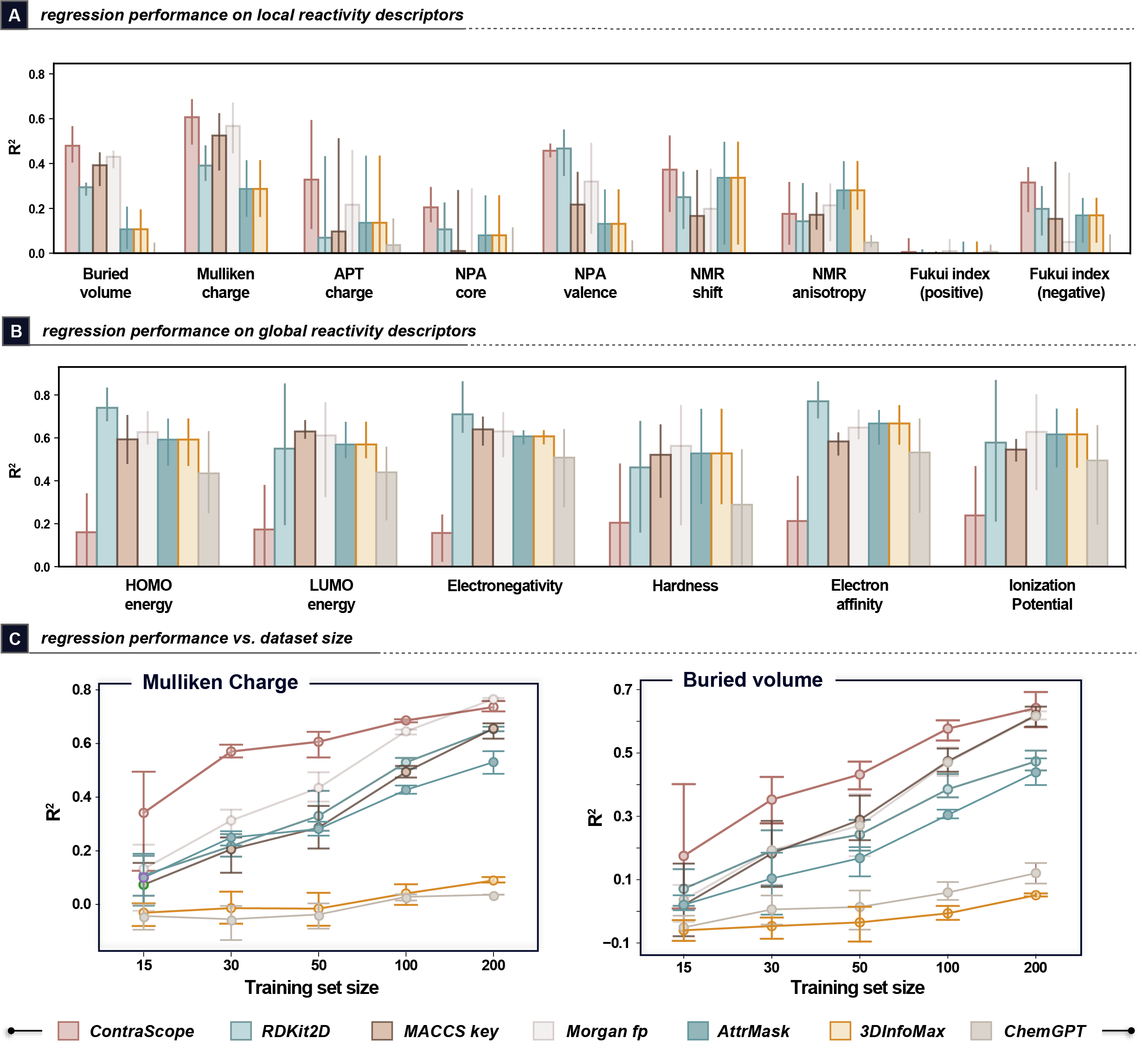
- 通过对20,798种芳基卤化物的训练,学习到的嵌入与反应性描述符相关,且在产率预测和区域选择性预测中表现出良好的应用效果。
📝 摘要(中文)
合成方法的底物耐受性和通用性通常通过“底物范围”表格展示。然而,底物选择存在出版偏见:不成功的实验或低产率结果很少被报道。本文深入探讨了这种出版偏见与化学反应性之间的关系,提出了一种新颖的神经网络训练策略——底物范围对比学习。通过将已报道的底物视为正样本,将未报道的底物视为负样本,该对比学习策略使模型能够根据历史出版的底物范围表中的趋势在数值嵌入空间中对分子进行分组。我们在2010-2015年间的20,798种芳基卤化物上进行训练,展示了学习到的嵌入与物理有机反应性描述符之间的相关性,并在反应建模任务中展现了应用潜力。
🔬 方法详解
问题定义:本文旨在解决化学文献中底物选择的出版偏见问题,现有方法未能充分考虑未报道实验的影响,导致对化学反应性的理解不全面。
核心思路:通过对比学习策略,将已报道的底物视为正样本,未报道的底物视为负样本,训练模型在数值嵌入空间中对分子进行分组,从而揭示底物选择与反应性之间的关系。
技术框架:整体架构包括数据收集、样本标记、模型训练和嵌入学习四个主要模块。首先,从CAS Content Collection中提取20,798种芳基卤化物的数据,然后进行正负样本的标记,最后通过对比学习训练模型。
关键创新:本研究的创新点在于提出了一种化学特定的机器学习训练策略,利用历史反应数据进行预训练,揭示了底物选择与反应性之间的潜在趋势。与传统方法相比,该方法能够更全面地反映化学反应的实际情况。
关键设计:在模型设计中,采用了特定的损失函数以优化嵌入空间的分布,同时使用了深度神经网络结构以增强模型的学习能力,确保能够有效捕捉底物之间的相似性和差异性。
🖼️ 关键图片


📊 实验亮点
实验结果表明,学习到的嵌入与物理有机反应性描述符之间存在显著相关性,且在产率预测和区域选择性预测任务中表现优异,展示了较传统方法更高的准确性和可靠性。
🎯 应用场景
该研究的潜在应用领域包括化学合成的优化、反应性预测和新材料的开发。通过揭示底物选择的趋势,研究者可以更有效地设计实验,减少资源浪费,提高成功率,推动化学研究的进步。
📄 摘要(原文)
A synthetic method's substrate tolerance and generality are often showcased in a "substrate scope" table. However, substrate selection exhibits a frequently discussed publication bias: unsuccessful experiments or low-yielding results are rarely reported. In this work, we explore more deeply the relationship between such publication bias and chemical reactivity beyond the simple analysis of yield distributions using a novel neural network training strategy, substrate scope contrastive learning. By treating reported substrates as positive samples and non-reported substrates as negative samples, our contrastive learning strategy teaches a model to group molecules within a numerical embedding space, based on historical trends in published substrate scope tables. Training on 20,798 aryl halides in the CAS Content Collection$^{\text{TM}}$, spanning thousands of publications from 2010-2015, we demonstrate that the learned embeddings exhibit a correlation with physical organic reactivity descriptors through both intuitive visualizations and quantitative regression analyses. Additionally, these embeddings are applicable to various reaction modeling tasks like yield prediction and regioselectivity prediction, underscoring the potential to use historical reaction data as a pre-training task. This work not only presents a chemistry-specific machine learning training strategy to learn from literature data in a new way, but also represents a unique approach to uncover trends in chemical reactivity reflected by trends in substrate selection in publications.