HIP Network: Historical Information Passing Network for Extrapolation Reasoning on Temporal Knowledge Graph
作者: Yongquan He, Peng Zhang, Luchen Liu, Qi Liang, Wenyuan Zhang, Chuang Zhang
分类: cs.AI
发布日期: 2024-02-19
备注: 7 pages, 3 figures
期刊: IJCAI (2021) 1915-1921
💡 一句话要点
提出HIP网络以解决时间知识图推理中的未来事件预测问题
🎯 匹配领域: 支柱九:具身大模型 (Embodied Foundation Models)
关键词: 时间知识图 事件预测 历史信息传递 深度学习 机器学习
📋 核心要点
- 现有的时间知识图推理方法通常假设所有时间戳和图形在训练时可用,导致未来事件预测困难。
- 本文提出的HIP网络通过时间、结构和重复性三个维度传递信息,旨在更准确地预测未来事件。
- 在五个基准数据集上的实验结果显示,HIP网络在Hits@1指标上显著提升,证明了其有效性。
📝 摘要(中文)
近年来,时间知识图(TKG)推理受到了广泛关注。现有方法通常假设在训练期间所有时间戳和相应图形都是可用的,这使得预测未来事件变得困难。为了解决这一问题,最近的研究开始基于历史信息推断未来事件。然而,这些方法未能全面考虑时间变化背后的潜在模式,导致历史信息的选择性传递、表示更新和事件预测不够准确。本文提出了历史信息传递网络(HIP网络)来预测未来事件。HIP网络从时间、结构和重复性三个角度传递信息,以建模事件的时间演变、同一时间步事件的交互以及已知事件。实验结果表明,HIP网络在五个基准数据集上表现优越,Hits@1的显著提升证明了该方法能够更准确地预测即将发生的事件。
🔬 方法详解
问题定义:本文旨在解决时间知识图推理中未来事件预测的挑战,现有方法未能充分利用历史信息和潜在模式,导致预测准确性不足。
核心思路:HIP网络通过从时间、结构和重复性三个角度传递历史信息,更新关系表示,以更好地捕捉事件的演变和交互,从而提高预测准确性。
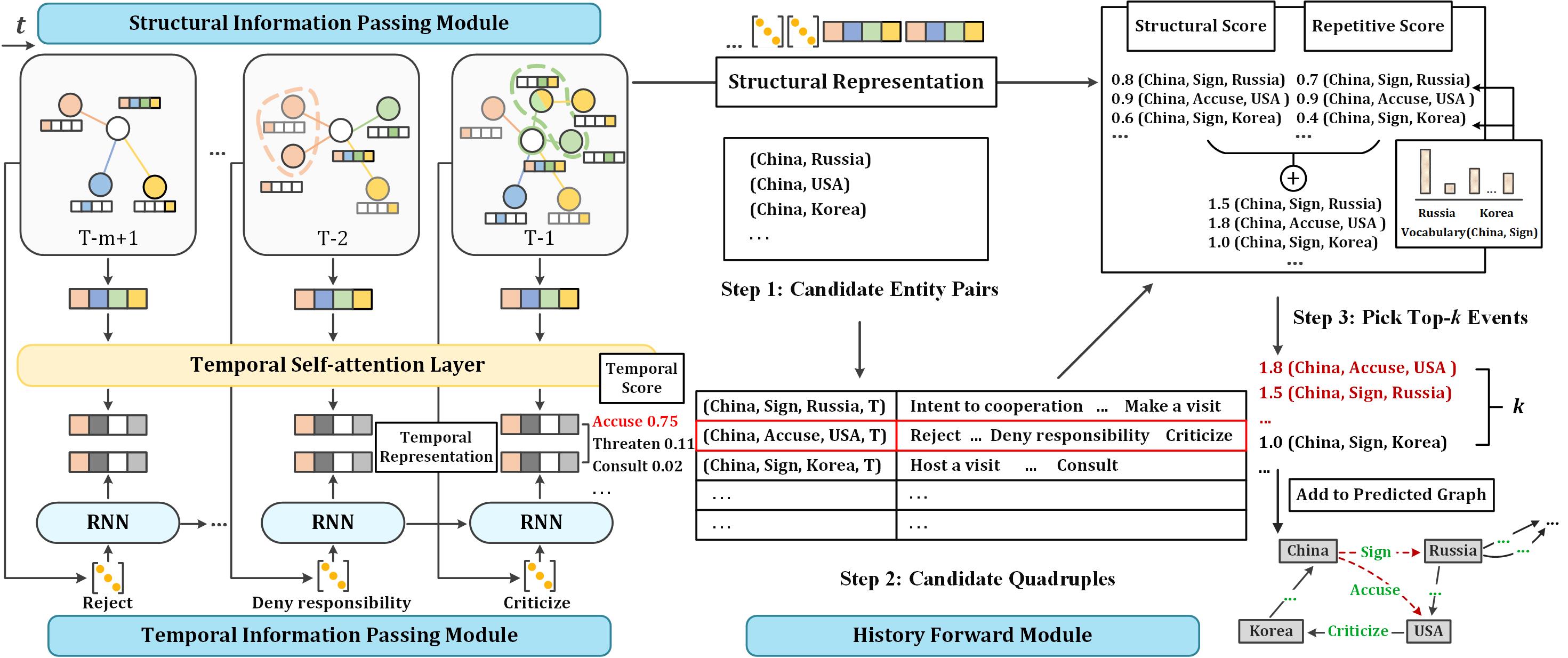
技术框架:HIP网络的整体架构包括三个主要模块:时间信息传递模块、结构信息传递模块和重复性信息传递模块。每个模块分别处理不同维度的信息,以形成全面的事件预测模型。
关键创新:HIP网络的创新之处在于其综合考虑了时间变化的潜在模式,并通过三种评分函数来更新关系表示,这与现有方法的单一视角显著不同。
关键设计:在网络设计中,采用了多层感知机(MLP)来实现信息传递和关系表示更新,损失函数则基于预测准确性进行优化,确保模型在训练过程中能够有效学习历史信息的影响。
🖼️ 关键图片
📊 实验亮点
实验结果显示,HIP网络在五个基准数据集上表现优越,特别是在Hits@1指标上实现了显著提升,证明其在未来事件预测中的有效性和准确性。与现有方法相比,HIP网络在预测性能上有明显的改善,展示了其在时间知识图推理中的应用潜力。
🎯 应用场景
该研究的潜在应用领域包括智能推荐系统、事件预测、社交网络分析等。通过更准确地预测未来事件,HIP网络可以帮助企业和组织在决策过程中做出更有效的策略调整,提升业务效率和用户体验。未来,该方法有望在更广泛的知识图谱应用中发挥重要作用。
📄 摘要(原文)
In recent years, temporal knowledge graph (TKG) reasoning has received significant attention. Most existing methods assume that all timestamps and corresponding graphs are available during training, which makes it difficult to predict future events. To address this issue, recent works learn to infer future events based on historical information. However, these methods do not comprehensively consider the latent patterns behind temporal changes, to pass historical information selectively, update representations appropriately and predict events accurately. In this paper, we propose the Historical Information Passing (HIP) network to predict future events. HIP network passes information from temporal, structural and repetitive perspectives, which are used to model the temporal evolution of events, the interactions of events at the same time step, and the known events respectively. In particular, our method considers the updating of relation representations and adopts three scoring functions corresponding to the above dimensions. Experimental results on five benchmark datasets show the superiority of HIP network, and the significant improvements on Hits@1 prove that our method can more accurately predict what is going to happen.